Eventing equipment must perform across three tests that place different demands on horse and rider. Dressage rewards precision and freedom of movement; show jumping combines accuracy with rapid changes of balance; cross-country adds speed, solid obstacles, uneven ground, water, variable footing and the consequences of a fall at height or momentum. The best equipment is therefore not simply the lightest, most fashionable or most expensive. It is equipment that is appropriate to the discipline, correctly fitted, maintained, legally and competitively compliant, and used with a realistic understanding of what it can and cannot do.
This guide is written primarily for the British market. Competition rules change, and the relevant organiser or governing body’s current rulebook always takes precedence over general advice. International competitors must also distinguish British Eventing requirements from FEI requirements.
Start with the risk profile, not the product category
There is no single item of equipment that makes eventing safe. Risk is managed through horse and rider preparation, course design, supervision, appropriate training, sound tack, correct fit, protective equipment and sensible decisions about weather, ground and the rider’s ability. Protective equipment reduces the severity or likelihood of some injuries; it does not make falls, rotational falls, kicks, crush injuries or impacts with fixed obstacles harmless.
Equipment should be assessed according to four questions:
- What hazard is it intended to address? A riding hat primarily manages impact and penetration risks to the head. A body protector manages some blunt impacts to the torso. An air vest is intended to inflate during separation from the horse and add coverage, but is not continuously protective until it deploys.
- What activity is involved? A garment suitable for hacking or low-risk schooling may not meet the requirements for cross-country.
- How does the equipment interact with other items? A body protector, air vest, saddle, breastplate, reins and clothing must work together without restricting movement or compromising release mechanisms.
- What happens when the equipment is damaged, incorrectly fitted or past its serviceable life? Compliance labels do not compensate for a poor fit, missing fastener, damaged shell, compressed foam or altered product.
Riding hats: standards, construction and fit
A riding hat is a protective helmet designed to reduce injury from particular types of impact. Typical construction combines an outer shell, energy-absorbing liner, comfort padding and a retention system. The shell helps distribute and resist impact and penetration; the liner manages some impact energy; the harness keeps the helmet positioned on the head. These components are engineered as a system, not as interchangeable layers.
In Great Britain, a purchaser should check both the applicable competition rules and the marking on the actual helmet. BS EN 1384:2023 is the current British adoption of the European standard for helmets used in equestrian activities. Its scope includes requirements relating to construction and field of vision, shock absorption, penetration resistance, lateral deformation, retention systems, peak deflection and product information. The existence of a standard does not mean that every helmet carrying a similar-looking label is acceptable for every event: organisers may specify accepted standards, and older standards may be withdrawn from particular disciplines.
For international eventing, FEI rules require protective headgear meeting the applicable FEI requirements. National and local competition rules may differ in the detail of accepted standards, colour, inspection procedures and when a hat must be worn. A manufacturer, retailer or rider should check the current rulebook rather than rely on a historic list printed on packaging or copied into a catalogue.
What to look for when buying
- Buy from a supplier able to measure and fit the rider, particularly for children, unusual head shapes and riders between sizes.
- Check that the helmet sits level, low enough to protect the forehead without obstructing vision, and does not rock, rotate or lift when the rider moves the head.
- The harness should contact the head and face consistently without being loose, twisted or uncomfortable. It should be fastened whenever mounted.
- Do not assume that a larger size with extra padding is an acceptable substitute for the correct shell size. Padding can alter comfort and fit, but cannot turn an unsuitable helmet into a correctly fitted one.
- Do not drill, trim, glue, decorate or modify the helmet unless the manufacturer expressly permits the alteration.
- Check the product label, date or production information, manufacturer instructions and accepted standard before purchase.
A helmet involved in a significant fall should normally be replaced, even if there is no visible damage. Energy-absorbing liners can be compromised internally. A second-hand hat with an unknown history is difficult to assess, and heat, chemicals, crushing and age can affect materials. Storage in a hot vehicle, damp tack room or under heavy equipment is poor practice.
Ventilation, removable liners, dial-fit systems, low-profile shells and rotational-impact technologies may improve comfort or offer additional design features. They should not be treated as a substitute for an accepted standard and correct fit. Marketing terms such as “advanced protection” or “impact system” require scrutiny: the important evidence is the helmet’s certification, construction, instructions and rulebook acceptance.
Body protectors: what the standards mean
Body protectors are padded protective garments intended to reduce some injuries caused by blunt impact, contact with the ground, obstacles or the horse. They do not provide complete protection to the spine, abdomen, pelvis, ribs, internal organs or collar bones, and they are not designed to prevent every type of injury.
BS EN 13158:2018 specifies requirements and test methods for protective jackets, body protectors and shoulder protectors for riders, people working with horses and horse drivers. The standard addresses matters including coverage, sizing, adjustability, restraint, ergonomics, construction and impact performance. The BETA 2018 Body Protector Standard is widely used in Britain and incorporates the relevant EN 13158:2018 requirements with its own scheme, labelling and retesting arrangements.
BETA classifies body protectors by performance level:
| Level | Intended use | Practical interpretation |
|---|---|---|
| Level 1 | Licensed jockeys | Low-bulk protection associated with racing weight restrictions; not an eventing choice. |
| Level 2 | Very low-risk situations | Lower than normal protection and unsuitable where jumping or eventing protection is required. |
| Level 3 | Normal riding and higher-risk equestrian activity | The level generally associated with general riding, working with horses and eventing. |
BETA describes Level 3 protection as intended to reduce minor bruising and soft-tissue injuries and to prevent a limited number of rib fractures. That wording is important. It does not promise prevention of all rib fractures, spinal injuries, organ damage or serious trauma. Performance levels are test classifications, not guarantees about the outcome of a real fall.
The BETA 2009 version has become unsuitable for some British disciplines from January 2024, which is distinct from saying that every older garment instantly becomes physically ineffective. The practical purchasing advice is straightforward: for new equipment, select a clearly labelled current model accepted by the relevant discipline, normally BETA 2018 Level 3 or another explicitly permitted standard. Check the rulebook before competing, especially when buying a used garment or entering a new class.
Construction and fitting
Modern protectors commonly use segmented closed-cell foams enclosed in textile covers, although designs vary in density, thickness, panel geometry and fastening systems. Segmentation allows the garment to flex around the rider while maintaining coverage. Foam may soften with warmth and mould to the body, but excessive heat, compression, waterlogging, solvents and repeated impacts can affect its performance.
A correctly fitted body protector should cover the required torso areas without riding up into the neck, restricting breathing, interfering with the saddle or leaving large gaps at the front, sides or lower back. It should be snug enough to remain in position during movement but not so tight that the rider cannot breathe, mount, bend or take a normal riding position. Fasteners should close securely, and the garment should be tried with the clothing normally worn for cross-country.
Fit should be reassessed after significant weight change, growth, pregnancy, a change of riding clothing or a change in body shape. Children may outgrow a garment while it still looks almost new. Alterations are not automatically permissible: changing panel positions, shortening straps or cutting foam may invalidate the certification and reduce coverage.
Inspection and replacement
BETA recommends replacing body protectors at least every three to five years depending on use and care, and replacing them sooner after a substantial impact or if the foam is visibly dented or damaged. This is guidance from the scheme rather than a universal law of material failure. Manufacturers may specify a different service life, and their instructions should be followed.
Inspect stitching, zips, hook-and-loop fasteners, binding, lining and foam. Look for cracks, delamination, compressed areas, hard or brittle foam, torn covers and changes in shape. Do not store a protector in a hot lorry, in direct sunlight or where horses can chew it. Keep it clean according to the manufacturer’s instructions and avoid unapproved detergents, machine washing or tumble drying.
Air vests and hybrid protectors
An air vest uses an inflatable chamber activated when a tether or other mechanism is pulled as the rider separates from the horse. The gas cartridge inflates the garment, creating additional cushioning and coverage around parts of the chest, back and neck depending on the design. Some systems are designed to be worn over a conventional body protector; others combine inflation chambers with an integrated protective garment.
Air vests are not the same as body protectors. A body protector provides continuous, passive protection while worn. An air vest provides its principal benefit only after deployment, and deployment depends on correct attachment, sufficient separation, a charged cartridge, intact chambers and a functioning mechanism. It may not deploy in every type of fall, including some situations in which the rider remains attached to the horse or is struck before the tether is pulled.
BETA has stated that there is no dedicated European standard specifically for equestrian air vests. Some manufacturers use testing to SATRA M38 or EN 1621-4, a standard developed for motorcycle airbag garments; neither should be assumed to be a compulsory universal equestrian certification. This is an important distinction for businesses and consumers: a test specification, manufacturer claim and competition requirement are separate matters.
For cross-country, the conservative and widely accepted approach is to wear a permitted Level 3 body protector under the air vest unless the current competition rules expressly allow another configuration. The air vest must not obscure the body-protector label where officials need to inspect it, and the combined thickness must not interfere with the saddle or the rider’s movement. The tether should be attached to the manufacturer-specified point on the saddle, not improvised around a girth strap or stirrup leather.
Before use, confirm the cartridge size, activation procedure, reset or re-arming process, tether length and replacement requirements. Never ride with a spent cartridge or a damaged air chamber. Consider how the system behaves when mounting, dismounting, falling at a fence or riding in a crowded warm-up arena. Manufacturers’ instructions and the competition rules control where and how the product may be used.
Footwear, stirrups and lower-leg security
Eventing footwear must provide a stable interface with the stirrup and protect the foot from the horse, ground and stirrup leather. Riding boots generally have a defined heel to reduce the chance of the foot sliding through the stirrup. The sole should be sufficiently structured to maintain control without being so wide or aggressive that it catches in the iron.
For cross-country, FEI rules specify boots with a well-defined heel to help prevent slipping through the stirrup. British rules may contain equivalent or additional requirements. Check that zips, laces, elastic panels and soles are intact. Mud, water and worn tread can alter grip. Trainers, wellingtons and casual footwear are inappropriate for riding because they may lack a suitable heel, sole profile or ankle support.
Safety stirrups are designed to reduce entrapment after a fall. Release mechanisms may use an outer arm, hinged side, breakaway tread or flexible component. They are not all compatible with every boot, and they require inspection for corrosion, blocked mechanisms, loose parts and incorrect assembly. The rider’s foot must still sit correctly in the iron. A safety stirrup cannot compensate for a foot forced too deeply into an ordinary iron or for a boot with a sole that catches.
Gloves, clothing and visibility
Gloves improve grip, reduce friction and protect the hands from reins, buckles and weather. Eventing gloves should allow a secure contact feel without becoming slippery when wet. Check the palm material, seam placement, closure and compatibility with reins. Excessively bulky gloves can reduce sensitivity; thin gloves may wear through quickly at the contact points.
Riding clothing should permit a full range of movement and avoid loose straps, scarves, jewellery or unsecured fabric that could catch on tack or vegetation. Cross-country clothing must also accommodate a body protector and, where used, an air vest without creating pressure points or interfering with inflation.
High-visibility clothing is particularly relevant when riding on roads, at public-access venues or in poor light. BETA distinguishes EN ISO 20471 for professional use, EN 1150 for leisure riders and EN 13356 for accessories. A fluorescent colour improves daytime conspicuity; retro-reflective material works when illuminated in darkness. A small reflective strip is not equivalent to a garment certified to a full high-visibility standard. Visibility equipment does not replace lights, route planning or road awareness.
Horse tack and protective equipment
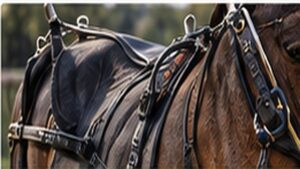
Eventing tack must be secure, suitable for the horse and compatible with the rider’s protective equipment. The saddle should be correctly fitted and stable through all three phases. A breastplate or martingale may help maintain saddle position or influence rein geometry, but each introduces straps that must be adjusted so they do not restrict the shoulders, rub the skin or interfere with the reins.
Girths, girth guards and saddle cloths should be checked for broken stitching, stretched elastic, damaged buckles and pressure points. A girth that is too loose permits movement; one that is overtightened can create discomfort and affect breathing and movement. Saddle cloths should not bunch beneath the panels. Numnahs and pads cannot correct a fundamentally unsuitable saddle fit.
Bridles and bits require the same inspection. Check leather for cracking, especially around cheekpieces, billet ends and reins; inspect stitching and buckles; and ensure reins cannot unexpectedly separate. Bit choice is a training and welfare decision as well as a control decision. Increasing mechanical severity is not a substitute for schooling, fitting and rider skill.
Horse boots and bandages are used to reduce some knocks and interference injuries, but they can also trap heat, retain water, slip, rub or conceal swelling. Cross-country boots should be fitted to the horse’s limb shape, checked before and after use and selected with regard to the venue’s rules. Boots that are too tight may restrict movement; boots that are loose may rotate or become caught. Use only products whose cleaning and drying instructions are understood, and remove them promptly after work so the skin can be inspected.
Equipment checks before an event
- Read the current rules for the specific organiser, class and phase.
- Check helmet standard, size, retention system and visible damage.
- Check the body protector’s label, level, age, fit, fasteners and foam condition.
- If using an air vest, confirm cartridge charge, tether attachment, deployment compatibility and re-arming instructions.
- Inspect saddle, girth, stirrup leathers, irons, reins, bridle and breastplate for cracks, stretching and loose stitching.
- Try the complete clothing system, including gloves, boots and protective layers, before arriving at the venue.
- Clean and dry horse boots and inspect the horse’s skin after use.
- Keep a record of purchase dates, inspections, falls, replacements and manufacturer servicing where relevant.
Common misconceptions
- “The most expensive equipment is the safest.” Price may reflect materials, design, testing, fit systems or branding, but correct size, standard and condition matter more than price alone.
- “An air vest replaces a body protector.” It normally does not. It deploys only under particular conditions and has no protection before inflation.
- “A CE or UKCA mark is a performance level.” Product conformity marking indicates a regulatory declaration or assessment route; it does not by itself identify the level of impact protection or eventing acceptance.
- “If there is no visible damage, the helmet or protector is fine.” Impact damage can be internal, and ageing or heat can affect materials without obvious marks.
- “Any body protector labelled Level 3 is acceptable everywhere.” The accepted version, year, label and rulebook requirements still need checking.
- “More straps and tighter adjustment mean more safety.” Over-tight or badly routed equipment can restrict movement, create pressure and interfere with emergency release.
For retailers, manufacturers and event organisers
Businesses should provide traceable product information, clear instructions, standard and level markings, care guidance, service-life advice and warnings about incompatible combinations. Staff fitting safety equipment should be trained and should understand that a fitting appointment is not merely a sizing exercise. It should cover head shape, body shape, riding position, clothing layers, adjustment, inspection and the intended discipline.
Manufacturers should distinguish tested performance from marketing aspiration, identify the test standard and version, and explain limitations in plain language. Air-vest suppliers should specify cartridge type, activation conditions, compatibility with body protectors, inflation clearance and post-deployment procedures. Retailers should avoid presenting an obsolete label as current simply because a garment remains visually saleable.
Event organisers need practical inspection systems that identify non-compliant or badly fitted equipment without creating false reassurance. Officials can check labels and visible condition, but they cannot certify hidden damage or guarantee the protective outcome of a real fall. This is why equipment compliance must sit alongside competent riding, appropriate horse preparation, course management and emergency planning.
Sources and further reading
- FEI Eventing Rules, 26th Edition, effective 1 January 2025
- BSI: BS EN 1384:2023, Helmets for equestrian activities
- BSI: BS EN 13158:2018, Protective clothing for equestrian use
- British Equestrian Trade Association: Body Protectors
- BETA 2018 Standard for Body and Shoulder Protectors
- BETA: A World of Choice—Rider Safety Equipment Guide
- BETA: High-visibility standards for professional and leisure riders
- GOV.UK: The Highway Code, rules about horse riders and safety equipment
- GOV.UK: Hiring out horses—statutory guidance for local authorities
Research note
Automatically researched source pack — editorial review required:
• www.gov.uk — https://www.gov.uk/guidance/the-highway-code/rules-about-animals-47-to-58
• www.gov.uk — https://www.gov.uk/government/publications/animal-activities-licensing-guidance-for-local-authorities/hiring-out-horses-licensing-statutory-guidance-for-local-authorities
• knowledge.bsigroup.com — https://knowledge.bsigroup.com/products/helmets-for-equestrian-activities-3
• www.gov.uk — https://www.gov.uk/motorcycle-helmet-law
• www.gov.uk — https://www.gov.uk/government/publications/designated-standards-ppe
• www.ipo.gov.uk — https://www.ipo.gov.uk/t-tmj/t-tmj/tm-journals/2026-015/jnl.pdf
• inside.fei.org — https://inside.fei.org/system/files/2024%20FEI%20Eventing%20Rules_Clean%20version.pdf
• www.bsigroup.com — https://www.bsigroup.com/en-GB/products-and-services/assessment-and-certification/validation-and-verification/client-directory-certificate/CE%20826824/
• inside.fei.org — https://inside.fei.org/system/files/18.3_ANNEX_GA19_EVENTING%20RULES%20MEMO.pdf
• landingpage.bsigroup.com — https://landingpage.bsigroup.com/LandingPage/Undated?UPI=000000000030061431
• inside.fei.org — https://inside.fei.org/system/files/7-Rules%20Proposals%208%20July%202025_EVENTING_Rule%20Book.pdf
• www.gov.uk — https://www.gov.uk/hmrc-internal-manuals/vat-clothing/vclothing4550
• www.dumfriesandgalloway.gov.uk — https://www.dumfriesandgalloway.gov.uk/sites/default/files/2025-04/Horse_Riding_Guidance_2015.pdf
• inside.fei.org — https://inside.fei.org/sites/default/files/2025%20FEI%20Eventing%20Rules_Clean%20version.pdf
• sharp.dft.gov.uk — https://sharp.dft.gov.uk/frequently-asked-questions/why-do-i-need-a-motorcycle-helmet/
• knowledge.bsigroup.com — https://knowledge.bsigroup.com/products/protective-clothing-protective-jackets-body-and-shoulder-protectors-for-equestrian-use-for-horse-riders-and-those-working-with-horses-and-for-horse-drivers-requirements-and-test-methods
• www.gov.uk — https://www.gov.uk/guidance/rating-manual-section-6-part-3-valuation-of-all-property-classes/eventing-courses
• www.nidirect.gov.uk — https://www.nidirect.gov.uk/articles/horse-safety-road
• beta-uk.org — https://beta-uk.org/body-protectors/
• beta-uk.org — https://beta-uk.org/wp-content/uploads/2024/10/BETA-2018-Standard-updated-October-2022-with-label-costs-and-licensee-fee.pdf
Cite this article
Stable research ID: ERA-2026-000057
The Equestrian Research Atlas (2026) ‘Eventing Equipment Guide’. The Equestrian Research Atlas. Available at: https://equestrianresearchatlas.co.uk/research/eventing-equipment-guide/ (Accessed: 3 November 2026).
The Equestrian Research Atlas. (2026). Eventing Equipment Guide. The Equestrian Research Atlas. https://equestrianresearchatlas.co.uk/research/eventing-equipment-guide/
The Equestrian Research Atlas. “Eventing Equipment Guide.” The Equestrian Research Atlas, 2026, https://equestrianresearchatlas.co.uk/research/eventing-equipment-guide/. Accessed 3 November 2026.
Research references (34)
- www.gov.uk
- www.gov.uk
- knowledge.bsigroup.com
- www.gov.uk
- www.gov.uk
- www.ipo.gov.uk
- inside.fei.org
- www.bsigroup.com
- inside.fei.org
- landingpage.bsigroup.com
- inside.fei.org
- www.gov.uk
- www.dumfriesandgalloway.gov.uk
- inside.fei.org
- sharp.dft.gov.uk
- knowledge.bsigroup.com
- www.gov.uk
- www.nidirect.gov.uk
- beta-uk.org
- beta-uk.org
- beta-uk.org
- beta-uk.org
- beta-uk.org
- beta-uk.org
- beta-uk.org
- beta-uk.org
- beta-uk.org
- beta-uk.org
- beta-uk.org
- beta-uk.org
- beta-uk.org
- beta-uk.org
- beta-uk.org
- beta-uk.org