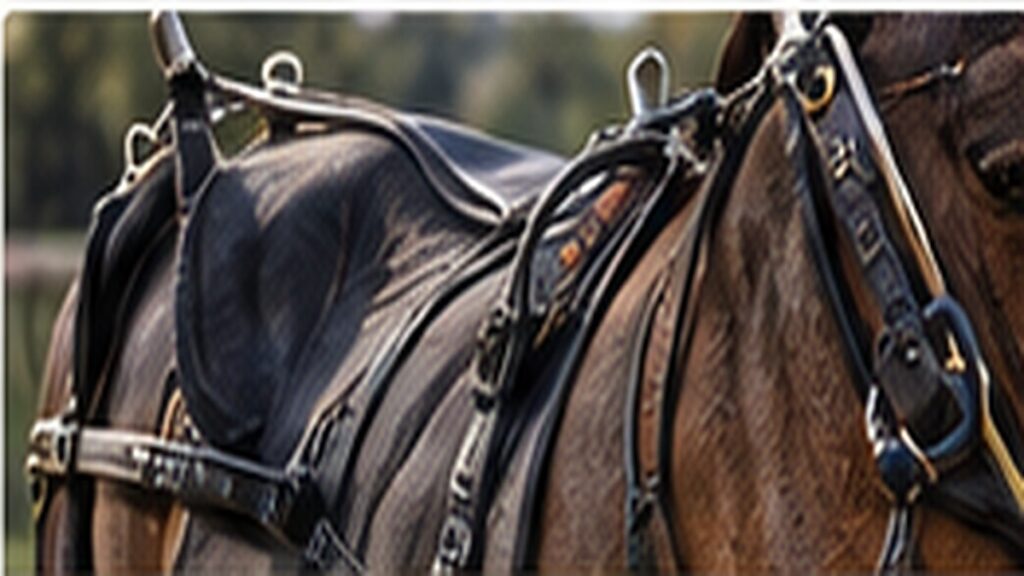
Carriage driving equipment has to do more than connect a horse to a vehicle. A complete turnout must transmit forward traction, support shafts where applicable, control and brake the vehicle, allow the horse to move freely, protect the driver and passengers, and remain serviceable under repeated loading. The equipment therefore works as a system: a well-made harness cannot compensate for a badly balanced carriage, and a sound vehicle cannot make an incorrectly fitted harness safe.
In Great Britain, equipment selection is influenced by the intended use. A lightweight exercise cart, a traditional trap, a competition marathon carriage and a passenger-carrying vehicle impose different demands. Road users must also consider the Department for Transport’s Code of Practice for Horse-Drawn Vehicles, the Highway Code, local licensing requirements and, for affiliated sport, the current British Carriagedriving rules. These sources should be treated as minimum or discipline-specific requirements rather than substitutes for competent instruction and inspection.
Start with the intended job
The correct equipment depends first on the work the turnout will perform. Relevant variables include the horse’s size and conformation, the vehicle’s mass, wheel arrangement, shaft or pole configuration, braking system, terrain, speed, passenger load and whether the turnout will work on public roads.
- Training and pleasure driving: equipment should prioritise predictable handling, easy adjustment, visibility and simple maintenance.
- Driving trials: the vehicle and harness must tolerate repeated acceleration, braking, turning and uneven ground. Secure quick-release systems, protected fittings and effective brakes become particularly important.
- Indoor or arena driving: manoeuvrability, balance and presentation may matter more than road equipment, but the harness must still provide reliable control and protection.
- Traditional or show driving: appearance, historical correctness and turnout conventions influence choice, but decorative features must not compromise strength or horse comfort.
- Passenger carrying or commercial work: risk assessment, maintenance records, driver competence, local authority conditions and the DfT Code of Practice are especially relevant.
Do not select a harness by horse size alone. Trace length, shaft length, vehicle balance and the position of the swingletree or splinter bar are interdependent. A harness that fits one cart may be unsuitable for another even when the same horse is used.
Harness architecture: what each part does
Bridle, bit and reins
A driving bridle normally includes cheekpieces, a crownpiece, throatlash, browband, bit attachments and blinkers or winkers. Blinkers restrict the horse’s rearward field of vision. Their purpose is not to hide every movement of the carriage, but to reduce visual distraction and help the horse concentrate on the driver’s instructions. They must not press on the eyes, eyelashes or facial bones, and the horse must be able to blink freely.
The bit should be selected for the horse, driver, discipline and level of training rather than simply for maximum leverage. Common driving bits include Liverpool-type curb bits, butterfly or Buxton patterns, straight or jointed snaffle designs and specialist bits used in pairs or teams. A curb bit introduces leverage through the cheek, curb chain and rein position; it is not automatically more effective or more humane than a snaffle. The driver must understand how the chosen bit functions and how rein position changes its action.
Driving reins are generally longer and constructed to pass from the bit through terrets on the saddle and then to the driver’s hands. They should be supple enough to give clear signals but substantial enough to handle safely. The reins must be free from cracks, stretched holes, weak stitching and damaged billets. A rein that is too short restricts the horse and causes the driver to lean forward; one that is excessively long can become difficult to organise in an emergency.
Breastcollar or full collar
The breastcollar transfers the pulling force to the horse through the chest. It should lie across the muscular portion of the chest without restricting the windpipe, shoulders or lower neck. A breastcollar is commonly used with a swingletree because the swingletree equalises movement between the two traces and reduces uneven rubbing as the shoulders advance.
A full collar, used with hames, surrounds the base of the neck and transfers load over a broader area. It is traditional in heavier work and can be appropriate where the vehicle and line of draft suit it. Collar fit is highly individual. The collar must not be too tight at the throat or too wide at the shoulders, and the hames must sit correctly rather than rock or rotate.
A common misconception is that a full collar is automatically stronger or more comfortable than a breastcollar. Neither is universally true. Comfort depends on the shape, fit, line of draft, vehicle and workload. A poorly fitted collar can cause pressure and movement restriction; a well-fitted breastcollar can be entirely suitable for a lightweight vehicle.
Driving saddle, saddle pad and girthing
The driving saddle is not a ridden saddle. It supports the shaft tugs, carries terrets and provides attachment points for the backstrap, bellyband and sometimes other components. With a fixed-shaft vehicle, the saddle and bellyband help support the shafts, but the horse should not be made to carry excessive downward force from an unbalanced carriage.
The saddle must sit in a stable position without interfering with the withers or shoulder movement. A pad protects the harness and can help manage fit, but padding is not a remedy for an unsuitable saddle shape. Excessive padding can make a saddle unstable or alter the pressure pattern. The girth should be secure without being over-tightened, and all billets should be checked for stretching, pulled stitching and edge cracking.
The term shaft tugs refers to the loops or sleeves through which the shafts pass. They must allow the shafts to move as designed while preventing them from escaping. Tug stops or other shaft-retaining arrangements are secondary safety features, not a substitute for correctly adjusted breeching.
Backstrap and crupper
The backstrap runs from the saddle towards the quarters and supports the breeching assembly. The crupper passes beneath the tail and prevents the saddle and associated harness from sliding forward. It must be introduced carefully beneath the tail, with sufficient adjustment to remain stable but without pulling the dock downward or rubbing the tail head.
A crupper is not intended to carry the vehicle’s braking load by itself. Its function is positional. A dirty, stiff or badly shaped crupper can cause rubbing, while an excessively tight one can make the horse uncomfortable and encourage resistance. Leather cruppers need conditioning appropriate to the leather; synthetic cruppers should be checked for hardening, splits and distortion.
Breeching: the primary braking connection
Breeching is the broad strap assembly around the horse’s quarters. In a vehicle without an effective independent braking system, it is a principal means of controlling the vehicle when slowing, stopping or travelling downhill. Breeching straps connect the breeching to the carriage and transmit the backward force.
The breeching seat should lie over the substantial part of the buttocks, approximately around the level of the lower quarters rather than on the weak lower limbs. If it is too low, it can interfere with the hind legs or be forced downwards during braking. If it is too high, it can slide over the point of the buttock and under the tail, creating a severe and potentially frightening problem.
When the horse is standing in draft, the breeching should be close enough to engage before the vehicle overruns the horse, but not so tight that it restricts ordinary hind-limb movement. A widely used practical guide is to allow approximately a hand’s breadth between the breeching and the quarters when the turnout is correctly set up, although conformation, vehicle balance and design affect the final adjustment. The RDA carriage-driving safety guidance similarly emphasises correct length, strong breeching straps and sound buckles.
Breeching is not required in every historical or lightweight arrangement. However, its omission should be a deliberate engineering decision based on vehicle mass, terrain, braking and discipline—not an assumption that the shafts or tug stops will provide adequate braking. A vehicle that regularly travels downhill, carries passengers or works on uneven ground requires a dependable method of controlling backward movement.
Traces and the line of draft
Traces carry the pulling force from the breastcollar or hames to the swingletree, splinter bar or other carriage connection. They should be equal in length, correctly aligned and free from stretching, cuts, weak stitching and damaged ends. The line of draft should be as straight and unobstructed as the vehicle design permits.
Trace length is governed by the vehicle as well as the horse. With the horse standing in draft, the traces should allow the tugs to remain correctly positioned on the saddle and should not pull the breastcollar backwards into the shoulders. Traces that are too short can alter the pulling angle and restrict movement; traces that are too long can create loops that catch legs or fittings, particularly when the turnout is not pulling.
Trace carriers keep slack traces elevated when the horse is not in draft. They are particularly important when the trace connection or swingletree sits below the shafts. Without adequate support, a loose trace can catch a foreleg or become entangled with the vehicle.
Quick-release fittings can speed up harnessing and emergency release, but they must be compatible with the carriage attachment and used in the intended orientation. A quick-release clip is not automatically safe merely because it can be opened quickly. It must close positively, resist accidental loading and be inspected for distortion, corrosion and gate failure.
Single, pair and team harness
Single harness supports one horse and usually includes a breastcollar or collar, saddle, breeching, traces and reins. Pair harness introduces additional components such as pole straps, neck straps, false martingales, coupling reins and pair-specific trace arrangements. Team harness adds further complexity, including leaders’ reins, pole and swing connections, and careful management of unequal movement between horses.
Parts must not be mixed casually between single and pair systems. Components may look similar while being designed for different loads or angles. Pair and team turnouts also require symmetrical adjustment and experienced handling; a correct fit for one horse does not guarantee a correct fit for the other.
Materials and construction
Leather
Good harness leather has appropriate thickness, consistent temper, clean edges and sound fibre structure. Full-grain leather is commonly valued because its strongest outer fibres remain intact, but “leather” alone says little about quality. Look for even cutting, properly finished edges, secure keeper loops, reinforced stress points and stitching that is neither loose nor buried under excessive finish.
Leather requires cleaning and conditioning, but over-oiling can soften it excessively and weaken its structure. It should be stored clean, dry and supported rather than folded sharply. Sweat, road salt and grit are particularly damaging around buckles, rings, terrets and folds.
Synthetic webbing and coated materials
Synthetic harnesses may be made from coated webbing, biothane-type materials, nylon or related polymers. Their advantages can include low water absorption, ease of cleaning, consistent dimensions and resistance to mould. They are not maintenance-free. Inspect for cuts, edge fraying, hardening, delamination, UV degradation and pulled stitching.
Some synthetic materials conceal damage beneath a coating, so visual inspection should be combined with flexing and careful examination at holes, loops and attachment points. Do not assume that a brightly coloured or modern-looking harness is stronger than a traditional leather one. Construction, dimensions, hardware and inspection history matter more than appearance.
Hardware
Rings, buckles, terrets, clips, hooks and shackles must be appropriate to the load and made from material that tolerates the expected environment. Stainless steel, plated steel, brass and high-strength alloys each have different corrosion and wear characteristics. Hardware should not be bent, cracked, heavily pitted or distorted. Welded rings and carriage fittings deserve special attention because a visually small defect can compromise a major load path.
Hardware should be loaded in the direction for which it was designed. Side-loading a ring, clipping onto an unsuitable shaft fitting or forcing a buckle beyond its intended adjustment can create failure without obvious warning. Manufacturers’ instructions should be followed where available.
Carriage equipment
Two-wheeled and four-wheeled vehicles
A two-wheeled cart or trap is supported partly by the horse through the shafts. Balance is therefore critical. Excessive downward or upward shaft weight affects comfort, steering and stability. The driver’s position, passenger weight, shaft angle and vehicle loading all influence the balance.
A four-wheeled carriage has different turning geometry and may include a pole, fifth wheel, forecarriage and independent braking components. It can carry more weight, but its additional mass and mechanical complexity require more inspection. Wheel bearings, tyres, spokes, hubs, springs, steering joints, pole fittings and brakes should be checked systematically.
Brakes and stopping systems
Mechanical brakes can reduce the load placed on the horse, especially with heavier vehicles, slopes or passengers. They do not eliminate the need for correctly fitted breeching or other harness controls. Brake components must be adjusted so that they engage progressively and do not interfere with the horse’s movement or the driver’s ability to steer.
Brake cables, linkages, pads, drums and operating levers need regular inspection. A carriage that has been stored for a long period may have seized or corroded components even if the brake appears to operate. Test the vehicle unloaded and under controlled conditions before carrying passengers.
Wheels, tyres and running gear
Wheels should run true, with no loose spokes, cracked felloes, damaged rims or excessive bearing play. Pneumatic tyres require correct pressure for the vehicle and load. Under-inflation can increase rolling resistance and instability; over-inflation can reduce grip and increase harshness. Solid or iron-tyred wheels have different maintenance requirements and may be unsuitable for some surfaces or modern road use.
Tyre condition includes age-related cracking and sidewall damage, not just tread. Any repair or replacement should preserve the manufacturer’s load and speed assumptions. A carriage may look sound while hidden corrosion, woodworm, fatigue or water damage has weakened structural parts.
Safety equipment and road use in Great Britain
The Highway Code states that horse-drawn vehicles used on the highway should be operated and maintained in accordance with the Department for Transport Code of Practice for Horse-Drawn Vehicles. It also states that horse-drawn vehicles should have two red rear reflectors. If driven at night, a white light to the front and a red light to the rear are required under the relevant lighting regulations.
The DfT Code is primarily aimed at vehicles carrying paying passengers, but its inspection principles are valuable for private driving. Its checklist covers the horse, harness, carriage, wheels, steering, braking, lamps, reflectors and general roadworthiness. Passenger-carrying operators should also check local authority licensing conditions, insurance requirements and any applicable workplace duties.
Visibility is not merely a road-traffic issue. The British Horse Society recommends hi-vis clothing and lights when riding or carriage driving, whether on or off the road, and advises against travelling at night or in poor visibility. Reflective material should be positioned so that approaching, overtaking and following road users can see both the vehicle and the horse.
A driver should carry practical emergency equipment appropriate to the route, such as a mobile phone, identification, hoof-pick, basic repair items, a torch and a method of contacting assistance. The precise contents should reflect the vehicle and journey; equipment should not be allowed to rattle, catch reins or interfere with the driver.
Competition and discipline-specific considerations
British Carriagedriving publishes current rules covering dressage, marathon, cones, equipment and protective headwear. Requirements can change between seasons, classes and organisers. Competitors should use the current rulebook rather than relying on an old checklist or advice from another discipline.
Competition equipment is often lighter and more specialised than road-driving equipment, but lightness is not the same as weakness. Marathon turnouts require secure attachment, unobstructed movement, reliable braking and a vehicle that remains stable under fast changes of direction. Cones vehicles need precise steering and predictable wheel tracking. Dressage turnouts may place greater emphasis on symmetry, presentation and quiet communication.
Harness checks at events are valuable because they can identify obvious defects before a start, but they are not a substitute for the owner’s inspection. The driver remains responsible for understanding the equipment, its limitations and its adjustment.
How to inspect a turnout before driving
- Clean and lay out the harness so every component is visible.
- Check leather or synthetic material for cracks, cuts, stretching, hardening, delamination and abrasion.
- Inspect every billet, hole, keeper, stitch line, buckle, ring, clip and trace end.
- Confirm that the bridle, bit and reins are correctly assembled and unobstructed.
- Check the saddle, girth, bellyband, shaft tugs, backstrap and crupper for stable fit.
- Confirm that breeching is correctly positioned and that breeching straps are attached to sound carriage fittings.
- Check that traces are equal, correctly routed and supported by trace carriers where needed.
- Inspect the vehicle’s shafts or pole, retaining fittings, swingletree, wheels, tyres, steering and brakes.
- Check reflectors, lamps, hi-vis equipment and any passenger restraints or handholds.
- Harness up quietly, walk the horse and vehicle a short distance if appropriate, then recheck girth, traces, breeching and shaft position before proceeding.
After driving, remove mud and sweat, inspect areas that have been under load, and record defects before the next use. A harness should be retired or professionally assessed when damage affects a load-bearing component. Temporary stitching, tape or improvised clips should not be used as a permanent repair to a critical connection.
Buying used or new equipment
When buying used equipment, establish what horse and vehicle it previously fitted and whether it has been stored in damp conditions. Examine the underside of leather, the areas around holes, the trace ends, breeching rings and the stitching concealed by folds. Ask whether the harness has been involved in a fall or vehicle accident.
For a new harness, obtain measurements from the actual horse and vehicle. Confirm the maker’s sizing method, return policy, available replacement parts and compatibility with the carriage fittings. A reputable maker or retailer should be able to explain the load path, adjustment range, material specification and maintenance requirements without relying solely on generic size labels.
Price is a poor substitute for assessment. High-end decorative hardware does not prove structural quality, while a plain synthetic harness may be entirely suitable if correctly designed, fitted and maintained. The important questions are whether the equipment is appropriate to the work, correctly fitted, inspectable and repairable.
Common misconceptions
- “The horse can brake through the shafts.” Shafts help locate and support the vehicle, but they are not a complete substitute for correctly adjusted breeching and sound vehicle brakes.
- “A tighter girth makes the turnout safer.” Excessive tightening can cause discomfort and does not correct poor balance or unsuitable fit.
- “Synthetic means maintenance-free.” Synthetic materials still deteriorate through abrasion, heat, ultraviolet exposure, chemicals and fatigue.
- “A stronger bit gives better control.” Control depends on training, fit, driver skill, rein handling and suitable vehicle preparation as well as bit design.
- “One trace length fits every cart.” Trace length is strongly influenced by the vehicle, swingletree position and shaft arrangement.
- “A harness check means the turnout is safe.” Event checks are limited inspections. They cannot replace maintenance, correct fitting or competent driving.
Related equipment topics
Carriage driving equipment connects directly with several wider subjects in equestrian equipment management. Harness fit overlaps with saddle-fitting principles because pressure, stability and movement must be considered together. Vehicle balance is closely related to biomechanics and welfare: uneven or excessive loading can alter the horse’s way of going and increase the risk of discomfort. Road driving also connects with rider and driver visibility, hoof care, loading, risk assessment and emergency planning.
For businesses, a written inspection schedule is useful. It should identify each harness and carriage, record repairs, note service intervals and define who may approve equipment for use. For manufacturers, clear load paths, replaceable wear parts, corrosion-resistant hardware and unambiguous fitting instructions are quality indicators. For owners, the best equipment is not necessarily the most traditional or expensive; it is the equipment whose function, limitations and condition are understood.
Sources and further reading
- Department for Transport: Code of Practice for Horse-Drawn Vehicles — road-driving assessment, carriage checklist and harness guidance.
- GOV.UK: The Highway Code, rules about animals — horse-drawn vehicle reflectors, lighting and road-use guidance.
- British Carriagedriving: current rules — competition requirements and rulebook access.
- The British Horse Society: hi-vis guidance — visibility advice for riding and carriage driving.
- RDA Carriage Driving Safety Code — practical guidance on harness components, breeching, traces and fittings.
- RDA Carriage Driving Handbook — harnessing sequence, equipment terminology and operational guidance.
- Health and Safety Executive: vehicle safety — general principles for inspection, maintenance, manoeuvring and safe vehicle operation.
- Harness Stuff: Fitting Carriage Driving Harness — practical trade guidance on bridle, saddle, breeching, traces and reins.
Research note
Automatically researched source pack — editorial review required:
• www.harnessstuff.co.uk — https://www.harnessstuff.co.uk/blogs/news/fitting-carriage-driving-harness
• www.myrda.org.uk — https://www.myrda.org.uk/assets/Carriage-Driving-Safety-Code-February-2022.pdf
• www.hse.gov.uk — https://www.hse.gov.uk/workplacetransport/vehicles/safedrivers.htm
• www.gutenberg.org — https://www.gutenberg.org/cache/epub/78603/pg78603-images.html
• www.ivccarriage.com — https://www.ivccarriage.com/blogs/ivc-carriage/horse-harness-trace-length
• myrda.org.uk — https://myrda.org.uk/assets/CD-handbook-FINAL-August-2022.pdf
• www.bhs.org.uk — https://www.bhs.org.uk/go-riding-and-learn/riding-out-hacking/what-to-wear/hi-vis/
• www.ivccarriage.com — https://www.ivccarriage.com/pages/educational-articles-horse-harness
• www.yumpu.com — https://www.yumpu.com/en/document/view/61944270/zilco-carriage-driving-brochure-vol-7-july-2018
• chimacumtack.com — https://chimacumtack.com/blog/2021/08/17/fitting-harness/
• www.bhs.org.uk — https://www.bhs.org.uk/go-riding-and-learn/riding-out-hacking/carriage-driving/
• www.hse.gov.uk — https://www.hse.gov.uk/roadsafety/employer/the-law.htm
• www.hse.gov.uk — https://www.hse.gov.uk/workplacetransport/vehicles/index.htm
• www.criterion-uk.com — https://www.criterion-uk.com/blogs/horse-tack-and-gear/pony-driving-harness-fit-comfort-control
• www.myrda.org.uk — https://www.myrda.org.uk/assets/CD-handbook-FINAL-August-2022.pdf
• www.operationgallop.org.uk — https://www.operationgallop.org.uk/wp-content/uploads/2024/09/BDS-Road-Safety-Guidelines.pdf
• www.hse.gov.uk — https://www.hse.gov.uk/pubns/priced/hsg270.pdf
• www.benningtoncarriages.co.uk — https://www.benningtoncarriages.co.uk/files/ww/2020%2008%20Harness%20Driving%20Catalogue%20XS.pdf
• en.wikipedia.org — https://en.wikipedia.org/wiki/Horse_harness
• en.wikipedia.org — https://en.wikipedia.org/wiki/Harness_saddle
Cite this article
Stable research ID: ERA-2026-000059
The Equestrian Research Atlas (2026) ‘Carriage Driving Equipment Guide’. The Equestrian Research Atlas. Available at: https://equestrianresearchatlas.co.uk/research/carriage-driving-equipment-guide/ (Accessed: 3 November 2026).
The Equestrian Research Atlas. (2026). Carriage Driving Equipment Guide. The Equestrian Research Atlas. https://equestrianresearchatlas.co.uk/research/carriage-driving-equipment-guide/
The Equestrian Research Atlas. “Carriage Driving Equipment Guide.” The Equestrian Research Atlas, 2026, https://equestrianresearchatlas.co.uk/research/carriage-driving-equipment-guide/. Accessed 3 November 2026.
Research references (61)
- www.harnessstuff.co.uk
- www.myrda.org.uk
- www.hse.gov.uk
- www.gutenberg.org
- www.ivccarriage.com
- myrda.org.uk
- www.bhs.org.uk
- www.ivccarriage.com
- www.yumpu.com
- chimacumtack.com
- www.bhs.org.uk
- www.hse.gov.uk
- www.hse.gov.uk
- www.criterion-uk.com
- www.myrda.org.uk
- www.operationgallop.org.uk
- www.hse.gov.uk
- www.benningtoncarriages.co.uk
- en.wikipedia.org
- en.wikipedia.org
- en.wikipedia.org
- en.wikipedia.org
- en.wikipedia.org
- en.wikipedia.org
- www.reddit.com
- www.reddit.com
- arxiv.org
- www.reddit.com
- www.reddit.com
- www.reddit.com
- www.gov.uk
- britishcarriagedriving.co.uk
- www.gov.uk
- www.britishdressage.co.uk
- www.britishdressage.co.uk
- britishcarriagedriving.co.uk
- upload.wikimedia.org
- mail.britishcarriagedriving.co.uk
- www.gov.uk
- www.gov.uk