
Equipment fit is often treated as a matter of matching a nominal size to a horse. In practice, it is a three-dimensional and dynamic problem. The horse changes shape with posture, movement, conditioning, body condition, age and season; the rider changes the loading pattern; and equipment changes through compression, stretch, wear, adjustment and cleaning. A saddle, bridle, girth, rug or boot that appears acceptable when stationary may create pressure, friction, restriction or instability during work.
In Great Britain, the welfare baseline is clear. The statutory Code of Practice advises that saddlery and harness should preferably be fitted by a qualified saddler or harness fitter, checked regularly as the horse’s body condition or development changes, and maintained in good order. It also states that bits, bridles, nosebands, harnesses, training aids, boots and bandages should be suitable for their purpose, correctly fitted to avoid discomfort or injury, and used by a competent person. These are welfare principles rather than a universal measurement chart: there is no single set of dimensions that fits every horse of a given breed, height or type.
What “fit” means in practice
Good fit has several components:
- Dimensional fit: the equipment is the appropriate size and shape for the horse’s anatomy.
- Positional fit: it remains in the intended location rather than migrating, twisting or collapsing into sensitive structures.
- Functional fit: it permits the movement, breathing, chewing, vision and posture required for the activity.
- Load distribution: forces are spread over appropriate areas rather than concentrated at edges, seams, buckles or narrow contact zones.
- Stability: the equipment does not rock, slip, bridge, pinch or rotate under movement.
- Material and construction suitability: padding, leather, synthetic materials, stitching, hardware and surface finishes remain safe and appropriate for the use.
Fit is also inseparable from adjustment. A well-designed item can be made harmful by excessive tightening, incorrect strap routing, uneven flocking, a twisted lining or a worn fastening. Conversely, adding extra padding or loosening a strap may conceal a problem without correcting the underlying geometry.
Common saddle fit problems
Tree width and shape mismatch
The saddle tree is the structural framework that determines much of the saddle’s bearing surface, angle and clearance. A tree can be too narrow, too wide, too straight, too curved, too long or otherwise incompatible with the horse’s back. “Wide” and “narrow” are not complete descriptions: two saddles carrying the same nominal width can have different headplate angles, rail profiles, panel shapes and overall curvature.
A saddle that is too narrow may create concentrated pressure at the front of the panels, restrict the horse’s thoracic movement and become unstable. A saddle that is too wide may drop towards the withers, roll, or rely on excessive pad thickness to remain stable. A wide saddle is not automatically comfortable simply because it does not appear to pinch. Research using pressure measurement has shown that changing tree width alters force distribution, but the effect is individual and cannot be reduced to a universal “one size wider is better” rule.
The horse’s back is not symmetrical or uniformly shaped. Muscle development can differ between sides, and asymmetry may be caused or worsened by training, lameness, conformation or rider imbalance. A saddle that fits the static topline may still load asymmetrically once the rider is mounted.
Bridging and excessive pressure at the ends
Bridging occurs when the saddle bears mainly at the front and rear while losing meaningful contact through the middle of the panels. This concentrates load into smaller areas and can make the saddle unstable. It is particularly important not to assess bridging only by pressing with a hand while the saddle is unloaded: the panel may appear to contact the back but lose contact when the rider’s weight and movement are introduced.
Research into saddle pressure and back problems has associated poor fit patterns, including bridging, with pressure differences and performance-related signs. However, pressure-map findings are not a substitute for a complete assessment. Electronic systems measure pressure under particular conditions, with a particular rider, girth, pad, gait and calibration. They can identify patterns, but they do not independently establish the cause of discomfort.
Insufficient wither and spinal clearance
Clearance must be assessed with the horse standing and moving, and with the rider mounted. The saddle should not contact the dorsal spinous processes or press directly into the withers. Clearance can disappear when the saddle drops, the horse changes posture, the rider sits heavily, the flocking compresses or a thick pad alters the saddle’s position.
Spinal clearance is not simply a matter of seeing daylight down the gullet. The channel must be sufficiently wide and shaped to avoid loading the midline while the horse moves. A channel that is visually generous may still place pressure on the edges of the spinal region if the panels are poorly shaped or the saddle is rotated.
Incorrect length and panel termination
The saddle should bear on the load-tolerant thoracic region and not extend onto the lumbar area. Excessive length can place pressure behind the last rib, interfere with movement of the back and complicate girth placement. Short-backed horses are not necessarily best served by a very short saddle if the tree and rider’s seat are unsuitable; reducing length must not create excessive pressure concentration.
Incorrect position and girthing
A saddle placed too far forward can restrict the shoulder and alter the tree’s relationship with the withers. One placed too far back may sit on less suitable tissue and encourage the rider to sit behind the movement. The correct position depends on the horse’s conformation, the saddle’s design and the intended work.
Girth grooves vary between horses. A girth may pull the saddle forward, backward or sideways if its position does not agree with the horse’s natural groove or with the saddle’s girthing arrangement. Point and balance straps can improve stability in some combinations but may create concentrated forces in others. A girth should not be tightened enough to compensate for a fundamentally unstable saddle.
Pad-related problems
A pad changes the interface between saddle and horse. It may improve cleanliness, moisture management or minor adjustment, but it cannot reliably correct a major tree, length or balance mismatch. A thick pad can reduce clearance, alter the tree angle and make a narrow saddle narrower in functional terms. A pad that is too small may allow the saddle to sit over its edge; one that is too large or poorly shaped may wrinkle beneath the panels.
Studies of pads beneath excessively wide saddles have found individual differences in pressure outcomes. This supports a cautious principle: a pad should be selected for a correctly assessed saddle and a defined purpose, not used as a universal remedy for poor fit.
Common girth fit problems
Girths are often selected by length alone, but the shape, elasticity, cut-back, central plate, material and buckle position all affect comfort and stability. A girth that is too short may place buckles in the sensitive area behind the elbow or make the saddle difficult to secure evenly. One that is too long may leave buckles beneath the rider’s leg or outside the saddle’s intended girthing zone.
A straight girth may be unsuitable where the elbow travels close to the ribcage or where the horse’s girth groove lies forward. Anatomically shaped or “anatomical” girths can create more elbow clearance, but their benefit depends on whether the shape actually corresponds with the individual horse. A protruding central plate or stiff edge can create focal pressure if it does not lie flat.
Elastic ends are not inherently gentler. Elastic can allow even tightening when correctly designed and used, but excessive elasticity may permit the saddle to move or encourage over-tightening. Elastic that has degraded, become uneven or stretched permanently is a replacement issue, not an adjustment issue.
Check for hair loss, broken hairs, scurf, heat, swelling, sensitivity, asymmetrical sweat patterns and girth movement. These signs do not diagnose the cause: they may reflect fit, skin disease, tack condition, rider balance, workload or several factors together. Persistent or marked discomfort warrants appropriate professional assessment rather than repeated changes of girth alone.
Common bridle and bit fit problems
Headpiece and poll pressure
The headpiece carries the weight and tension of the bridle. Conventional narrow or heavily padded headpieces may concentrate pressure around the poll and behind the ears. Anatomical designs can alter the pressure distribution, but “anatomical” is a construction description, not proof that a particular model suits every horse.
Fit should allow the headpiece to sit in its intended position without pressing into the base of the ears, slipping forward or being pulled down by the cheekpieces. Buckles should not lie on prominent bony areas or create pressure beneath the headpiece. The crownpiece and cheekpieces should be adjusted symmetrically unless there is a documented reason for asymmetry.
Bit size, height and mouthpiece mismatch
A bit that is too narrow can pinch the lips or cheeks; one that is too wide can move excessively and may be drawn sideways through the mouth. A bit’s size is not determined by the horse’s height or breed. Mouth conformation, tongue volume, palate shape, dental status and the design of the bit all matter.
Bit height is commonly judged by the position of the cheekpieces and the horse’s response, but there is no sound basis for treating a fixed number of mouth wrinkles as a universal rule. Some horses carry different bits comfortably at different heights. The bit should sit without pressing continuously into the corners, rubbing the lips or contacting the teeth. The mouthpiece, rings, cheeks and any leverage components must be considered as one system.
Noseband problems
A noseband that is too tight can restrict jaw movement, swallowing, licking and chewing, and can conceal behavioural signs of discomfort. It may also place pressure on soft tissue and sensitive facial structures. A noseband that is too loose may migrate or function unpredictably.
The common “two-finger” check is not a complete assessment because finger size, location and applied force vary. Assess the actual pressure, the position of the noseband and whether the horse can move its jaw and breathe normally. Flash straps, crank mechanisms and drop nosebands require particular care because they can be tightened substantially without appearing obviously tight.
Bitless does not mean pressure-free
Bitless bridles remove the mouthpiece but transfer force to other structures, commonly the nose, jaw, cheeks or poll. Different designs produce different pressure paths. Recent research comparing nasal and occipital pressures in bitted and bitless arrangements reinforces the need to evaluate each design mechanically rather than assuming that one category is automatically mild. A bitless bridle can be poorly fitted, overly restrictive or unsuitable for an individual horse.
Resistance, head tossing, gaping, tongue behaviours, reluctance to go forward or changes in performance may have multiple causes, including dental, musculoskeletal, training, pain or equipment factors. They should not be interpreted as proof of a bit problem without broader assessment.
Common rug and clothing fit problems
A rug must be large enough to cover the intended area without pulling across the chest, restricting the shoulder or shifting sideways. It must also be secure without creating pressure from straps, surcingles or leg straps. Excess material can catch, twist or rub; insufficient depth can expose the quarters or pull the neckline backwards.
Chest closures are a frequent source of pressure. If the rug is too small, the front edge may rub the point of the shoulder or restrict the base of the neck. If it is too large, the rug can slip backwards and place tension on the wither or expose the chest. Surcingles should lie flat and be adjusted so that the rug is secure but not compressive. Leg straps should pass correctly and be crossed where the manufacturer specifies.
Fit is only one part of rug selection. Weight, insulation, waterproofing, breathability, ventilation and the horse’s coat, body condition, clipping, age, health and access to shelter must also be considered. The British Horse Society advises following the manufacturer’s fitting guidance, checking rugs regularly and removing them daily to inspect for rubbing or discomfort. Over-rugging can cause overheating and reduce normal behaviours such as social contact and self-grooming.
Boots, bandages and protective equipment
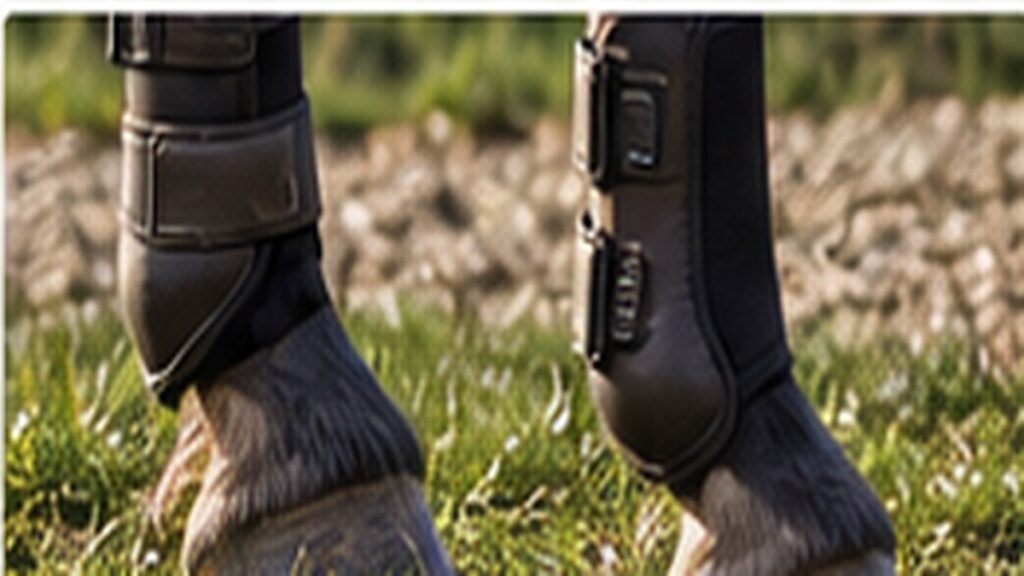
Protective boots should sit in the intended anatomical position, remain stable during movement and avoid pressure at the fetlock, pastern, heel bulbs, tendons and coronary band. Boots that rotate can expose the area they were intended to protect while creating friction elsewhere. Dirt, trapped moisture, damaged fasteners and rough edges are common contributors to skin problems.
Bandages require even application and appropriate tension. Uneven or excessive tension can create pressure differences around the limb; loose bandages can slip and form constricting folds. Bandages and boots should not be left on for longer than necessary, and the limb and skin should be checked after removal.
Transport equipment introduces additional risks because the horse may be confined, unable to dislodge equipment and exposed to heat, movement and prolonged wear. Headcollars, poll guards, tail guards, boots and rugs must be suitable, correctly fitted and checked during use. Equipment should never be selected solely because it is marketed for transport.
Materials, construction and quality indicators
Quality is not synonymous with price, branding or visual complexity. Important indicators include:
- smooth, even edges with no exposed abrasive reinforcement;
- consistent stitching with secure ends and no skipped or loose stitches;
- hardware that is appropriate for the load, corrosion-resistant and free from sharp edges;
- leather or synthetic materials that remain flexible without cracking, delaminating or becoming brittle;
- padding that is resilient, evenly distributed and not permanently compressed;
- elastic that returns to its intended length and is not frayed or uneven;
- adjusters that hold securely without cutting into straps;
- linings that remain flat and do not create ridges, wrinkles or localised seams.
Maintenance is part of fit. Dirt and sweat stiffen leather and abrade surfaces; wet storage encourages degradation; repeated washing may alter padding or coatings; and a saddle’s flocking can settle unevenly. A technically well-fitted item can become unsuitable as it wears.
A practical fit-check routine
- Inspect the horse first. Note body condition, coat changes, muscle development, asymmetry, areas of hair loss, heat or swelling and any recent change in behaviour or performance.
- Inspect the equipment. Check stitching, leather, padding, fasteners, elasticity, distortion and cleanliness before fitting it.
- Fit without rushing. Position the equipment according to its design, then check symmetry, clearance and stability.
- Assess movement. Observe walk and the relevant work, including transitions where appropriate. Look for slipping, twisting, restricted stride, altered posture and repeated evasive behaviour.
- Recheck after work. Examine hair, skin, heat, sweat distribution and equipment movement. Sweat patterns alone do not prove fit, but asymmetry or dry pressure-shaped areas can justify further investigation.
- Record changes. Note saddle adjustments, rider, pad, girth, workload, body condition and season. This makes gradual fit changes easier to identify.
For saddles, a qualified saddle fitter should assess the horse, saddle, pad, girth and rider together. For bridles, a competent bridle fitter can evaluate the relationship between the headpiece, cheekpieces, bit, noseband and the horse’s facial anatomy. Veterinary input is appropriate where pain, lameness, persistent back sensitivity, mouth lesions, dental concerns or unexplained behavioural change may be involved. Equipment fitting should not be used to diagnose or treat a medical problem.
Misconceptions worth avoiding
- “The horse is not visibly lame, so the saddle fits.” Discomfort may appear as subtle performance or behavioural change rather than overt lameness.
- “More padding makes a saddle safer.” Padding changes geometry and pressure distribution; it is not a universal correction.
- “A horse of this breed always takes this size.” Breed and height provide poor substitutes for individual measurement and shape assessment.
- “Even sweat means even pressure.” Sweat is influenced by heat, exertion, coat, pad materials and grooming, and cannot validate fit by itself.
- “An anatomical label guarantees comfort.” It describes intended design features, not the outcome on every horse.
- “Bitless equipment cannot hurt.” Removing the bit changes the pressure sites; it does not remove force.
- “A new item is automatically safe.” New equipment can still be incorrectly sized, unsuitable in shape or poorly adjusted.
Conclusion
Common equipment fit problems are usually not isolated sizing errors. They arise from the interaction of anatomy, construction, adjustment, movement, load, maintenance and changing body shape. The most reliable approach is to treat fit as a dynamic welfare and performance question: identify where forces are applied, whether movement is restricted, whether the equipment remains stable, and whether the horse’s responses are changing.
Routine checks are especially important after weight gain or loss, seasonal coat change, clipping, injury, altered workload, muscle development, a change of rider or a change of saddle, pad, girth or bridle. Where a problem persists, repeated trial-and-error purchases are less useful than a structured assessment by the relevant qualified professional, with veterinary investigation where pain or disease cannot be excluded.
Sources and further reading
- Department for Environment, Food and Rural Affairs: Code of Practice for the Welfare of Horses, Ponies, Donkeys and their Hybrids
- GOV.UK: Hiring out horses licensing statutory guidance
- British Equine Veterinary Association: Clinical catch-up—Saddle Fit
- British Equine Veterinary Association: Clinical catch-up—Bridle Fit
- World Horse Welfare: Bridles—how to choose and fit them correctly
- The British Horse Society: Types of rugs and rugging a horse
- World Horse Welfare: Rugging horses—when does your horse need a rug?
- Meschan et al., The Veterinary Journal: The influence of the width of the saddle tree on forces and pressure distribution
- Nyikos et al., Pferdeheilkunde: Measurements of saddle pressure in conjunction with back problems in horses
- Equine Veterinary Journal: Comparison of nasal and occipital pressures for horses ridden in snaffle and bitless bridles
Research note
Automatically researched source pack — editorial review required:
• www.gov.uk — https://www.gov.uk/government/publications/code-of-practice-for-the-welfare-of-horses-ponies-donkeys-and-their-hybrids
• www.gov.uk — https://www.gov.uk/government/publications/animal-activities-licensing-guidance-for-local-authorities/hiring-out-horses-licensing-statutory-guidance-for-local-authorities
• assets.publishing.service.gov.uk — https://assets.publishing.service.gov.uk/media/5ad4b5f5e5274a76c13dfb33/horses-welfare-codes-of-practice-april2018.pdf
• www.gov.uk — https://www.gov.uk/keeping-horses/looking-after-horses
• www.beva.org.uk — https://www.beva.org.uk/courses/clinical-catch-up-saddle-fit/
• www.telford.gov.uk — https://www.telford.gov.uk/media/u51b4xh2/hiring_out_horses___version_12.pdf
• www.researchgate.net — https://www.researchgate.net/publication/235979402_Measurements_of_saddle_pressure_in_conjunction_with_back_problems_in_horses
• www.researchgate.net — https://www.researchgate.net/publication/7149172_The_influence_of_the_width_of_the_saddle_tree_on_the_forces_and_the_pressure_distribution_under_the_saddle
• www.researchgate.net — https://www.researchgate.net/profile/Christian-Peham/publication/246543326_Evaluation_of_pressure_distribution_under_a_too_wide_saddle_with_different_saddle_pads/links/5a27aa35aca2727dd883c3fd/Evaluation-of-pressure-distribution-under-a-too-wide-saddle-with-different-saddle-pads.pdf?origin=scientific-contributions
• www.gov.uk — https://www.gov.uk/guidance/keeping-horses-commercially
• www.fareham.gov.uk — https://www.fareham.gov.uk/PDF/licencing_and_inspections/GuidanceNotesHiringHorses18.pdf
• skillsengland.education.gov.uk — https://skillsengland.education.gov.uk/media/4622/final_acm_tlevel_outlinecontent_oct2020_itt.pdf
• www.gov.uk — https://www.gov.uk/keeping-horses/transporting-horses
• www.gov.uk — https://www.gov.uk/guidance/farmed-animal-welfare-at-shows-and-markets
• www.bromley.gov.uk — https://www.bromley.gov.uk/leaflet/220488/1/788/ch
• www.researchgate.net — https://www.researchgate.net/publication/348637817_Feel_the_Force-Prevalence_of_Subjectively_Assessed_Saddle_Fit_Problems_in_Swiss_Riding_Horses_and_Their_Association_With_Saddle_Pressure_Measurements_and_Back_Pain
• www.researchgate.net — https://www.researchgate.net/publication/279890785_Measurement_of_the_pressures_exerted_by_saddles_on_the_horse%27s_back_using_a_computerized_pressure_maesuring_device
• www.horseandhound.co.uk — https://www.horseandhound.co.uk//industry-news/scottish-government-equine-welfare-guidance
• www.bhs.org.uk — https://www.bhs.org.uk/horse-care-and-welfare/health-care-management/seasonal-care/types-of-rugs-and-rugging-a-horse/
• www.worldhorsewelfare.org — https://www.worldhorsewelfare.org/advice/bridles-how-to-choose-and-fit-them-correctly
Cite this article
Stable research ID: ERA-2026-000078
The Equestrian Research Atlas (2026) ‘Common Equipment Fit Problems’. The Equestrian Research Atlas. Available at: https://equestrianresearchatlas.co.uk/research/common-equipment-fit-problems/ (Accessed: 3 November 2026).
The Equestrian Research Atlas. (2026). Common Equipment Fit Problems. The Equestrian Research Atlas. https://equestrianresearchatlas.co.uk/research/common-equipment-fit-problems/
The Equestrian Research Atlas. “Common Equipment Fit Problems.” The Equestrian Research Atlas, 2026, https://equestrianresearchatlas.co.uk/research/common-equipment-fit-problems/. Accessed 3 November 2026.
Research references (53)
- www.gov.uk
- www.gov.uk
- assets.publishing.service.gov.uk
- www.gov.uk
- www.beva.org.uk
- www.telford.gov.uk
- www.researchgate.net
- www.researchgate.net
- www.researchgate.net
- www.gov.uk
- www.fareham.gov.uk
- skillsengland.education.gov.uk
- www.gov.uk
- www.gov.uk
- www.bromley.gov.uk
- www.researchgate.net
- www.researchgate.net
- www.horseandhound.co.uk
- www.bhs.org.uk
- www.worldhorsewelfare.org
- www.gov.uk
- www.bluecross.org.uk
- www.beva.org.uk
- beva.onlinelibrary.wiley.com
- int.worldhorsewelfare.org
- www.rspca.org.uk
- www.gov.wales
- www.rugby.gov.uk
- food.ec.europa.eu
- www.sporthorsegb.co.uk
- durham-repository.worktribe.com
- pure.hartpury.ac.uk
- en.wikipedia.org
- www.reddit.com
- www.reddit.com
- en.wikipedia.org
- en.wikipedia.org
- en.wikipedia.org
- www.horseandhound.co.uk
- www.reddit.com
Related research
 Adjustability, Measurement Tolerance and Fit Range in Horse EquipmentContinue research →Ergonomics in Equestrian EquipmentContinue research →
 Harness Sizing ExplainedContinue research →
 Saddle Fit TerminologyContinue research →
 Bridle Sizing ExplainedContinue research →
 How to Measure a Horse for a RugContinue research →