
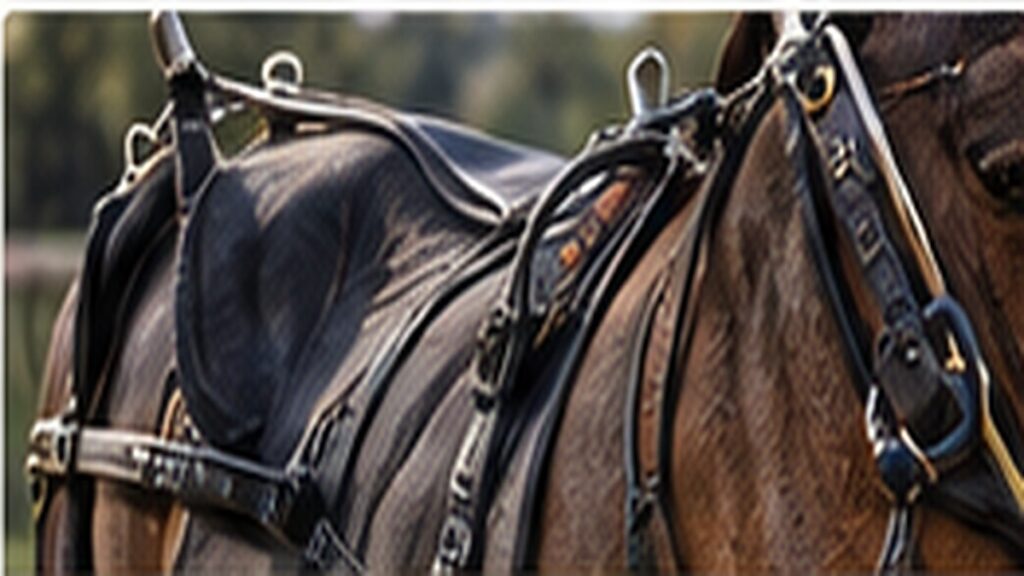
Harness sizing is often presented as a simple choice between pony, cob, full and perhaps extra-full. That shorthand is useful for ordering, but it is not a fit assessment. A driving harness is a collection of connected components, each with a different job and a different relationship with the horse’s anatomy. A horse may need a cob breastcollar, a full-size bridle, a longer girth and a different breeching adjustment in the same harness.
For that reason, the correct question is not “What size harness does my horse wear?” It is “What measurements, component dimensions and adjustments allow this harness to remain secure, comfortable and mechanically appropriate for this horse, vehicle and work?”
In Great Britain, the Government’s Code of practice for horse-drawn vehicles states that harness should be selected and fitted for the particular horse and use, and regularly checked for soundness and safety. It does not prescribe a universal sizing chart, because harness fit depends on construction, design, workload, vehicle and the individual horse. The Government code of practice is therefore best understood as a safety framework rather than a measurement manual.
What “size” means in a driving harness
Manufacturers use size labels to group component dimensions. The labels are not controlled, universal standards. A “cob” from one maker may overlap a “pony” or “full” from another, while synthetic harnesses may use different size conventions from leather harnesses. Even within one range, the nominal size of a breastcollar may not correspond directly to the size of the bridle, girth or breeching.
The main variables are:
- Component geometry: the shape and length of the breastcollar, collar, saddle, breeching and bridle parts.
- Adjustment range: the distance between the first and last usable holes, including whether the component can be changed safely without overloading a buckle or keeper.
- Construction: padded synthetic webbing, leather, biothane-type coated webbing and traditional leather harness do not all flex or distribute pressure in the same way.
- Horse conformation: height is only a rough indicator. Neck length, chest width, shoulder angle, barrel circumference, back length, hindquarter shape and head dimensions are more directly relevant.
- Use: a harness for light training with a small, well-braked vehicle may require different arrangements from one used for heavier work, long road journeys or competitive driving.
- Vehicle design: shafts, pole, balance, brakes, weight and the presence or absence of a breeching requirement alter the loads and adjustments involved.
A useful principle is that size labels are a starting point for selecting samples, not proof that the harness fits.
The components that need sizing
Bridle and headstall
The driving bridle must be large enough to sit in the intended position without pulling the browband into the ears, compressing the cheek or placing the throatlash and noseband under unnecessary tension. It must also be small enough that adjustment holes do not leave excessive loose strap, unstable buckles or a cheekpiece that can move into the eye.
Do not assume that the horse’s riding bridle size transfers directly to the driving bridle. Driving bridles may have different cheekpiece lengths, blinkers, throatlash arrangements, nosebands and rein attachments. A horse with a broad forehead but a relatively short head may need a mixture of sizes or a made-to-measure browband and crownpiece.
Check both sides. The bridle should remain symmetrical when the horse is standing square, and it should not shift markedly when the reins are taken up. Blinkers, where used, must not touch the eyelashes or obstruct the intended field of view more than the design requires. Any check or bearing arrangement must be adjusted as part of the whole driving system, not used to force the head into a fixed outline.
Breastcollar or breastplate
A breastcollar transfers traction from the horse’s chest to the traces. It is not fitted like a riding breastplate and should not be treated as a decorative strap across the front of the horse.
The collar should lie against the chest in a stable, even contact pattern while leaving the windpipe and the points of the shoulder free. It must not ride up into the throat, sit across the lower edge of the windpipe, or fall so low that it interferes with shoulder movement. The side straps, balance or martingale arrangements must keep the main pulling surface correctly oriented rather than allowing it to rotate or lift.
Zilco’s technical fitting information illustrates why a simple circumference measurement is inadequate. Its guidance distinguishes height fit, which keeps the airway and shoulder points clear, from angle fit, which keeps the breastplate in contact without the upper or lower edge digging in. The same catalogue gives different component dimensions for pony, cob and full sizes, demonstrating that the labels represent a manufacturer’s own dimensional system rather than a universal rule. Zilco driving harness catalogue and fitting instructions.
For a breastcollar, record at least:
- the chest height at which the collar must sit;
- the distance between the intended attachment points;
- the length and adjustment range of the balance straps;
- the length of the traces or trace attachments;
- whether the collar remains stable when the horse walks, trots and turns.
Some harnesses use a breastcollar with integral traces; others use separate traces attached to the collar or saddle. These arrangements cannot be compared by collar length alone.
Full collar and hames
A full collar is a different sizing problem from a breastcollar. It must conform closely to the horse’s neck and shoulder shape, while allowing the airway to remain clear and the shoulder to move. The collar is used with hames, which carry the trace attachments and must also be correctly shaped and secured.
Full collars are not normally selected by a generic pony, cob or full label alone. The horse should be measured according to the collar maker’s method, and the collar assessed on the horse. A collar that is too tight can restrict the throat and shoulder region; one that is too loose can move, rub and transmit traction unevenly. Because collar fit is less forgiving than breastcollar fit, professional measurement is particularly valuable for heavy work, traditional harness and horses with unusual neck or shoulder conformation.
Girth, bellyband and saddle
The driving saddle supports the tugs or shafts and helps stabilise the harness. The girth or bellyband must be long enough to sit in the intended position and have sufficient adjustment for seasonal or condition changes, but not so long that the buckles end up under the shafts, traces or other pressure points.
Measure around the horse at the actual girthing position, rather than relying on a riding girth measurement. The horse should be standing square on a level surface, with the tape lying flat but not compressing the coat. If the harness has a separate bellyband, measure and assess it separately: its position, width, padding and connection to the saddle can alter how the whole harness behaves.
The saddle should sit on the intended area of the back and remain stable without bridging, rocking or drifting sideways. It should not be placed so far forward that it interferes with the scapulae, nor so far back that the weight and shaft forces are concentrated over a less suitable section of the back. The correct position depends on the saddle design, shaft arrangement and vehicle, so a nominal harness size cannot determine it by itself.
Tugs, shaft loops and traces
Tugs or shaft loops must hold the shafts at the required height and position without allowing excessive movement. Their dimensions are related to the shafts and vehicle, not only to the horse. A harness may fit the horse but be inappropriate for shafts that are too wide, too narrow, too high or incorrectly balanced.
Traces should be long enough to connect correctly to the vehicle while maintaining the intended alignment through turns and changes of pace. They must not be so long that they sag into the legs or so short that they pull the breastcollar or collar out of position. Trace length is therefore checked with the actual vehicle, not measured in isolation.
Breeching
Breeching allows the horse to help slow or hold back a vehicle, particularly where the vehicle and terrain make that function necessary. It must follow the shape of the hindquarters without cutting into the tail, dock or gaskins. The breeching seat should be high enough to remain stable but low enough to engage the broad, muscular part of the quarters; the exact position depends on the design and the vehicle.
The breeching straps should be long enough to preserve freedom of movement and short enough to prevent the breeching from dropping below the working position. Breeching that is too loose may fail to engage when needed; breeching that is too tight may interfere with the hindlimbs or remain under constant pressure. The crupper, hip straps and backband must work together so that the breeching remains centred when the horse turns.
How to measure a horse for harness
Use the manufacturer’s measurement diagram whenever one is available. Do not substitute a general “horse measurement” for a component-specific measurement. Record measurements in centimetres and inches if purchasing from different suppliers, and note the date, body condition, coat condition and whether the horse was measured before or after work.
- Prepare the horse. Stand the horse square on level ground. Use a flexible but non-stretch tape. Do not measure over thick rugs, a wet coat or temporary padding.
- Record basic identification. Note height, breed or type, sex, age, current body condition and any relevant changes in neck, barrel or topline. These are context, not substitutes for measurements.
- Measure the girth region. Place the tape where the harness girth or bellyband will sit. Keep it level and record whether the tape was snug or relaxed.
- Measure the chest and breastcollar region. Follow the maker’s specified route. A straight-line chest measurement, a circumference and a measurement between attachment points are not interchangeable.
- Measure the head. Take the crown, browband, cheek and noseband dimensions required by the bridle design. Check the length of the head as well as its circumference.
- Measure for a full collar if required. Follow the collar maker’s instructions precisely. Do not infer collar size from the breastcollar or bridle.
- Measure breeching and back length. Use the manufacturer’s reference points, particularly where the design includes a crupper, hip straps or an integral backband.
- Measure the vehicle interface. Record shaft width and height, trace attachment position, pole dimensions where relevant, and the distance from the horse to the vehicle’s working attachments.
Ideal Equestrian publishes a component-based measurement chart covering items such as breast dimensions, collar dimensions and harness parts. Its chart is useful as an example of how manufacturers organise measurements, but it should not be treated as a universal industry standard. Ideal Equestrian measurement charts.
Assessing fit on the stationary horse
Begin without the vehicle and inspect the harness in the order in which it is put on. Look for symmetry, correct strap direction, adequate adjustment range and any buckle or keeper that lies over a pressure-sensitive area.
At minimum, assess:
- Airway clearance: the breastcollar or collar must not press into the windpipe or throat region.
- Shoulder freedom: the breastcollar, balance straps and saddle must not obstruct the points of the shoulders or the movement of the scapulae.
- Even contact: load-bearing surfaces should lie flat rather than having an edge, fold or buckle concentrated in one spot.
- Stability: the saddle, breastcollar, bridle and breeching should remain in their intended positions when the horse lowers and raises the head.
- Adjustment security: buckles should be correctly engaged, keepers used, and no strap should depend on the last hole or have excessive loose length.
- Leg clearance: traces, breeching straps and loose ends should be clear of the forelegs and hindlegs.
Static clearance alone is not enough. A harness can look acceptable when the horse is standing and become restrictive when the horse walks, trots, turns, backs or negotiates an incline.
Assessing fit in motion
Observe the horse at walk in hand before attaching the vehicle, then inspect again with the vehicle correctly put to. The horse should be observed from the front, side and rear. Look for movement of the breastcollar, saddle, breeching and bridle rather than judging fit from a single photograph.
Warning signs include a breastcollar that climbs into the throat or drops onto the shoulder, a saddle that rocks or migrates, traces that become slack or pull sharply through turns, breeching that shifts sideways, and any strap that approaches the limbs. Behavioural changes such as repeated head tossing, reluctance to move forward, altered stride, tail swishing or resistance to being harnessed are not proof of a sizing fault, but they justify stopping and reassessing the complete setup.
After work, inspect the skin and coat under every load-bearing or rubbing area. Heat, hair disturbance, pressure marks, swelling, broken skin or localised tenderness should not be dismissed as normal break-in. If there is a persistent or significant welfare concern, remove the equipment and seek appropriately qualified veterinary or harness-fitting advice; this article is not a diagnostic guide.
Leather, synthetic and hybrid harnesses
Material affects fit because it affects flexibility, thickness, weight, moisture response and maintenance. Good leather can soften and mould with use, but it can also stretch if poorly maintained or loaded when wet. Synthetic webbing may offer consistent dimensions and easy cleaning, but different webbing, padding and hardware combinations have different stiffness and friction characteristics. Coated webbing products can be dimensionally stable but still require regular inspection for cuts, delamination, damaged stitching and weakened holes.
Do not assume that a synthetic harness can be adjusted indefinitely because the material is flexible. The webbing may fold at a buckle, padding may compress, or the load may become concentrated at a keeper or stitched joint. Conversely, a leather harness should not be deliberately fitted tight on the assumption that it will “give” into the correct shape.
Quality indicators include clean, even stitching; suitable edge finishing; strong, correctly oriented hardware; sound holes and keepers; adequate padding where required; trace and tug attachments appropriate to the intended work; and parts that can be inspected, cleaned, repaired or replaced. Interchangeable components can be advantageous, particularly for horses between standard sizes, but only where compatibility and load capacity are confirmed by the manufacturer.
Common sizing mistakes
Choosing by height alone
Height may correlate loosely with general size, but it does not describe chest width, neck shape, barrel circumference or head dimensions. A narrow, long-backed 15.2-hand horse and a compact, deep-bodied horse of the same height may need different components.
Buying a complete set in one nominal size
A complete “full” set may contain a bridle that fits but a breastcollar that is too low, or a girth that is too short. Treat every component as an individual fit decision within a compatible system.
Using a riding breastplate as a driving breastcollar
Riding breastplates and driving breastcollars may look similar, but their load paths, trace attachments and balance arrangements differ. A component designed to stabilise a saddle is not automatically designed to transmit traction to a vehicle.
Making the breastcollar tight to stop movement
Stability comes from correct height, angle, balance straps, saddle position and vehicle alignment. Excessive tightening can reduce airway and shoulder clearance instead of solving the underlying problem.
Ignoring the vehicle
Harness fit cannot be separated from the vehicle. Shaft balance, trace length, braking, vehicle weight and terrain determine how forces reach the horse. A harness that is acceptable for one vehicle may be unsuitable for another.
Assuming fit is permanent
Horses change with age, season, workload, pregnancy, clipping, weight fluctuation and muscle development. Leather stretches, padding compresses and holes wear. Recheck fit at the start of each driving season, after significant changes in the horse or vehicle, and whenever work, behaviour or skin condition changes.
When off-the-peg sizing is not enough
Seek a competent harness fitter or maker when the horse falls between sizes, has an unusual neck or shoulder shape, requires a full collar, is doing heavy or commercial work, or repeatedly develops movement, stability or rubbing problems. A mixed-size or made-to-measure harness may be more economical and safer than forcing an unsuitable complete set to fit.
Professional assessment should include the horse, harness and vehicle together. The fitter should be able to explain which measurements are being taken, which parts can be altered, which parts must be replaced, and how the proposed changes affect load distribution and adjustment range. For businesses carrying passengers or working horses on public roads, fitting should sit within a wider system of competence, inspection, maintenance and risk management.
The UK Government’s code emphasises that harness must be appropriate for the particular use and regularly checked for safety. That principle is more useful than a universal chart: sizing is successful only when the assembled equipment remains secure, comfortable and mechanically suitable throughout the work for which it is intended.
A practical sizing checklist
- Have the horse measured using the manufacturer’s component-specific instructions.
- Record chest, girth, head, back and hindquarter measurements rather than relying on height.
- Confirm the actual size and adjustment range of every component.
- Check breastcollar or collar height, angle, airway clearance and shoulder freedom.
- Check the saddle, girth and tugs against the horse’s back and the vehicle’s shafts.
- Check trace length and alignment with the vehicle attached.
- Check breeching position, movement and clearance from the hindlimbs and tail.
- Inspect stitching, leather, webbing, buckles, holes, keepers and trace attachments before every use.
- Observe the harness in walk, turns, backing and the intended work conditions.
- Reassess after changes in body condition, workload, vehicle, season or equipment.
- Stop and obtain competent advice if fit cannot be achieved without using extreme adjustment or compromising clearance.
Related industry reference: For businesses moving from technical research into trade sourcing, explore driving-harness suppliers on EquiGuild.
Sources and further reading
- UK Government: Code of practice for horse-drawn vehicles — guidance on safe preparation, correct harness fitting, vehicle checks and competent operation.
- Zilco Driving Harness Catalogue — manufacturer dimensions, component sizing and breastplate fitting guidance.
- Ideal Equestrian Measurement Charts — example component-based harness measurements and size ranges.
- Harness Stuff: Web Z driving harness parts — example of manufacturer-specific dimensions and interchangeable component practice.
- The British Driving Society — GB driving education, proficiency and safety information.
- The British Horse Society: Equestrians on the road — wider GB road-safety context for carriage driving.
Research note
Automatically researched source pack — editorial review required:
• www.bhs.org.uk — https://www.bhs.org.uk/go-riding-and-learn/riding-out-hacking/what-to-wear/hats-and-helmets/
• www.bhs.org.uk — https://www.bhs.org.uk/go-riding-and-learn/riding-out-hacking/riding-on-roads/
• www.bhs.org.uk — https://www.bhs.org.uk/about-us/latest-news/top-tips-for-equine-road-safety/
• www.gov.uk — https://www.gov.uk/government/publications/code-of-practice-for-horse-drawn-vehicles/code-of-practice-for-horse-drawn-vehicles
• www.benningtoncarriages.co.uk — https://www.benningtoncarriages.co.uk/files/ww/HDR%20Catalogue%20-%20Vol%205-%20%20English%20-%20lowres%20Oct%202015.pdf
• www.idealequestrian.com — https://www.idealequestrian.com/en/metric-conversion-table/
• www.ponyandcarriage.co.uk — https://www.ponyandcarriage.co.uk/horse-harness-leather-pairs-single-team-middle-range-shop.htm
• www.bhs.org.uk — https://www.bhs.org.uk/media/tcifci12/2022-sept-bhs-health-safety-policy-signed.pdf
• www.harnessstuff.co.uk — https://www.harnessstuff.co.uk/collections/web-z-parts
• www.criterion-uk.com — https://www.criterion-uk.com/blogs/horse-tack-and-gear/how-to-harness-a-horse-driving-cart-harness-history
• www.equus.co.uk — https://www.equus.co.uk/pages/collegiate-size-guide
• western-saddler.co.uk — https://western-saddler.co.uk/pages/buckaroo-sizing-guide
• www.beaux-equestrian.co.uk — https://www.beaux-equestrian.co.uk/about-us/size-guides
• www.harnessstuff.co.uk — https://www.harnessstuff.co.uk/collections/build-over-time
• s3.eu-west-1.amazonaws.com — https://s3.eu-west-1.amazonaws.com/cdn.webfactore.co.uk/10986-2-harnessfitmeasurementguide2024.pdf
• democracy.stratford.gov.uk — https://democracy.stratford.gov.uk/documents/s16636/Horse%2520Drawn%2520Omnibus%2520Appendix%25202.pdf
• www.benningtoncarriages.co.uk — https://www.benningtoncarriages.co.uk/files/ww/2020%2008%20Harness%20Driving%20Catalogue%20XS.pdf
• bsha.online — https://bsha.online/assets/uploads/aff/equine-schedule-2025.pdf
• en.wikipedia.org — https://en.wikipedia.org/wiki/Breastplate_%28tack%29
• en.wikipedia.org — https://en.wikipedia.org/wiki/British_Horse_Society
Cite this article
Stable research ID: ERA-2026-000076
The Equestrian Research Atlas (2026) ‘Harness Sizing Explained’. The Equestrian Research Atlas. Available at: https://equestrianresearchatlas.co.uk/research/harness-sizing-explained/ (Accessed: 3 November 2026).
The Equestrian Research Atlas. (2026). Harness Sizing Explained. The Equestrian Research Atlas. https://equestrianresearchatlas.co.uk/research/harness-sizing-explained/
The Equestrian Research Atlas. “Harness Sizing Explained.” The Equestrian Research Atlas, 2026, https://equestrianresearchatlas.co.uk/research/harness-sizing-explained/. Accessed 3 November 2026.
Research references (38)
- www.bhs.org.uk
- www.bhs.org.uk
- www.bhs.org.uk
- www.gov.uk
- www.benningtoncarriages.co.uk
- www.idealequestrian.com
- www.ponyandcarriage.co.uk
- www.bhs.org.uk
- www.harnessstuff.co.uk
- www.criterion-uk.com
- www.equus.co.uk
- western-saddler.co.uk
- www.beaux-equestrian.co.uk
- www.harnessstuff.co.uk
- s3.eu-west-1.amazonaws.com
- democracy.stratford.gov.uk
- www.benningtoncarriages.co.uk
- bsha.online
- en.wikipedia.org
- en.wikipedia.org
- www.reddit.com
- www.reddit.com
- en.wikipedia.org
- www.reddit.com
- en.wikipedia.org
- www.reddit.com
- en.wikipedia.org
- www.reddit.com
- en.wikipedia.org
- www.horseandhound.co.uk
- www.reddit.com
- www.reddit.com
- www.reddit.com
- www.reddit.com
- arxiv.org
- www.reddit.com
- www.reddit.com
- www.reddit.com
Related research
 Adjustability, Measurement Tolerance and Fit Range in Horse EquipmentContinue research →Common Equipment Fit ProblemsContinue research →Ergonomics in Equestrian EquipmentContinue research →
 Saddle Fit TerminologyContinue research →
 Bridle Sizing ExplainedContinue research →
 How to Measure a Horse for a RugContinue research →