
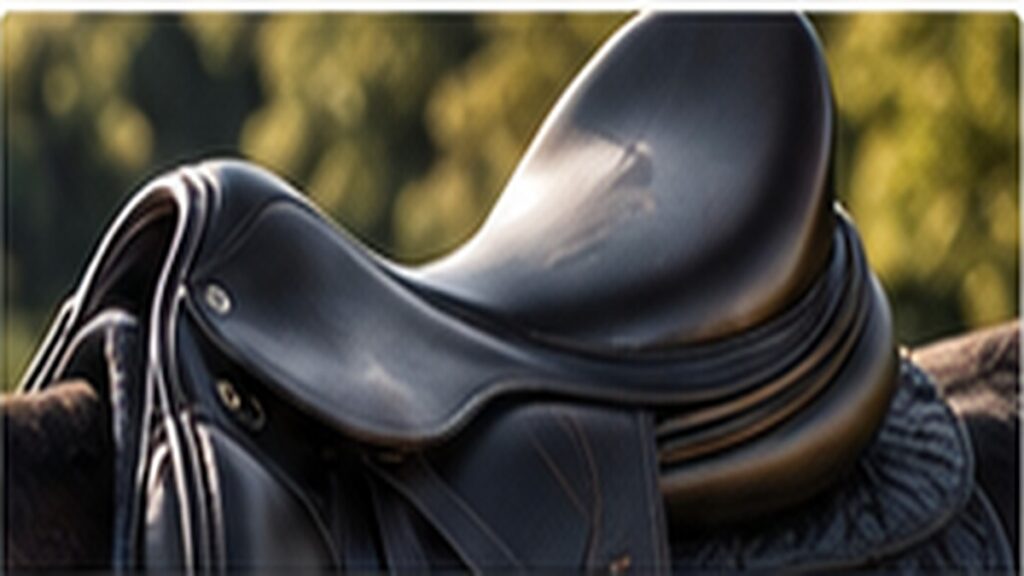
Saddle fitting is a multi-variable assessment of how a saddle interacts with the horse, the rider and the intended work. It is not simply a matter of choosing a nominal width and seat size. A saddle may have an apparently suitable tree width yet fail because its panel shape, longitudinal curvature, length, balance or rider interface is unsuitable. Conversely, a saddle that appears acceptable when standing still may create excessive or uneven loading when the horse and rider move.
The terminology used by saddlers, saddle fitters, manufacturers and riders is not completely standardised. Some words describe identifiable construction features; others are shorthand for a professional judgement. Terms such as “medium-wide”, “good clearance” or “balanced” should therefore be understood as part of an assessment rather than as independent guarantees of fit.
In Great Britain, a qualified saddle fitter will normally consider the horse in its current condition, the saddle’s construction and adjustability, the rider’s size and shape, and the work the combination performs. The British Horse Society describes saddle fitting as involving static and dynamic assessment of horse and rider, while recognising that horses change shape with weight, fitness, muscle development and age. ([bhs.org.uk](https://www.bhs.org.uk/horse-care-and-welfare/features/saddle-fit/?utm_source=openai))
What “saddle fit” means
Saddle fit is the suitability of the complete saddle-and-rider system for a particular horse and workload. It includes:
- the relationship between the tree and the horse’s thoracic shape;
- the distribution of load through the panels and bearing surfaces;
- clearance of the spinal processes and other sensitive structures;
- freedom for the scapula and surrounding soft tissues;
- longitudinal stability and resistance to unwanted slipping or bridging;
- the saddle’s balance under the rider;
- the rider’s ability to sit in a secure, effective and symmetrical position; and
- the way those factors change during the intended ridden activity.
Fit is therefore relative to a horse, a rider and a use. A saddle suitable for a short-backed native pony may be unsuitable for a long-backed warmblood, even if both are described as “medium” width. A saddle that works for hacking may not provide the required support or stability for jumping, dressage, racing or long-distance work.
Research supports the importance of assessing several fit features rather than relying on one measurement. In a study of sound Swiss riding horses, only 10% of the saddles assessed were free of the investigated fit problems. The study also found that certain subjective fit assessments corresponded with measured pressure patterns, while absolute pressure showed only limited association with back pain. This does not make pressure measurement unhelpful; it demonstrates that pressure is one part of a wider assessment and is not, by itself, a complete definition of comfort or fit. ([sciencedirect.com](https://www.sciencedirect.com/science/article/pii/S0737080621000186?utm_source=openai))
Basic saddle construction terminology
Tree
The tree is the structural framework of an English saddle. It determines much of the saddle’s overall geometry, including the relationship between the head, points, seat and panels. Traditional trees may incorporate laminated wood and spring steel; modern saddles may use synthetic, composite or other engineered materials. The exact construction varies between manufacturers and models.
The tree is not the same thing as the visible leather or synthetic saddle. Nor is “tree width” a universal measurement shared consistently between brands. A nominal width may refer to a manufacturer’s fitting category, a headplate specification, the angle between the points, or another proprietary measurement. Width labels should therefore be compared cautiously.
Tree points
The tree points are the forward extensions of the tree on either side of the withers. They help determine how the saddle sits around the front of the thoracic region and influence the distribution of load near the shoulder.
When a fitter discusses point length, they are referring to how far the points extend and how they lie relative to the horse’s shape. Long points may provide stability on some conformations but can become restrictive or sit against unsuitable anatomy on others. Shorter or cut-back arrangements may be used where greater shoulder freedom is required, although no point design is automatically appropriate for every horse.
Head, headplate and pommel
The head is the forward part of the tree and saddle. The headplate, sometimes called the gullet plate in manufacturer literature, is the component that helps establish the width and angle at the front of some saddles. In adjustable designs it may be interchangeable or mechanically altered.
The visible raised front of the saddle is the pommel. Pommel height is affected by the tree, seat design, panel construction and the horse’s shape. A high pommel is not automatically evidence of inadequate clearance, and a low pommel is not automatically evidence of a low saddle. The saddle must be assessed in relation to the withers, tree angle, panel contact and the rider’s weight.
Cantle
The cantle is the raised rear section of the saddle. Its height, angle and shape influence rider security and seat design. A cantle that is excessively high for the rider or discipline may restrict movement; one that is too low or poorly matched to the rider may offer insufficient support. Cantle shape also contributes to the manufacturer’s intended position of the rider.
Seat and twist
The seat is the area in which the rider sits. Its nominal size, usually expressed in inches for English saddles, is not a direct measurement of the rider’s height or body weight. Seat size relates to the saddle’s internal geometry and should be assessed alongside the rider’s pelvis, thigh length, hip mobility and discipline.
The twist describes how narrow or broad the saddle feels between the rider’s thighs, especially through the central part of the seat. A narrow twist may suit one rider’s pelvic anatomy but feel unstable or uncomfortable to another. “Narrow” and “wide” twist are design descriptions, not universal quality ratings.
Waist
The waist is the narrower central area of the saddle seat. Its width and shape affect rider position and comfort. The term may be used somewhat differently in different saddlery traditions, so a fitter should explain whether they are discussing the rider-facing seat or the underlying tree and panel geometry.
Flaps, blocks and knee rolls
The flap is the large leather or synthetic panel beneath the rider’s leg. Flap length and forwardness should correspond with the rider’s thigh length, stirrup position and discipline. A rider with a long thigh may require a longer or more forward flap, but increasing the external flap length does not necessarily increase the saddle’s weight-bearing length on the horse.
Knee blocks and calf blocks are shaped or padded supports intended to help position the rider’s leg. Their location, height and firmness affect the rider’s freedom and stability. A block that feels supportive in a showroom may force the knee or thigh into an unsuitable position once the rider is mounted and the stirrups are set for work.
Panel terminology
Panels
The panels are the padded structures between the tree and the horse’s back. They create the principal bearing surfaces and influence the saddle’s angle, stability and pressure distribution. Panel shape must correspond with the horse’s back, not merely with the saddle’s labelled width.
Panels may be made or filled using wool flocking, foam, air systems or combinations of materials. Each system has different service characteristics. Wool can be adjusted by a skilled saddler, while some foam or air systems have manufacturer-specific servicing requirements. The presence of an adjustable material does not mean that unlimited correction is possible or that adjustment can compensate for an unsuitable tree.
Flocking
Flocking is the material inserted into saddle panels to create padding and shape. In traditional British saddlery this is commonly wool-based. Over time, flocking may settle, migrate, harden, become uneven or lose its intended profile. Adjustment is normally performed by a competent saddler or fitter with the appropriate bench skills.
Reflocking means removing, redistributing or adding flocking to alter the panel shape or balance. Reflocking is not the same as changing the tree. It may improve a saddle that is fundamentally suitable but has developed local unevenness or requires a modest correction. It cannot reliably transform a saddle with the wrong tree angle, excessive length or unsuitable curvature into an appropriate saddle.
Panel angle and bearing surface
Panel angle describes the angle at which the panel sits against the horse. It should be considered in relation to the horse’s thoracic contour and the tree. A panel can be too steep, too flat, too narrow or otherwise mismatched, creating localised loading or poor stability.
The bearing surface is the area through which the saddle transfers load to the horse. More bearing area is not automatically better: a long panel may extend beyond the horse’s functional weight-bearing region, while a short panel may concentrate load. The shape, evenness and location of contact matter as much as nominal area.
Bridging and rocking
Bridging occurs when a saddle has contact at the front and rear but reduced or absent contact through the middle of the panels. This can concentrate loading at the ends and reduce stability.
Rocking describes a saddle that moves or pivots excessively from front to back, often because its curvature does not match the horse or because the balance and contact are unsuitable. Rocking may be apparent during mounting, girthing or ridden work. It should not be confused with every instance of saddle movement: some movement can arise from rider asymmetry, girthing, slipping, the horse’s movement or the surface used for assessment.
Panel symmetry
Panel symmetry refers to whether the left and right panels are equivalent in shape and condition. A saddle may have asymmetrical panels because of manufacturing variation, wear, previous adjustment, damage or deliberate correction. A horse and rider may also be asymmetrical, but compensating for asymmetry requires professional judgement. Uneven panels should not be accepted as normal merely because the horse itself is not perfectly symmetrical.
Clearance and contact terminology
Wither clearance
Wither clearance is the space between the saddle’s front structure and the horse’s withers. It must be considered with the rider mounted, because the rider’s weight changes the saddle’s position. Clearance should not be judged solely by inserting fingers under the pommel or by viewing the saddle from above.
Clearance also has to be maintained laterally and through movement. A saddle may have apparent vertical clearance but still press against the sides of the withers or restrict the shoulder. Conversely, a very generous visual gap is not necessarily beneficial if the tree and panels fail to contact the horse appropriately.
Spinal clearance and channel
The channel, sometimes called the gullet channel, is the space between the panels running along the horse’s spine. Its purpose is to avoid direct loading on the dorsal midline while allowing the panels to bear weight on the appropriate structures beside it.
Spinal clearance is not simply a matter of seeing daylight from the rear. The channel must remain clear under load and during movement, and its width and shape must be compatible with the horse. A channel that is too narrow may risk contact with the midline; one that is excessively wide may reduce useful bearing surface and concentrate load farther laterally.
Terminology can be confusing because some riders use “gullet” to mean the channel visible between the panels, while manufacturers may use “gullet” or “gullet width” to describe the front opening or headplate specification. When buying or comparing saddles, ask which part is being measured.
Shoulder freedom
Shoulder freedom means that the saddle does not unnecessarily restrict the movement of the scapula and associated soft tissues. It depends on tree point position and angle, panel shape, saddle length, girthing arrangement, horse conformation and the way the horse moves.
Some saddles are described as cut-back, meaning that the front of the saddle is shaped to provide additional room around prominent withers or the shoulder region. Cut-back design is not a universal solution: the complete saddle still has to match the horse’s back and the rider’s position.
Balance, stability and position
Balance
A balanced saddle places the rider in the manufacturer’s intended central position without the rider having to brace, push the pelvis forward or sit behind the movement. Balance is assessed with the rider mounted and should be considered in relation to the horse’s conformation, the saddle’s design and the work being performed.
A saddle that is pommel-high is often described as “downhill” or “front-low”, while one that is cantle-high may be described as “behind the movement”. These descriptions identify an observed position, not necessarily the cause. The cause may include tree geometry, panel shape, flocking, girthing, rider size, horse shape or the interaction of several factors.
Stability
Saddle stability is the ability of the saddle to remain appropriately positioned without excessive lateral, longitudinal or rotational movement. A stable saddle is not one that is forcibly clamped to the horse; it must remain stable while allowing the horse’s back and shoulders to move normally.
Unwanted movement may be associated with poor fit, but it can also reflect an unbalanced rider, asymmetrical loading, unsuitable girthing, incorrect saddle placement, the horse’s changing musculature or the demands of a particular gait. A static saddle check cannot establish stability in all circumstances.
Centre of gravity and rider position
The saddle’s design influences the position of the rider’s mass relative to the horse. A rider who is repeatedly displaced to one area of the saddle may create uneven loading even when the saddle appears symmetrical. The British Horse Society notes that a saddle must fit both horse and rider, and that an unsuitable rider-size relationship can create uneven weight distribution and pressure points. ([bhs.org.uk](https://www.bhs.org.uk/go-riding-and-learn/stable-mates/rider-size/?utm_source=openai))
Tree width, angle and shape
Width is not angle
Tree width and tree angle are related but distinct. Width commonly refers to the overall spread of the front of the tree, while angle describes how the tree and points sit against the horse. Two saddles may have similar labelled widths but different angles, resulting in very different contact.
A tree that is too narrow may create concentrated pressure near the withers and points. A tree that is too wide may drop too far around the horse, allow excessive movement or sit low at the front. These are general mechanisms, not diagnostic rules: the actual effect depends on the entire saddle and horse.
Tree shape and curvature
Longitudinal curvature is the front-to-back shape of the tree and panels. A saddle with more curve may suit a horse with a more curved back, while a flatter design may suit a flatter profile. If the curvature is mismatched, the saddle may bridge, rock or load unevenly.
Hoop tree is an industry term usually referring to a tree with a rounder, more open shape through the front-to-middle section. It may be considered for horses with broad ribcages, lower or less prominent withers and a rounder back. “Hoop” is not a universal technical specification, however, and different manufacturers apply the term to different geometries.
Fit assessment terms and methods
Static assessment
A static assessment examines the horse and saddle while the horse is standing, usually without the rider or with the rider mounted as a separate stage. It may include evaluation of saddle placement, tree points, panel contact, channel clearance, girthing, symmetry, length and rider fit.
Static assessment is essential but limited. It cannot show how the saddle behaves at walk, trot, canter, jumping or during transitions. The BHS and professional saddle-fitting practice therefore distinguish between static and dynamic assessment. ([bhs.org.uk](https://www.bhs.org.uk/bhs-professional-qualifications-and-careers/equine-careers/saddlery/?utm_source=openai))
Dynamic assessment
Dynamic assessment examines the saddle while the horse and rider move. The fitter may observe the horse from the ground, assess the rider’s position, examine saddle movement and compare different saddles or adjustments. Where appropriate, assessment may include the intended discipline rather than only a short period of walking.
Dynamic observations should be interpreted carefully. A horse’s way of going can be influenced by pain, training, footing, rider balance, tack and many other variables. Saddle fit should not be used as a diagnosis of lameness or back pain. Signs such as resistance, altered movement, reluctance to go forward or sensitivity should be referred to the appropriate veterinary or professional team rather than attributed automatically to the saddle.
Pressure mapping
Saddle pressure mapping uses a pressure-sensing mat or similar system placed between the saddle and the horse. It can provide information about pressure distribution, asymmetry, peak loading and changes during movement.
Pressure systems have limitations. Results depend on the equipment, calibration, mat thickness, saddle, rider, gait, surface and analytical method. A pressure map is not a direct measurement of pain, and a low peak-pressure reading does not prove that a saddle is suitable in every respect. Reviews of pressure-mat research have highlighted differences between studies and the need to interpret measurements in context. ([tandfonline.com](https://www.tandfonline.com/doi/pdf/10.1080/10255842.2020.1714912?utm_source=openai))
Thermography and sweat patterns
Thermography records surface temperature patterns and has been investigated as a means of examining saddle interaction. It may identify asymmetrical or localised heat patterns, but temperature is influenced by many factors and should not be treated as a stand-alone fit test.
Sweat patterns are sometimes used as an informal post-exercise observation. They may provide useful clues about contact, but they cannot prove the absence of pressure, because sweat production, hair direction, weather, exercise intensity and saddle-cloth materials all affect the pattern. A dry patch is not automatically a pressure sore, and an even sweat pattern is not proof of correct fit.
Materials and adjustability
Wool-flocked saddles
Wool-flocked panels can be altered by adding, removing or redistributing flocking. This can be valuable where a saddle is fundamentally compatible but requires maintenance or a controlled correction. Wool flocking settles with use and should be checked periodically, particularly when the horse’s condition changes.
Foam panels
Foam panels use synthetic foams of varying density and construction. They can provide consistent manufactured shape and may be relatively low-maintenance, but their adjustability depends on the design. Some foam saddles can be modified; others cannot be altered in the same way as wool-flocked saddles.
Air systems
Air panels use sealed or semi-sealed air chambers. They may alter the feel and distribution of load, but servicing and adjustment are system-specific. Changes should be made by a person trained or authorised to work on that design.
Adjustable gullets and headplates
An adjustable gullet or interchangeable headplate allows the front geometry to be altered within a defined range. It does not make a single saddle universal. Adjustability may not change panel length, longitudinal curvature, channel design, seat shape or the rider interface. The saddle still requires assessment on the individual horse.
Common misconceptions
- “The width is correct, so the saddle fits.” Width is only one part of fit. Angle, curvature, panel shape, length, channel and rider position also matter.
- “Three fingers of clearance proves the saddle fits.” Finger tests are crude and do not reproduce the effects of the mounted rider or movement.
- “A saddle should not move at all.” Some movement is normal; excessive or functionally disruptive movement is the concern.
- “A clean sweat pattern proves good fit.” Sweat patterns are affected by many variables and are not a complete assessment.
- “More padding is always kinder.” Additional material can alter balance, reduce effective clearance or concentrate pressure if it is unsuitable.
- “A new saddle does not need checking.” New saddles still require fitting to the horse and rider, and fit can change as the horse and rider adapt.
- “A saddle can be made to fit any horse by reflocking.” Flocking adjustments have limits and cannot correct every tree, length or curvature mismatch.
- “The same saddle should fit all horses of the same breed.” Breed labels do not remove individual variation in conformation, musculature, asymmetry or workload.
Quality indicators when selecting a saddle or fitter
For owners and businesses, quality is better indicated by the process and documentation than by marketing terms such as “anatomical”, “close contact” or “ergonomic”. Useful questions include:
- Is the saddle assessed on the individual horse rather than selected solely by a template, photograph or nominal width?
- Is the rider mounted and observed in the intended discipline?
- Can the fitter explain which features are adjustable and which are fixed?
- Is the saddle’s make, model, age, tree construction and previous alteration history known?
- Are flocking, stitching, tree integrity, girthing and panel symmetry checked?
- Are the horse’s current workload, body condition, age, muscle development and expected changes discussed?
- Is there a clear recommendation for reassessment after adjustment or when the horse’s shape changes?
- Does the fitter distinguish a saddle-fit finding from a veterinary diagnosis?
The Society of Master Saddlers and BHS recognise saddle fitting as a skilled occupation involving horse and rider assessment, measurement, advice and, where appropriate, flocking and adjustment. Qualification alone does not remove the need for good judgement, continuing experience and clear communication, but a transparent professional process is a useful quality indicator. ([bhs.org.uk](https://www.bhs.org.uk/horse-care-and-welfare/features/saddle-fit/?utm_source=openai))
How terminology connects to the wider fit assessment
Saddle terminology is most useful when it describes relationships rather than isolated components. Tree width connects to point angle and wither shape. Panel length connects to the horse’s usable bearing area and the rider’s size. Channel width connects to spinal clearance and panel contact. Balance connects to both tree geometry and rider position. Flocking connects to maintenance but not to unlimited correction.
The practical conclusion is that a saddle should be treated as an engineered interface between three moving bodies: the horse, the saddle and the rider. Fit must be checked in the condition and work for which the saddle is intended, then reviewed as the horse’s body, the rider’s requirements or the saddle’s materials change. Evidence supports using objective tools where appropriate, but no single number, visual check or pressure map replaces a competent, whole-system assessment.
Related industry reference: For businesses moving from technical research into trade sourcing, explore saddle and saddlery suppliers on EquiGuild.
Sources and further reading
- The British Horse Society: Saddle Fit
- The British Horse Society: Rider Size
- The British Horse Society: Saddlery and saddle-fitting careers
- Dittmann et al. (2021), “Feel the Force”: Prevalence of Subjectively Assessed Saddle Fit Problems in Swiss Riding Horses
- Review of pressure-mat studies of saddle fitting to the horse’s back
- Equine Veterinary Journal: Reducing peak pressures under the saddle panel
- Roost et al. (2019), The effects of rider size and saddle fit for horse and rider on forces and pressure distribution
- Relationship Between Saddle and Rider Kinematics, Horse Locomotion, and Thoracolumbar Pressures in Sound Horses
Research note
Automatically researched source pack — editorial review required:
• www.bhs.org.uk — https://www.bhs.org.uk/horse-care-and-welfare/features/saddle-fit/
• www.bhs.org.uk — https://www.bhs.org.uk/go-riding-and-learn/stable-mates/rider-size/
• www.bhs.org.uk — https://www.bhs.org.uk/bhs-professional-qualifications-and-careers/equine-careers/saddlery/
• www.sciencedirect.com — https://www.sciencedirect.com/science/article/pii/S0737080621000186
• www.bhs.org.uk — https://www.bhs.org.uk/media/jfgftanb/unit-1-stage-4-senior-care-trainer-guide-v3.pdf
• www.bhs.org.uk — https://www.bhs.org.uk/media/3rkbqegh/silver-about-the-horse-checklist-guidance.pdf
• prod.bhs.org.uk — https://prod.bhs.org.uk/horse-care-and-welfare/ownership-loaning/guide-to-buying-a-horse-questions-to-ask-and-more/viewing-and-trying-your-potential-horse-how-to-prepare/
• sure.sunderland.ac.uk — https://sure.sunderland.ac.uk/id/eprint/10680/
• nixonequinevetconsultancy.com — https://nixonequinevetconsultancy.com/wp-content/uploads/2022/10/bspa-conference-2017-saddlery-update1.pdf
• www.bhs.org.uk — https://www.bhs.org.uk/go-riding-and-learn/riding-out-hacking/what-to-wear/
• beva.onlinelibrary.wiley.com — https://beva.onlinelibrary.wiley.com/doi/10.1111/evj.44_12612
• wwwtest10.bhs.org.uk — https://wwwtest10.bhs.org.uk/media/0ktbggts/stage-1-care-and-ride-syllabus-2025-v2-with-amends-highlighted.pdf
• www.sciencedirect.com — https://www.sciencedirect.com/science/article/pii/S0737080618301114
• www.tandfonline.com — https://www.tandfonline.com/doi/pdf/10.1080/10255842.2020.1714912
• www.equestrianindex.com — https://www.equestrianindex.com/news/master-saddler-laurence-pearman-on-the-art-of-saddle-fitting
• www.researchgate.net — https://www.researchgate.net/publication/287177110_16_years_of_saddle_pressure_measurement_-_state_of_the_art_and_benefit_for_the_horse
• irep.ntu.ac.uk — https://irep.ntu.ac.uk/id/eprint/32853/
• www.usdf.org — https://www.usdf.org/EduDocs/Tack/Saddle_Care.pdf
• www.reddit.com — https://www.reddit.com/r/Equestrian/comments/1bv988t
• en.wikipedia.org — https://en.wikipedia.org/wiki/English_saddle
Cite this article
Stable research ID: ERA-2026-000075
The Equestrian Research Atlas (2026) ‘Saddle Fit Terminology’. The Equestrian Research Atlas. Available at: https://equestrianresearchatlas.co.uk/research/saddle-fit-terminology/ (Accessed: 3 November 2026).
The Equestrian Research Atlas. (2026). Saddle Fit Terminology. The Equestrian Research Atlas. https://equestrianresearchatlas.co.uk/research/saddle-fit-terminology/
The Equestrian Research Atlas. “Saddle Fit Terminology.” The Equestrian Research Atlas, 2026, https://equestrianresearchatlas.co.uk/research/saddle-fit-terminology/. Accessed 3 November 2026.
Research references (42)
- www.bhs.org.uk
- www.bhs.org.uk
- www.bhs.org.uk
- www.sciencedirect.com
- www.bhs.org.uk
- www.bhs.org.uk
- prod.bhs.org.uk
- sure.sunderland.ac.uk
- nixonequinevetconsultancy.com
- www.bhs.org.uk
- beva.onlinelibrary.wiley.com
- wwwtest10.bhs.org.uk
- www.sciencedirect.com
- www.tandfonline.com
- www.equestrianindex.com
- www.researchgate.net
- irep.ntu.ac.uk
- www.usdf.org
- www.reddit.com
- en.wikipedia.org
- www.reddit.com
- en.wikipedia.org
- www.reddit.com
- www.reddit.com
- www.reddit.com
- en.wikipedia.org
- www.reddit.com
- en.wikipedia.org
- en.wikipedia.org
- www.reddit.com
- www.reddit.com
- en.wikipedia.org
- www.reddit.com
- www.reddit.com
- www.reddit.com
- www.reddit.com
- arxiv.org
- www.bhs.org.uk
- www.sciencedirect.com
- www.bhs.org.uk
Related research
 Adjustability, Measurement Tolerance and Fit Range in Horse EquipmentContinue research →Common Equipment Fit ProblemsContinue research →Ergonomics in Equestrian EquipmentContinue research →
 Harness Sizing ExplainedContinue research →
 Bridle Sizing ExplainedContinue research →
 How to Measure a Horse for a RugContinue research →