
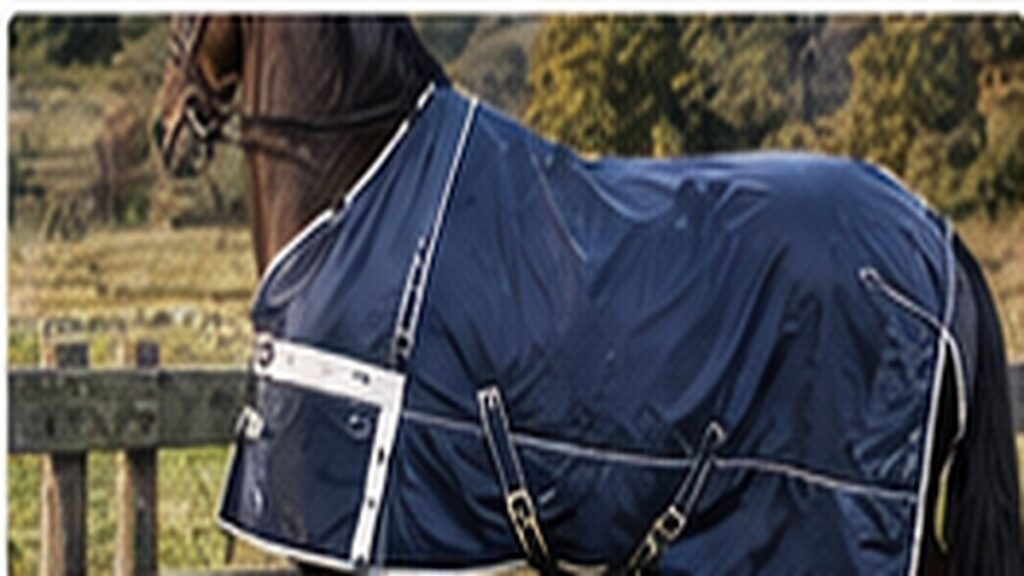
Why accurate rug measurement matters
A horse rug is not a simple rectangle that can be selected reliably from the horse’s height, breed or the size printed on an old rug. It is a shaped garment that must accommodate the chest, shoulder, withers, back, barrel, quarters and movement of an individual animal. A measurement is therefore a starting point for selecting a pattern, not a guarantee that every rug carrying the same nominal size will fit.
In Great Britain, most rugs are sold using an overall body-length measurement expressed in feet and inches, such as 5 ft 6 in or 6 ft 9 in. However, some European manufacturers use a back-seam measurement in centimetres. These systems are not interchangeable unless the manufacturer provides a conversion chart. Confusing them is one of the most common reasons for ordering the wrong size.
Fit has direct welfare implications. The British Horse Society advises that a rug should fit correctly and be removed daily so the horse can be checked for rubbing, soreness or discomfort. The current BHS guidance also recommends comparing the measurement with the individual manufacturer’s chart because sizing varies between brands and designs. An ill-fitting rug can cause hair loss, pressure, skin injury, restricted shoulder movement, slipping, entanglement or damage to the rug itself.
Measurement is also linked to the wider decision of whether a rug is required. The UK government’s welfare code states that not all horses need rugs, particularly hardy horses with thick winter coats, while clipped, elderly or less hardy animals may need protection in cold, wet weather. A correctly measured rug is still inappropriate if its weight, construction or use does not suit the horse and conditions.
The two rug-sizing systems used in the UK market
Body length or overall length
The common UK, United States and Australian method measures from the centre of the chest, around the shoulder and along the side of the horse to the rear of the quarters. The endpoint is usually described as the point of the buttock, the rear of the hind leg, the centre of the tail or a vertical line level with the top of the tail. In practical terms, it is the distance represented by the lower or outer length of the rug.
This is the measurement normally associated with sizes such as 5 ft 3 in, 6 ft 0 in or 7 ft 0 in. A rug described as 6 ft 6 in in the UK is generally not referring to the distance from the withers to the tail. It refers to the manufacturer’s defined body-length system.
Back-seam measurement
The European method usually measures from the highest point of the withers along the back to the top of the tail. It is commonly expressed in centimetres, for example 125 cm, 145 cm or 155 cm. This is a shorter anatomical line than the body-length measurement, so a 145 cm European rug should not automatically be treated as a 145 cm UK rug.
Although conversion tables are useful, they are approximate because the two measurements follow different routes and because rug patterns differ. A conversion table supplied by the brand making the rug takes priority over a generic chart.
| Term | Typical route | Common UK presentation | Main limitation |
|---|---|---|---|
| Body length | Centre of chest, around shoulder, to rear of quarters | Feet and inches | Can vary with the exact endpoint and pattern design |
| Overall length | Usually the same general system as body length | Feet and inches or inches | Manufacturer definitions may differ |
| Back seam | Highest point of withers to top of tail | Centimetres | Not a direct equivalent to UK body length |
What you need before measuring
- A soft, flexible tape measure long enough to follow the horse’s side. A dressmaking tape is suitable; a rigid builder’s tape is less useful.
- A calm horse standing squarely on level ground.
- An assistant, particularly for a large horse, young horse or animal unfamiliar with tape measures.
- A notebook or phone to record the measurement in centimetres and inches.
- The manufacturer’s current size chart for the specific rug, not merely a general chart found online.
Measure without a rug on the horse. The coat should be reasonably flat, but do not compress a thick winter coat aggressively. The horse should stand naturally rather than stretched forward or parked with one hind leg underneath the body. If the horse is changing condition, measure again before buying a costly seasonal rug or a large quantity of stock.
Take the measurement at least twice. If the results differ, check the starting point, the route over the shoulder and the endpoint. Record the actual result rather than rounding immediately to the nearest available size.
How to measure a horse for a UK-sized rug
- Position the horse safely. Stand the horse on level ground, ideally with its head in a neutral position. Do not wrap the tape tightly around the body.
- Find the starting point. Place one end of the tape at the centre of the chest, approximately where the front fastening of the rug will sit. This is not the point of the shoulder and not the bottom of the chest.
- Follow the shoulder contour. Carry the tape around the widest part of the shoulder. The tape should follow the route that the front edge of the rug must cover, rather than passing in a straight line across the front of the chest.
- Continue along the side. Run the tape along the side of the horse in a continuous line. Keep it smooth and reasonably level, without pulling it into the hollow of the flank.
- Identify the endpoint. Finish at the rear of the quarters, usually level with the top of the tail or the furthest point of the buttock, according to the manufacturer’s diagram. Do not extend the tape down the hind leg.
- Repeat and record. Take the measurement again, preferably from the other side or with the assistant checking the endpoint. Record the result in both inches and centimetres.
- Use the brand chart. Match the measurement to the chart for the exact rug, including whether it is a standard, high-wither, cob, pony, heavy-horse or extended-neck pattern.
Manufacturer diagrams do not all use exactly the same language. WeatherBeeta describes measuring from the centre of the chest around the body to the rear of the quarters. Horseware describes a route from the centre point of the chest over the high point of the shoulder to the centre of the tail. These descriptions are materially similar, but the published chart for the chosen product remains decisive.
How to measure for a European back-seam size
If a product is sold by back-seam length, place the tape at the highest point of the withers and follow the topline to the top or centre of the tail, depending on the manufacturer’s instructions. Keep the tape on the surface of the back rather than measuring through the air above it.
This measurement should not be substituted for the UK body-length measurement. If a retailer gives only a European size, look for the product’s conversion table or ask the retailer to confirm the equivalent UK size. A conversion based solely on a horse’s height is much less reliable than a measurement taken from the individual horse.
Back-seam sizing can be particularly confusing where a rug has a contoured back, a large gusset, a shaped tail flap or a generous drop. The label may describe the nominal seam rather than the maximum distance the rug covers. This is why the same nominal size can look different on two horses or fit differently across brands.
Why height, breed and existing rug size are only guides
Height is measured to the withers; rug length is measured around the shoulder and along the body. They describe different dimensions. Two horses of the same height may have very different back lengths, shoulder widths, barrel depths and quarter shapes. A compact cob may require a different pattern from a narrow, long-lined Thoroughbred of similar height.
Breed labels are also imperfect predictors. A horse may have a broad chest but a short back, a prominent wither but a deep barrel, or a large shoulder developed through work. Age, pregnancy, seasonal coat, weight change and muscle development can all alter how a rug sits without changing the horse’s height.
An old rug can be a useful reference only if it fits correctly and belongs to the same brand and pattern family. Measure the horse as well as the rug. A stretched, distorted or worn rug may no longer represent its original dimensions, and one manufacturer’s 6 ft 6 in may not correspond to another’s.
Measurement is not the same as fit
A rug can have the correct nominal length and still be unsuitable. After placing a new rug on the horse, assess the complete pattern before removing labels or using it outdoors. If a retailer’s returns policy permits, try it over a clean sheet and follow the stated conditions for returns.
Chest and shoulder
The front of the rug should sit smoothly without pulling backwards into the base of the neck or pressing into the windpipe. The chest fastenings should hold the rug securely but should not force the front seam into the point of the shoulder. When the horse lowers its head, walks and turns, the fabric should allow the shoulder to move without the rug cutting across it.
A front closure that is too tight may create pressure and restrict movement. One that is too loose can allow the rug to shift backwards, increasing pressure over the withers and causing the front edge to gape. Adjustable clips, buckles and cross surcingles provide some fine adjustment; they cannot transform a fundamentally unsuitable pattern into a correct fit.
Withers and topline
The rug should lie evenly over the withers without a hard seam or raised edge digging into them. High-wither, cut-back and shaped-neck designs may suit horses with prominent withers, whereas a low-withered, broad horse may need a different neckline. Check the fit with the horse standing and after movement, because a rug that appears acceptable in the stable may migrate when the horse rolls, grazes or walks.
Length and rear coverage
The rug should cover the body adequately without extending so far back that it interferes with the tail or hind legs. A turnout rug should provide useful protection to the quarters and tail area, but the back edge should not hang low and heavy over the hindquarters. If the rug repeatedly rotates to one side or exposes the shoulder, it is not being stabilised correctly by the pattern or adjustments.
Depth
Depth is the distance the rug drops down the sides of the horse. A correct length does not guarantee sufficient or appropriate depth. A deep-bodied horse may need a deeper cut, while a finer horse may be overwhelmed by a very generous drop. The rug should cover the trunk without obstructing the elbow, pressing into the armpit or hanging close to the ground.
Surcingles and leg straps
Cross surcingles should be secure but not tight enough to compress the belly or distort the rug. They should hang in the intended position and should not migrate into the elbow area. Leg straps should be adjusted according to the manufacturer’s instructions, with enough freedom for normal movement but not so much slack that a hoof can become caught. Some products use a single fillet string instead of leg straps; this still needs to be secure and correctly positioned.
The BHS fitting guidance used in its educational materials includes checks for rug depth, tail coverage, space at the neck and chest, belly clearance and leg-strap adjustment. These are practical inspection points rather than a universal measurement standard, so the product’s own instructions should also be followed.
How to tell whether a rug is too small
- The chest fastening is under constant tension even when correctly adjusted.
- The rug pulls backwards when the horse lowers its head or walks.
- The front edge cuts into the shoulder or restricts the horse’s stride.
- There are rubs at the point of shoulder, withers, chest or behind the elbow.
- The rug rides high over the quarters or leaves an inadequate area of the body covered.
- The cross surcingles or leg straps cannot be adjusted without distorting the rug.
- The fabric forms tight horizontal creases across the chest or shoulder.
A small rug is not made safe by loosening the chest straps. Doing so may reduce one pressure point while allowing the rug to slip backwards or sideways.
How to tell whether a rug is too large
- The neck opening falls away from the base of the neck or leaves excessive space at the chest.
- The rug slides backwards, rotates or bunches over the withers.
- The back edge hangs well beyond the intended rear coverage and interferes with the hindquarters.
- The rug’s weight pulls on the chest or creates folds behind the shoulder.
- There is excessive slack in the surcingles or leg straps after adjustment.
- The horse can step into loose straps or the rug moves significantly during ordinary activity.
Choosing the next size up is sometimes appropriate when a horse falls between sizes, particularly where the brand has a generous adjustable chest. It is not an automatic rule. A larger rug may solve inadequate rear coverage but create a loose neckline, excess depth or unsafe strap slack. Compare the horse’s proportions with the product pattern rather than applying a blanket “size up” instruction.
Different horses need different rug patterns
High-withered or narrow horses
These horses may need a cut-back front, shaped wither area or suitable neck design to prevent pressure and slipping. A rug that is broad and flat across the withers may bridge, move backwards or create rubbing.
Broad, cobby or heavy horses
A standard length may be correct while the chest, shoulder or depth is insufficient. Look for a pattern specifically made for broad horses, but verify the length independently. Extra width is not a substitute for correct rear coverage.
Long-backed horses
They may need a longer body measurement, but increasing the nominal size can also increase depth and neck circumference. A product with a longer cut but controlled depth may be more suitable than simply moving to the next size.
Growing, changing or pregnant horses
A young horse or a horse whose condition is changing may outgrow a previously correct rug. Frequent checks are more important than trying to purchase a size intended to last indefinitely. A rug that is acceptable in one season may become tight through the chest or shoulder as the horse develops.
Rug design factors that affect fit
Neck styles
Standard-neck, high-neck and detachable or fixed neck-cover designs distribute fabric differently over the withers and shoulders. A neck cover can improve weather protection but may rub the mane, press on the neck or contribute to overheating if unnecessary. It should be selected for the horse and intended use, not simply because it appears more protective.
Shoulder gussets and pleats
Gussets are intended to improve freedom of movement by allowing the rug to open over the shoulder as the horse walks. Their effectiveness depends on placement, fabric flexibility and the rest of the pattern. A gusset does not compensate for a tight chest or incorrect length.
Tail flaps and contours
Turnout rugs often include tail flaps to improve rain protection. The flap should sit over the tail without pulling the rug backwards. A shaped back seam can improve stability, but it also means that a generic tape measurement may predict fit less accurately than trying the actual design.
Fill, denier and waterproofing
Fit and thermal performance are separate decisions. Denier generally describes the linear density of fibres in a fabric and is used commercially as an indication of outer-fabric strength; it is not, by itself, a complete measure of durability or waterproofing. Fill describes the insulating material and is often marketed in grams, but the stated fill weight does not fully describe warmth because construction, loft, lining, moisture and the horse’s own coat also matter.
The BHS commonly groups light rugs as 0–100 g, medium rugs as 150–300 g and heavy rugs as 350 g or more. These categories are useful retail shorthand, not a universal performance standard. A well-fitting 0 g waterproof sheet may be appropriate for rain protection in some conditions, while a heavyweight rug can cause sweating and discomfort if used on an unclipped horse in mild weather.
Checking the rug after fitting
Walk the horse for a few minutes if it is safe to do so, allowing it to lower its head and turn. Observe whether the rug shifts, pulls at the chest, catches behind the elbow or exposes the withers. Check under the rug with a hand behind the withers: the horse should feel comfortably warm and dry, not hot, damp or sweaty. A single check is not enough; weather, exercise, coat condition and rug layering change the result.
Remove the rug daily when practicable and inspect the skin, coat and pressure areas. Pay particular attention to the withers, point of shoulder, front of chest, behind the elbows and along the spine. A rug that has caused hair breakage, tenderness, scurf, a wet patch from sweating or a persistent rub should be removed and reassessed rather than simply tightened or covered with another rug.
The government welfare code recommends having more than one rug available so that wet rugs can be removed and dried. Wet, dirty or damaged rugs can irritate the skin and may not provide the protection expected from them. Fastenings, stitching, waterproof coatings and straps should be checked regularly, especially after rolling or turnout with other horses.
Common measurement mistakes
- Measuring from the withers to the tail for a UK rug. This is usually the back-seam method, not the UK body-length method.
- Measuring in a straight line across the chest. The tape should follow the shoulder route used by the manufacturer.
- Using the horse’s height as the primary measurement. Height is only a broad guide.
- Measuring over an existing rug. This measures the garment, not the horse.
- Assuming all 6 ft 6 in rugs fit alike. Cut, depth, neckline, gusset position and adjustment range vary.
- Pulling the tape tight. This produces an artificially short result and does not represent the space required by the rug.
- Ignoring body condition and seasonal change. A horse’s proportions can change enough to alter fit.
- Checking only the back edge. A rug can be long enough while being too tight across the chest or too deep at the sides.
- Leaving the rug on continuously without inspection. Daily removal and checking are important safeguards against unnoticed rubbing and overheating.
A practical buying and fitting workflow
- Decide whether the horse needs a rug for the intended conditions and management system.
- Measure the horse using the method specified by the intended manufacturer.
- Record body length, back-seam length if relevant, approximate depth and any notable conformation features.
- Compare the result with the exact product chart, including any separate cob, pony, high-wither or heavy-horse range.
- Check the retailer’s exchange and return conditions before removing labels or using the rug.
- Fit the rug on a clean, dry horse and inspect chest, shoulder, withers, depth, rear coverage and straps.
- Walk and observe the horse where safe, then remove the rug and check the skin after initial use.
- Keep a written record of the brand, model, size and adjustments that work. This is useful for repeat purchases but should not replace reassessment when the horse or product changes.
Key points for trade professionals and manufacturers
Retailers should state clearly whether a chart refers to body length, overall length or back seam, and should show the measurement route in a diagram. A chart that lists only horse height is less useful and may encourage incorrect substitution across brands.
Manufacturers should define the start and end points, identify the units used, explain whether a measurement is taken over the horse or along a seam, and disclose meaningful pattern differences between ranges. Size increments should not be presented as if they were a universal industry standard. The same nominal size can produce different outcomes because of neckline shape, drop, gussets, closure geometry, fabric weight and adjustment range.
For professional fitting, the horse’s static measurement should be combined with an assessment of movement and pressure-prone areas. A rug is successful when it remains secure during normal behaviour without compromising freedom of movement, thermal comfort or skin condition.
Summary
For most UK rugs, measure from the centre of the chest, around the shoulder and along the side to the rear of the quarters. Record the result and match it to the exact manufacturer’s chart. Do not confuse this body-length measurement with the European back-seam measurement from the withers to the tail.
Then assess the actual fit. The rug should sit evenly, permit shoulder movement, cover the body appropriately, avoid pressure at the withers and chest, and have safely adjusted surcingles and leg straps. Height, breed and the size of an old rug are only secondary clues. Daily removal and inspection remain essential, because a correctly measured rug can still be unsuitable if its pattern, weight, condition or use does not match the individual horse.
Sources and further reading
- The British Horse Society: Types of rugs and rugging a horse — measurement, fit, thermal comfort, rug construction and daily checking guidance.
- DEFRA: Code of practice for the welfare of horses, ponies, donkeys and their hybrids — UK welfare guidance on rugging, inspection and drying wet rugs.
- World Horse Welfare: Rugging horses: when does your horse need a rug? — individual factors affecting rug need, weight and comfort.
- WeatherBeeta: How to measure your horse for a rug — manufacturer explanation of the UK body-length measurement.
- Horseware: Rug fitting and measuring guide — manufacturer guidance on chest-to-tail measurement and sizing limitations.
- The British Horse Society Stage 1 Care Syllabus — practical assessment points for rug fit, rubs, sores, straps and welfare.
- The British Horse Society: About the Horse Silver awards guidance — practical checks for depth, tail coverage, chest, belly and leg straps.
Research note
Automatically researched source pack — editorial review required:
• www.discount-equestrian.co.uk — https://www.discount-equestrian.co.uk/size-guide
• ponyo-horsewear.com — https://ponyo-horsewear.com/pages/rug-sizing-information
• www.onlineforequine.co.uk — https://www.onlineforequine.co.uk/blogs/blog/how-to-measure-a-horse-for-a-rug
• www.ruggles-horse-rugs.co.uk — https://www.ruggles-horse-rugs.co.uk/pages/measuring-guide
• www.tds-saddlers.com — https://www.tds-saddlers.com/information/rug-fitting-guide/
• www.ruggles-horse-rugs.co.uk — https://www.ruggles-horse-rugs.co.uk/pages/faqs
• bucasdirect.co.uk — https://bucasdirect.co.uk/pages/how-to-measure-your-horse-for-a-bucas-rug
• www.horse-supplies.co.uk — https://www.horse-supplies.co.uk/size-guides-fitting-advice-for-customers/
• www.weatherbeeta.co.uk — https://www.weatherbeeta.co.uk/measuring-your-horse-rug
• thebighorseshop.co.uk — https://thebighorseshop.co.uk/pages/horse-rug-size-guide-regular-fit
• www.elitesaddlery.co.uk — https://www.elitesaddlery.co.uk/app/uploads/2021/04/Premer-Equine-rug-size-guide-1.pdf
• www.houghtoncountry.co.uk — https://www.houghtoncountry.co.uk/gallop-equestrian-size-guides
• www.ruggles-horse-rugs.co.uk — https://www.ruggles-horse-rugs.co.uk/blogs/journal/how-to-measure-your-horse-pony-or-donkey-for-a-rug
• www.rugworks.co.uk — https://www.rugworks.co.uk/resources/Made%20to%20Measure%20Order%20Form.pdf
• upload.horseware.com — https://upload.horseware.com/transfer/brochure/aw19/rug/aw19_rugs_english.pdf
• img.cdn.mountainwarehouse.com — https://img.cdn.mountainwarehouse.com/marketplace/sellers/HarryHall/SizeGuide_HarryHall_20250623.pdf?maxheight=4000
• cdn.abicart.com — https://cdn.abicart.com/shop/7500/art67/185012967-45f46d-storleksguide_shires_hasttacken.pdf
• www.valleyvet.com — https://www.valleyvet.com/Library/lib_52977_-Size_Chart.pdf
• www.reddit.com — https://www.reddit.com/r/Horses/comments/qesi45
• www.reddit.com — https://www.reddit.com/r/Equestrian/comments/1no9lxe
Cite this article
Stable research ID: ERA-2026-000073
The Equestrian Research Atlas (2026) ‘How to Measure a Horse for a Rug’. The Equestrian Research Atlas. Available at: https://equestrianresearchatlas.co.uk/research/how-to-measure-a-horse-for-a-rug/ (Accessed: 3 November 2026).
The Equestrian Research Atlas. (2026). How to Measure a Horse for a Rug. The Equestrian Research Atlas. https://equestrianresearchatlas.co.uk/research/how-to-measure-a-horse-for-a-rug/
The Equestrian Research Atlas. “How to Measure a Horse for a Rug.” The Equestrian Research Atlas, 2026, https://equestrianresearchatlas.co.uk/research/how-to-measure-a-horse-for-a-rug/. Accessed 3 November 2026.
Research references (56)
- www.discount-equestrian.co.uk
- ponyo-horsewear.com
- www.onlineforequine.co.uk
- www.ruggles-horse-rugs.co.uk
- www.tds-saddlers.com
- www.ruggles-horse-rugs.co.uk
- bucasdirect.co.uk
- www.horse-supplies.co.uk
- www.weatherbeeta.co.uk
- thebighorseshop.co.uk
- www.elitesaddlery.co.uk
- www.houghtoncountry.co.uk
- www.ruggles-horse-rugs.co.uk
- www.rugworks.co.uk
- upload.horseware.com
- img.cdn.mountainwarehouse.com
- cdn.abicart.com
- www.valleyvet.com
- www.reddit.com
- www.reddit.com
- www.reddit.com
- www.reddit.com
- arxiv.org
- www.reddit.com
- en.wikipedia.org
- www.reddit.com
- www.reddit.com
- www.reddit.com
- www.reddit.com
- www.reddit.com
- www.reddit.com
- www.reddit.com
- arxiv.org
- en.wikipedia.org
- en.wikipedia.org
- en.wikipedia.org
- en.wikipedia.org
- arxiv.org
- en.wikipedia.org
- www.gov.uk
Related research
 Adjustability, Measurement Tolerance and Fit Range in Horse EquipmentContinue research →Common Equipment Fit ProblemsContinue research →Ergonomics in Equestrian EquipmentContinue research →
 Harness Sizing ExplainedContinue research →
 Saddle Fit TerminologyContinue research →
 Bridle Sizing ExplainedContinue research →