Technical fabrics have changed riding clothing from a choice between heavy natural fibres and basic waterproofs into a much more specialised field. Modern breeches, base layers, competition shirts, jackets, gilets, rain shells and protective garments may combine several fibres, yarn types, fabric structures, membranes, coatings and finishes. The result can be excellent comfort and performance, but the terminology used to describe it is not always consistent.
For riders, the important question is not whether a garment is labelled “technical”, “high performance” or “breathable”. It is whether its construction is appropriate to the activity, weather, level of exertion, contact with the horse and expected care routine. For manufacturers and retailers, the corresponding question is whether a claim can be defined, tested and supported.
This article considers technical fabrics used in riding clothing in the Great Britain market. It distinguishes fibre properties from fabric performance, and fabric performance from the performance of a finished garment.
What makes a fabric “technical”?
“Technical fabric” is an industry term rather than a single regulated category. It generally describes a textile engineered to provide one or more functional properties beyond basic covering, decoration or modesty. Typical objectives include:
- moving liquid sweat away from the skin;
- drying rapidly;
- providing stretch and recovery for a stable riding position;
- resisting wind and rain;
- retaining warmth while limiting bulk;
- withstanding abrasion from saddles, boots, tack and stable work;
- controlling odour, static, ultraviolet exposure or soiling;
- maintaining shape and appearance after repeated laundering.
These properties are produced by a system. Fibre choice matters, but so do yarn size, twist, knitting or weaving method, fabric weight, density, surface treatment, lamination, seams, garment pattern and fit. A polyester jersey, for example, may be cool and fast-drying in one construction but warm and insulating in another. “Polyester” alone does not describe the finished performance.
Fibres used in riding clothing
Polyester
Polyester is widely used in base layers, competition tops, mid-layers, fleece, soft shells and outer fabrics. It has relatively low moisture regain, meaning it does not absorb large quantities of water into the fibre itself. This can support rapid drying, particularly when the fabric is engineered to spread liquid across a large surface area. Polyester can also be produced with a wide range of cross-sections, yarn textures and finishes.
Its limitations include potential odour retention, pilling in some constructions, and sensitivity to high heat. A smooth polyester garment may feel clammy if sweat remains between the skin and fabric; a well-designed moisture-management knit may feel substantially different. Recycled polyester can have similar functional properties to virgin polyester, but “recycled” describes feedstock rather than automatically proving durability, low environmental impact or superior comfort.
Polyamide or nylon
Polyamide, commonly called nylon, is used where strength, abrasion resistance and a relatively soft hand are valuable. It appears in breeches, tights, outer shells, reinforcements and stretch fabrics. Nylon can be strong for its weight and can produce a smooth, comfortable surface, but it may absorb more moisture than polyester and can be more vulnerable to some forms of ultraviolet degradation or heat depending on the fibre and finish.
In riding clothing, polyamide is often blended with elastane. That combination can give a dense, supportive fabric suitable for breeches, provided the fabric retains recovery after repeated stretching, perspiration and washing.
Elastane
Elastane, also known as spandex or by the trade name Lycra in some contexts, provides substantial stretch and recovery. It is normally used as a minority component rather than the main fibre. Its contribution is important in close-fitting breeches, base layers, show shirts and riding tights, where the garment must accommodate hip, knee, ankle and shoulder movement without sagging.
Elastane is not a substitute for good pattern cutting. Excessive stretch can reduce support, distort pockets or cause seams to experience repeated stress. It is also susceptible to degradation from high temperatures, chlorine, some chemicals and prolonged exposure to ultraviolet light. Care instructions therefore matter more than the fibre percentage alone suggests.
Wool and other animal fibres
Wool remains relevant to technical riding garments, particularly base layers, socks, jumpers and insulating mid-layers. Its useful characteristics include moisture buffering, warmth across a range of conditions and reduced tendency to feel cold immediately when damp. Merino wool is commonly selected for next-to-skin garments because of its softness compared with many traditional wool types.
Wool can be slower to dry than a thin synthetic fabric, may require more careful laundering and can be damaged by abrasion or unsuitable agitation. It is not inherently waterproof. A wool garment can remain thermally comfortable in damp conditions, but that should not be confused with resistance to rain.
Other animal fibres may appear in luxury or specialist products. In Great Britain, textile labelling rules require fibre content to be stated, including relevant non-textile parts of animal origin. Manufacturers and retailers should ensure that fibre descriptions are accurate and correspond to the product actually placed on the market. UK Government textile labelling guidance.
Cotton and cellulosic fibres
Cotton is comfortable, familiar and absorbent, but it can hold substantial moisture and dry relatively slowly. It may be suitable for casual stable wear or low-intensity use, but a saturated cotton layer can become heavy and cold. Cotton is therefore less commonly used as the sole fibre in high-output base layers or wet-weather shells.
Cellulosic fibres such as lyocell, modal and viscose can provide a soft hand and useful moisture absorption. Their performance depends strongly on fibre type, blend and construction. They should not be categorised simply as “natural” or “synthetic” alternatives: those labels do not by themselves establish durability, drying rate or environmental impact.
Fibre, yarn and fabric: three different levels of performance
A fibre is the basic material. A yarn is made by assembling fibres or continuous filaments. A fabric is produced by knitting, weaving, bonding, laminating or otherwise constructing yarns and layers. Performance claims should identify the level being described.
For example, a fibre may be hydrophobic, but the finished fabric may still wet out because of its surface geometry, contamination, pressure or loss of a water-repellent finish. Similarly, a fabric may be described as breathable, although the garment’s waterproof coating, seam tape, pockets, closures and close fit restrict the movement of water vapour in actual use.
Knitted and woven structures
Knits
Knitted fabrics are formed from interlocking loops. They are common in base layers, competition shirts, fleece, jersey breeches and riding tights because they can provide stretch, softness and freedom of movement. Single jersey is light and flexible; interlock constructions are generally more stable and may feel smoother on both sides; rib structures can provide additional stretch and recovery.
Knits can snag or abrade more readily than dense woven fabrics, although construction and yarn choice are decisive. A tightly knitted, high-denier fabric may be highly durable, while a delicate fashion jersey may not be suitable for stable work.
Wovens
Woven fabrics interlace warp and weft yarns. They are often selected for breeches, jackets, riding coats and shells where dimensional stability, wind resistance and abrasion resistance are important. Plain weaves can be robust and stable; twill weaves may offer a distinctive surface and useful drape; ripstop constructions incorporate heavier reinforcement yarns to limit tear propagation.
Wovens generally offer less inherent stretch than knits unless elastane is incorporated or the fabric is cut on the bias. A two-way or four-way stretch label should therefore be interpreted alongside the actual composition and construction.
Stretch, recovery and fit
Stretch is the ability to extend under force. Recovery is the ability to return towards the original dimensions after the force is removed. Both are important in riding clothing. A garment that stretches easily but recovers poorly may become baggy at the seat, knees or waistband. A very compressive garment may restrict movement, create pressure points or increase discomfort during long periods in the saddle.
Fit is also a performance variable. A moisture-management fabric cannot perform as intended if it is so loose that sweat does not contact the fabric, or so tight that air movement and evaporation are severely restricted. In a waterproof shell, excess fabric may flap and wear against tack; insufficient ease may stress seams and closures.
For product development, useful evidence includes stretch and recovery measurements in more than one direction, seam performance, dimensional stability after laundering and wear trials on representative body shapes. A single fabric swatch test cannot fully predict garment behaviour.
Moisture management and “breathability”
Moisture management includes absorption, spreading, wicking, evaporation, drying and the movement of water vapour through a fabric. These are related but not identical properties.
- Absorption is the uptake of liquid by fibres or fabric spaces.
- Wicking is the movement of liquid, often along yarns or through capillary spaces.
- Drying rate describes how quickly moisture leaves the fabric under specified conditions.
- Water-vapour transmission concerns the passage of vapour through a textile or membrane.
- Breathability is an imprecise consumer term unless the test method and result are stated.
AATCC lists separate methods for liquid moisture management, vertical and horizontal wicking, drying rate and water-vapour transmission. This distinction is important: a fabric can wick liquid effectively but dry slowly in cool, humid air, or transmit vapour well while offering little resistance to external rain. AATCC textile test methods.
Riders also produce moisture through sweating at different rates depending on workload, temperature, humidity, riding skill, body composition and clothing layers. The humidity gradient between the warm, damp microclimate next to the skin and the surrounding air is central to evaporation. In high humidity, evaporation becomes less effective, even when the fabric itself is technically capable of transmitting vapour.
Water resistance, water repellency and waterproofing
These terms should not be treated as interchangeable.
- Water repellency usually describes how readily droplets bead and run from a surface.
- Water resistance describes resistance to water penetration under a defined test condition.
- Waterproofing is commonly used for a higher level of resistance, but its meaning depends on the product specification, test method and claimed end use.
A durable water-repellent finish, often abbreviated DWR, is normally applied to the outer face of a fabric. It reduces wetting and can help rain run off rather than spreading across the surface. It does not necessarily make the complete garment waterproof, because water can enter through seams, zips, cuffs, pockets, needle holes or damaged fabric.
AATCC TM22 is a spray test used to assess resistance to wetting. It is a screening method for surface repellency, not a complete simulation of prolonged heavy rain or a guarantee that a garment will remain dry. AATCC also lists separate methods for rain impact, hydrostatic pressure and water-vapour transmission. AATCC explanation of the spray test.
Hydrostatic testing applies water pressure to a fabric and measures penetration. It can be useful for comparing materials, but results depend on the method, specimen preparation, pressure increase, backing and interpretation. A high hydrostatic result on a flat fabric does not prove that a finished jacket will resist rain at the shoulders while a rider is leaning forward, or at the seat under pressure from a wet saddle.
Membranes, coatings and laminates
Waterproof-breathable shells commonly use one of three broad approaches:
- Coated fabrics: a polymer coating is applied to one side of the textile. Coatings may be continuous or microporous, and their properties vary considerably.
- Membranes: a separate film is bonded to the textile. The membrane may be microporous, hydrophilic or based on another transport mechanism.
- Laminates: two or more layers are bonded together, often with a face fabric, functional membrane and protective lining or print.
Construction affects handle, noise, durability, repairability and breathability. A three-layer shell may be more robust and less prone to liner movement than a two-layer construction, but it may also be stiffer or more expensive. A lightweight shell may pack small yet be less tolerant of repeated rubbing against tack, branches or stable surfaces.
Membranes do not actively pump sweat out of a garment. Vapour movement depends on temperature, humidity, pressure, garment design and the absence of liquid blockage. If the outer fabric wets out, the shell may feel less breathable even when the membrane remains intact, because the wet face fabric changes the moisture-transfer conditions.
Insulation and thermal regulation
Warmth in clothing is principally influenced by trapped air, fabric thickness, loft, wind resistance, moisture content and fit. Fleece fabrics create a raised surface that traps air; synthetic wadding uses lofted fibres; wool relies on fibre structure and air retention; quilted constructions hold insulation in defined zones.
Insulation performance can fall when material is compressed, saturated or contaminated. A gilet may be warm on the torso but leave the arms exposed; a close-fitting base layer may manage sweat but provide little insulation. Layering works because each layer can perform a different job:
- Base layer: manages contact moisture and provides next-to-skin comfort.
- Mid-layer: retains air and warmth.
- Outer layer: limits wind and precipitation.
These functions may be combined in one garment, but combining them can create compromises in weight, drying rate, flexibility and packability.
Durability in equestrian use
Riding clothing is exposed to an unusual combination of forces. Fabric may rub against the saddle, stirrup leathers, reins, stable doors, fences and grooming equipment. It may be contaminated with sweat, dust, hair, mud, grease, sunscreen and stable chemicals. Breeches experience repeated flexing and tension at the seat and knees. Jackets may be compressed by a safety garment or rubbed beneath a body protector.
Relevant quality indicators include fabric abrasion resistance, tear strength, seam strength, pilling resistance, colourfastness to perspiration and laundering, dimensional stability, elastane recovery and closure durability. No single figure predicts service life in every riding discipline. A fabric that performs well in a laboratory abrasion test may still fail at a poorly designed pocket or seam.
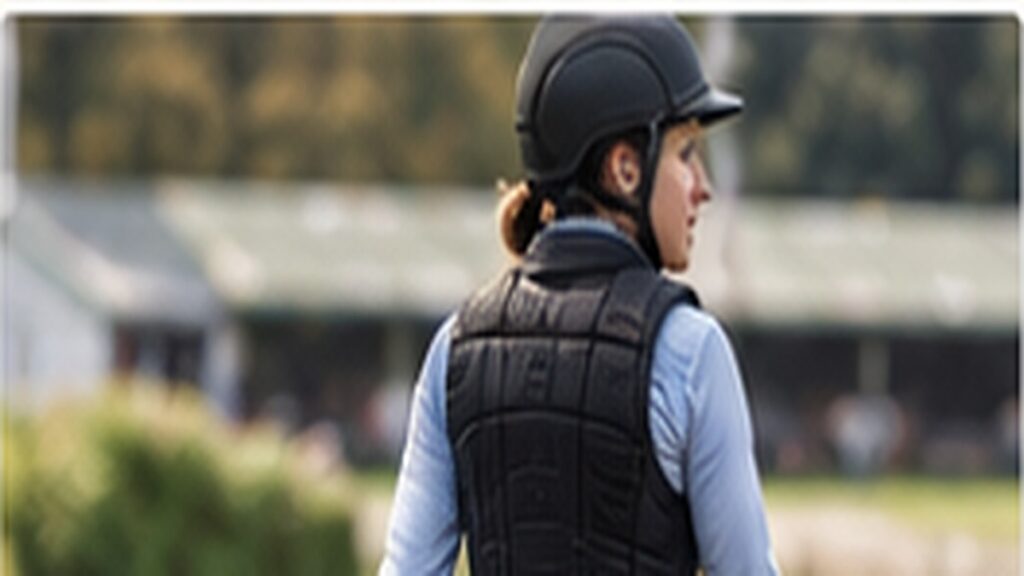
For riding garments used with safety equipment, bulk and compatibility matter. A bulky hood, stiff collar, heavy zip pull or poorly positioned seam may interfere with a helmet, body protector or air vest. Protective garments should be assessed against the relevant product-specific standard rather than assumed to be protective because the fabric is strong. ISO 13688 sets general requirements for protective clothing, including ergonomics, innocuousness, sizing, ageing, compatibility, marking and manufacturer information, but it is not a stand-alone protective-performance standard. ISO 13688:2013.
Finishes and treatments
Textile finishes can alter handle, wetting, friction, odour, static, ultraviolet response and resistance to stains. Examples include water-repellent finishes, softeners, anti-static treatments, antimicrobial treatments and durable-press finishes.
Finishes can diminish through laundering, abrasion, body oils, detergents and environmental exposure. A garment that was initially highly water-repellent may require reproofing or may eventually need replacement. Reproofing products should be used only as directed: an unsuitable treatment can affect wicking, breathability, stretch or colour.
“Antibacterial” and “odour control” claims require careful interpretation. Reduced odour in a test does not mean that a garment will remain odour-free during prolonged stable work. Some treatments may lose effectiveness over time, and some consumers may reasonably prefer laundering and ventilation over biocidal treatment. Claims should identify the tested effect, conditions and durability rather than imply permanent hygiene.
Care, laundering and maintenance
Care instructions are part of the technical specification. Washing at excessive temperature, using unsuitable detergents, applying fabric conditioner, tumble-drying at high heat or ironing a membrane can alter performance. Fabric conditioner may leave a surface deposit that affects absorbency or repellency. Residual detergent can also complicate assessment of water-repellent finishes after repeated washing; AATCC materials specifically discuss the importance of removing residual detergent when evaluating durable water repellency. AATCC water-absorbency and DWR testing information.
For riders, practical maintenance usually means:
- following the garment label rather than assuming all technical fabrics can be washed identically;
- closing zips and fasteners before washing;
- removing mud before it is ground into the fabric;
- avoiding unapproved softeners and harsh bleach;
- drying thoroughly before storage;
- checking seams, cuffs, elastic and closures regularly;
- reproofing only when the face fabric begins to wet out and the manufacturer permits it.
Repeated laundering can change dimensions, colour, surface smoothness and performance. A product that is technically impressive when new but difficult to clean is not necessarily a good choice for equestrian use.
Common misconceptions
“Natural fibres breathe; synthetics do not”
Breathability is not determined by natural or synthetic origin. Fibre chemistry, yarn, construction, finishes, thickness and humidity all matter. Wool, polyester, nylon and cellulosic fibres can each be engineered into fabrics with different moisture behaviours.
“Water-repellent means waterproof”
Beading on the face fabric is evidence of surface repellency, not proof that rain cannot pass through the garment. Waterproof performance depends on the whole construction, including seams and closures.
“More elastane means a better riding garment”
Additional elastane may increase stretch but can reduce stability, alter compression and increase sensitivity to heat or chemicals. The right balance depends on pattern, fabric weight, recovery and intended use.
“A high waterproof rating proves superior quality”
A test result is meaningful only with its method, units, specimen preparation and product context. A shell with a high laboratory water-pressure result may still have weak seams, poor breathability or inadequate abrasion resistance.
“Recycled fibre automatically means sustainable”
Recycled content is a specific material claim, not a complete environmental assessment. Fibre source, dyeing, finishing, manufacturing, transport, durability, repairability, washing and end-of-life all influence impact. UK Government guidance advises that environmental claims should be clear, specific and supported by evidence, including accurate percentages where relevant. UK Government guidance on environmental claims in fashion retail.
How to assess a technical riding garment
A useful assessment begins with the actual task rather than the marketing name.
- Define the use: schooling, competition, hacking, endurance, hunting, yard work, travel or all-weather turnout.
- Identify the exposure: rain, wind, cold, heat, sweat, mud, abrasion and repeated laundering.
- Examine the construction: fibre content, fabric type, stretch direction, lining, membrane or coating, seam finish and closures.
- Look for test information: waterproofing, water-vapour transmission, wicking, abrasion, colourfastness and dimensional stability should be tied to identifiable methods.
- Check compatibility: helmet, body protector, air vest, saddle, gloves, boots and other equipment may affect fit and wear.
- Read the care label: a technically advanced garment that cannot withstand the required maintenance routine may be unsuitable.
- Assess evidence: distinguish measured performance from vague terms such as “advanced”, “pro”, “smart” or “climate control”.
For trade professionals and manufacturers, a robust specification should state the intended end use, fabric composition, construction, target performance, test method, acceptance criteria, care process and foreseeable failure modes. Garment-level testing and field trials should complement fabric testing, especially where contact with tack, protective equipment and repeated seated movement is central to use.
Conclusion
Technical fabrics are best understood as engineered textile systems, not as a list of fashionable fibre names. Polyester, polyamide, wool, cotton, elastane and cellulosic fibres can all be useful when matched to the right construction and application. The most reliable decisions come from considering moisture, temperature, wind, rain, stretch, abrasion, fit, compatibility and care together.
For riders, the strongest indicator of quality is a coherent specification that explains what the garment is designed to do and under what conditions. For businesses, trustworthy product information means using precise fibre descriptions, identifying meaningful test methods, avoiding absolute claims and recognising the difference between a promising fabric swatch and a durable finished riding garment.
Related industry reference: For businesses moving from technical research into trade sourcing, explore equestrian suppliers and manufacturers on EquiGuild.
Sources and further reading
- UK Government: Textile labelling — fibre-content and animal-origin labelling guidance for Great Britain.
- The Textile Products (Labelling and Fibre Composition) Regulations 2012 — UK statutory background.
- AATCC: Standard Test Methods and Procedures — moisture management, wicking, drying, water resistance and vapour transmission methods.
- AATCC: The Art of Testing Water Repellency — explanation of spray testing and its purpose.
- AATCC: Water Absorbency Spray Rating Testing — durable water-repellent assessment and laundering considerations.
- ISO 13688:2013, Protective clothing — General requirements — general requirements for protective clothing and manufacturer information.
- UK Government: Complying with consumer law when making environmental claims in fashion retail — substantiation and clarity of environmental textile claims.
Research note
Automatically researched source pack — editorial review required:
• www.gov.uk — https://www.gov.uk/guidance/textile-labelling
• www.aatcc.org — https://www.aatcc.org/news-read/insights/the-art-of-testing-water-repellency
• www.aatcc.org — https://www.aatcc.org/testing/standards
• www.iso.org — https://www.iso.org/standard/51449.html
• www.aatcc.org — https://www.aatcc.org/wp-content/uploads/2021/01/Sample_Issue_AATCC_REVIEW.pdf
• www.aatcc.org — https://www.aatcc.org/wp-content/uploads/2020/10/Water-Absorbency-Spray-Rating.pdf
• www.legislation.gov.uk — https://www.legislation.gov.uk/uksi/2012/1102/pdfs/uksiod_20121102_en.pdf
• www.aatcc.org — https://www.aatcc.org/news-read/insights/the-resurgence-of-water-repellency-testing
• www.gov.uk — https://www.gov.uk/government/publications/complying-with-consumer-law-when-making-environmental-claims-in-the-fashion-retail-sector/complying-with-consumer-law-when-making-environmental-claims-in-the-fashion-retail-sector
• www.aatcc.org — https://www.aatcc.org/wp-content/uploads/2020/01/September17-AATCCrev.pdf
• www.aatcc.org — https://www.aatcc.org/news-read/insights/visit-the-aatcc-textile-test-zone-this-fall
• www.aatcc.org — https://www.aatcc.org/wp-content/uploads/2022/12/MHF22-1.pdf
• www.aatcc.org — https://www.aatcc.org/about/history
• www.gov.uk — https://www.gov.uk/government/publications/nutrient-profiling-model-2018/nutrient-profiling-model-2018-technical-guidance
• www.gov.uk — https://www.gov.uk/guidance/food-standards-labelling-durability-and-composition
• www.gov.uk — https://www.gov.uk/guidance/food-labelling-giving-food-information-to-consumers
• www.hse.gov.uk — https://www.hse.gov.uk/textiles/fabric-finishes.htm
Cite this article
Stable research ID: ERA-2026-000052
The Equestrian Research Atlas (2026) ‘Technical Fabrics in Riding Clothing’. The Equestrian Research Atlas. Available at: https://equestrianresearchatlas.co.uk/research/technical-fabrics-in-riding-clothing/ (Accessed: 26 September 2026).
The Equestrian Research Atlas. (2026). Technical Fabrics in Riding Clothing. The Equestrian Research Atlas. https://equestrianresearchatlas.co.uk/research/technical-fabrics-in-riding-clothing/
The Equestrian Research Atlas. “Technical Fabrics in Riding Clothing.” The Equestrian Research Atlas, 2026, https://equestrianresearchatlas.co.uk/research/technical-fabrics-in-riding-clothing/. Accessed 26 September 2026.