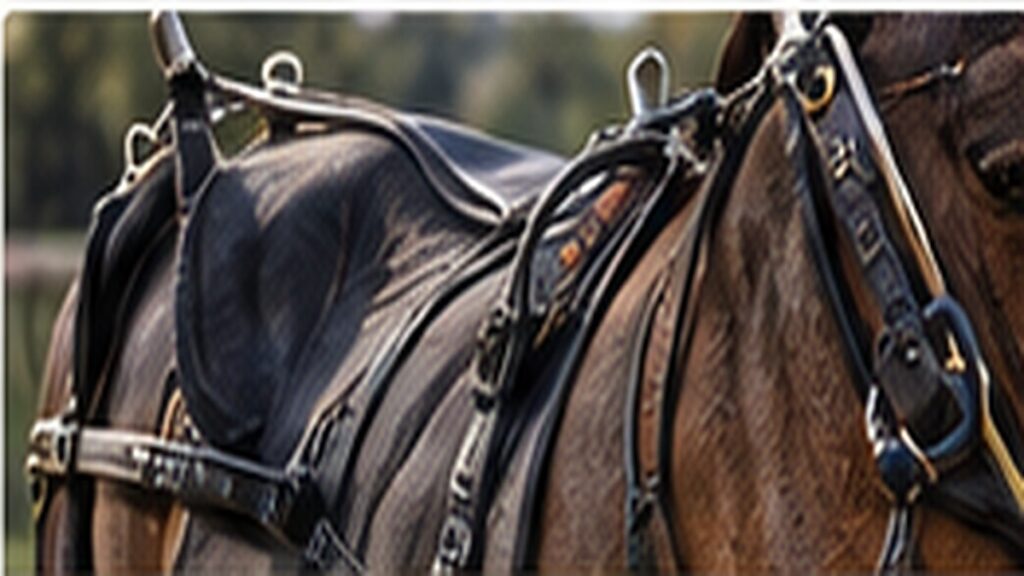
What driving harness is designed to do
Driving harness is the equipment system that connects a horse to a carriage, cart or other drawn load while allowing the driver to control the horse and, where necessary, help regulate the movement of the vehicle. Unlike riding tack, it does not primarily carry a rider. Its central engineering problem is the transfer of force: the horse must pull through a suitable part of its body, the carriage must remain aligned behind the horse, and the system must permit turning, stopping and independent movement without creating damaging pressure.
A complete turnout may include a bridle and bit, reins, collar or breastcollar, hames where applicable, traces, saddle or back pad, bellyband, crupper, breeching, shaft tugs, terrets, false martingale, neck strap, pole straps, breastplate, kicking strap and a range of buckles, rings and fittings. Not every harness contains every component. The correct arrangement depends on the horse, vehicle, load, terrain, speed, braking system and whether the harness is intended for show, pleasure driving, commercial work, heavy horse use, racing or competition.
The historical development of harness is therefore not a simple progression from “primitive” to “modern”. Different systems remain useful for different jobs. A light breastcollar harness may be entirely appropriate for a small, well-braked carriage, while a properly fitted full collar and hames system remains advantageous for heavy draught work. Modern practice is best understood as a collection of solutions to different traction and control problems.
Early traction systems and the problem of the neck
The earliest harnesses used with wheeled vehicles and loads appear to have relied on arrangements of neck straps, girths, yokes and ropes. Evidence from ancient art and experimental reconstruction is incomplete, and the chronology is more complicated than older accounts suggested. Some traditional histories presented the ancient world as using one universally inefficient “throat-and-girth” harness, followed by a sudden medieval invention of the efficient collar. Archaeological and iconographic research has challenged that simplified model: ancient societies used several harnessing arrangements, and some elements associated with modern harness—including traces and forms of whippletree—may have existed much earlier than once assumed.
The fundamental weakness of a poorly designed neck harness is mechanical as well as anatomical. If the line of pull bears across the windpipe or at the base of the neck, increasing resistance from the load can interfere with breathing and concentrate pressure on tissues poorly suited to sustained traction. The historical importance of later designs was not simply that they were stronger; it was that they moved the principal load-bearing contact toward the chest and shoulders.
Research associated with the study of early harness systems identifies two important developments: the breast-strap or breastcollar system, in which traction is taken through a horizontal element across the chest, and the collar system, in which a shaped padded collar bears around the base of the neck and against the shoulders. Both removed the main bearing point from the throat. The chronology remains debated, particularly for early examples, but breast-strap harness is generally associated with transmission into Europe during the early medieval period, while the padded collar became predominant in western Europe by the twelfth and thirteenth centuries. These broad dates should not be treated as evidence that one design instantly replaced another across all regions.
Breastcollar and breast-strap harness
In a breastcollar harness, the horse pulls through a broad strap or padded breastplate positioned across the chest. Traces lead from the breastcollar to the vehicle or to a swingletree. The harness is comparatively light, visually open and relatively straightforward to adjust. It is common in light driving, pleasure driving, some competition disciplines and many small-pony turnouts.
The main advantage is flexibility. A breastcollar can suit a range of horses and vehicles without the expense or fitting complexity of a made-to-measure full collar. It also avoids the need for hames. Its limitations arise when the vehicle is heavy, poorly balanced, insufficiently braked or used on steep ground. The available bearing surface is smaller than that of a well-fitted collar, and the position of the breastcollar is critical. Too high, it can interfere with the lower neck and windpipe; too low, it may restrict the shoulders or ride down onto soft tissue. The breastcollar must remain stable without being tightened as though it were a girth.
Historical and technical descriptions sometimes use “breast-strap”, “breastcollar”, “breastplate” and “breast harness” inconsistently. In practical British driving terminology, a breastcollar normally means the load-bearing padded or leather component connected to the traces. A breastplate may refer to a lighter stabilising or decorative component, although terminology varies between makers and disciplines. The function—not the label—should be established when assessing a harness.
The rise of the collar and hames
The full collar was a major development because it distributed traction around a larger area of the horse’s shoulders and upper chest. A collar is not merely a thick strap placed around the neck. It is a shaped, often moulded and padded structure whose internal form must match the horse. Its lower opening, length, width and angle determine whether the horse can move and breathe freely while pulling.
Traditional collars were made from leather stuffed or padded with materials such as straw, hair or later synthetic fillings. The finished collar was shaped to the individual horse and could become a highly specialised item of saddlery. Heavy horse collars were often robust, thick and closely associated with agricultural and commercial work, while lighter collars could be made for coach horses and fine harness.
Hames are the paired rigid members fitted over the outside of a collar. They carry the trace attachments and help transmit the pulling force from the collar to the vehicle. Hames may be made from wood, steel or combinations of materials, with a hame strap or other fastening at the top and a lower connection. The collar bears against the horse; the hames provide the structural framework for the traces. A hame collar is therefore a system of collar, hames and traces rather than three unrelated items.
A well-fitted collar allows the horse to push into the collar with the shoulders while keeping the line of traction stable. A collar that is too short can press into the throat and shoulders; one that is too long may move excessively and fail to support the hames correctly. A collar that is too narrow can pinch the neck and shoulder region, while an excessively wide collar can move laterally and create rubbing. Traditional harness makers often regard collar fitting as a specialist skill because small differences in shape can have large effects once the horse is working.
Traces, swingletrees and the transmission of pull
Traces are the principal longitudinal elements that connect the horse’s load-bearing harness to the vehicle. In a single turnout they normally run from the breastcollar or hames to the carriage’s trace hooks, swingletree or other attachment point. In a pair or team, trace arrangements become more complex and may involve pole straps, neck yokes, leader traces and couplings.
The swingletree, or whiffletree in some terminology, is a pivoting bar that allows the traces to move with the horse’s stride and reduces unequal rubbing or jerking. Without some provision for independent movement, a rigid connection can cause one trace to tighten more than the other as the horse turns or works unevenly. In multiple-horse work, swingletrees and whippletrees also help divide the load between horses.
Trace length is not simply a matter of appearance. It affects the distance between horse and vehicle, turning clearance, shaft position and the action of breeching. Traces that are too short can restrict movement and pull the vehicle into the horse; those that are too long may allow the carriage to run forward excessively during braking or create unsafe slack. The correct length depends on the vehicle, shaft or pole geometry and the horse’s size.
Stability: saddle, bellyband, crupper and breeching
The driving saddle, sometimes called the back pad in light harness, does not function like a riding saddle. It supports the shaft tugs, terrets and other upper harness components, and helps keep the traces and shafts in the correct relationship to the horse. It should distribute pressure over an appropriate area without bearing heavily on the withers or spine.
The bellyband secures the saddle and helps retain the harness beneath the horse. It must be firm enough to prevent movement but not tightened unnecessarily. A common misconception is that a driving saddle should be fastened as tightly as a riding girth. In practice, excessive tightness can create discomfort and restrict breathing or movement, while insufficient security allows the harness to shift.
The crupper is a loop that passes beneath the tail and connects to the saddle. Its purpose is to prevent the saddle from moving forward, especially on a downhill gradient or when the carriage pushes against the harness. It should sit smoothly in the tail dock without twisting or being used to compensate for an incorrectly positioned saddle. A crupper that is too tight can cause rubbing and resistance; one that is too loose may fail to perform its stabilising function.
Breeching is the part of the harness that allows the horse to help slow or hold back the carriage. It generally encircles the quarters and connects through breeching straps to the shafts or vehicle. When the horse slows, the vehicle moves forward against the breeching rather than relying entirely on the traces or the horse’s mouth. This is particularly important with two-wheeled vehicles, downhill work and vehicles without effective brakes.
Not every turnout requires breeching in the same form. Light vehicles with efficient brakes, correct balance and appropriate use may use a different arrangement, while heavy vehicles and traditional carriages often depend heavily on breeching. Omitting breeching is not automatically unsafe, but it removes one important method of controlling vehicle movement and must be considered alongside vehicle design, terrain and driving competence.
Bridles, bits, reins and the development of control
The driving bridle evolved from the need to provide reliable steering and stopping while keeping the reins clear of the vehicle and other harness components. Driving bridles commonly incorporate blinkers or winkers, a throatlash, cheekpieces, browband, noseband and terrets or rein guides. Blinkers were historically associated with preventing the horse from being distracted by the vehicle and the movement behind it, although not every driving tradition uses them in the same way.
Driving bits range from simple snaffle patterns to more specialised curb and Liverpool-style bits. The appropriate bit is determined by the horse’s training, mouth conformation, the vehicle, the driver’s hands and the required level of control—not by fashion or the assumption that a stronger-looking bit is automatically safer. A bit cannot compensate for poor harness fit, inadequate vehicle brakes or insufficient driving skill.
Reins are usually longer and handled differently from riding reins. They pass through terrets on the saddle and may be arranged for a single horse, pair or team. The rein system must permit clear, independent communication with each horse where necessary and must not catch on buckles, hame fittings or other hardware. The history of driving includes considerable regional and professional variation in rein handling, team arrangement and the use of special rein systems.
Harness during the carriage age
From the seventeenth to nineteenth centuries, the growth of private carriages, public transport, postal services, agriculture and commercial haulage created a wide range of specialised harness. A coach-and-four turnout required different equipment from a farm wagon, a mail coach, a gig, a phaeton, a landau or a tradesman’s cart. Harness became both technical equipment and visible evidence of occupation, status and regional style.
Fine harness developed elaborate polished leatherwork, brass or plated fittings, decorative rosettes, false martingales and carefully matched vehicle appointments. Commercial and agricultural harness prioritised durability, repairability and load-bearing strength. Military harness developed around standardisation, team movement and field repair. Racing harness, particularly for trotting, evolved toward reduced weight and specialised attachment to lightweight sulkies.
The nineteenth century also encouraged greater specialisation among harness makers. Leather selection, skiving, edging, stitching, riveting, moulding and metalwork were distinct skills. A quality harness was not defined by leather thickness alone. Fibre direction, temper, finishing, reinforcement placement, stitch quality and the interaction between leather and metal fittings were equally important.
The decline of horse-drawn transport in the twentieth century did not eliminate harness making. Instead, the craft moved increasingly into preservation, heavy horse work, leisure driving, competition, racing, ceremonial use and bespoke manufacture. Museums and working collections now preserve evidence of the relationship between vehicle development and harness design, while modern carriage driving maintains many traditional forms in active use.
Materials and construction
Leather
Vegetable-tanned leather has traditionally been valued for harness because it can be shaped, edged, stitched and repaired. Good harness leather should have consistent substance, adequate tensile strength and a finish appropriate to its location. Flexible leather is useful for straps that must bend repeatedly; firmer leather is needed where shape retention or load distribution matters. “Thick” is not synonymous with “strong”: a poorly selected or damaged heavy strap may be less reliable than a correctly specified lighter one.
Stitching is generally preferred over relying solely on rivets in many load-bearing areas because stitching can distribute stress and is repairable. Rivets, buckles and keepers remain important, particularly at points requiring adjustment or high local strength. The edge treatment matters because rough or cracked edges can damage adjacent straps and increase skin abrasion.
Synthetic materials
Nylon, polyester, beta-style materials, synthetic leather and coated webbing are now common in driving harness. They can reduce weight, resist moisture and simplify cleaning. They may also be useful where consistent dimensions and colourfastness are important. However, synthetic materials vary widely in construction and quality. Resistance to water does not guarantee resistance to ultraviolet degradation, heat, abrasion or fatigue. Some coated materials can conceal internal deterioration, making close inspection essential.
Metal fittings
Steel, stainless steel, brass, alloy and plated fittings are used for buckles, rings, terrets, hames, trace hooks and rein guides. Fittings should be appropriate to the load and free from cracks, deformation, sharp edges and serious corrosion. Decorative plating is not evidence of structural capacity. Particular attention is needed where a ring or buckle is sewn or riveted into leather, because the junction between flexible and rigid materials is often a fatigue point.
Modern competition and specialist development
Modern driving includes pleasure driving, private driving, traditional turnout, combined driving, para-driving, heavy horse work, harness racing and commercial passenger operations. Each has influenced harness design.
Competition has encouraged lighter materials, precise adjustment, standardised presentation and vehicle-specific arrangements. Marathon and obstacle phases place high demands on turning clearance, breeching security, trace alignment and rapid inspection. Traditional driving places greater emphasis on historical correctness and the relationship between harness, vehicle and period turnout. Harness racing has pursued low weight, low aerodynamic resistance and rapid hitching systems; these solutions should not be transferred automatically to road or heavy carriage work.
Manufacturers now offer harness with synthetic alternatives to leather, stainless fittings, shaped breastcollars, modular breeching, quick-adjust buckles and vehicle-specific shaft or pole arrangements. These are useful developments when they solve a real fitting, maintenance or performance problem. They are not inherently superior simply because they are newer. A modern harness should still be assessed by load path, fit, adjustability, durability, inspectability and compatibility with the carriage.
Selection and quality assessment
Selection should begin with the complete system rather than the harness in isolation. Consider:
- the horse’s size, conformation, shoulder movement and sensitivity;
- the carriage’s weight, balance, shaft or pole arrangement and braking system;
- whether the work is light, heavy, recreational, competitive or commercial;
- the terrain, gradients, road surfaces and expected weather;
- whether the harness must accommodate one horse, a pair or a team;
- the available adjustment range and whether specialist fitting is required;
- the material’s resistance to moisture, abrasion, ultraviolet exposure and repeated flexing;
- the availability of replacement parts and competent repair;
- the driver’s experience and the operating procedures used by the business or yard.
Quality indicators include clean stitching, correctly finished edges, sound holes, smooth buckle tongues, properly seated rivets, aligned rings, flexible but not spongy leather, secure trace attachments and hardware without sharp projections. On synthetic harness, inspect webbing for fraying, glazing, cuts, distortion and loss of flexibility. Examine the areas hidden beneath keepers, pads and folded straps; deterioration often begins where moisture and dirt are trapped.
Harness should be fitted with the horse standing square and then checked again after movement. The horse’s shoulder action, breathing, turning, backing and transitions can reveal problems not visible when standing still. Fit should be judged in relation to the vehicle, because shaft height, trace length and breeching geometry alter the loads through the system.
Common misconceptions
- “A tighter harness is safer.” Excessive tightening can create pressure, restrict movement and increase rubbing. Security comes from correct design and adjustment, not maximum tension.
- “A collar is always better than a breastcollar.” A collar may distribute heavy traction well, but it requires accurate fitting and is not automatically suitable for every horse or vehicle.
- “Breeching is decorative.” It is a functional braking and holding-back component, particularly important where the vehicle can run forward against the horse.
- “Synthetic harness needs no maintenance.” It may require less conditioning than leather, but it still needs cleaning, inspection and replacement when fibres, coatings or fittings deteriorate.
- “Polished brass proves quality.” Appearance says little about the strength of stitching, leather selection, fitting accuracy or structural load path.
- “A stronger bit solves a control problem.” Control depends on training, driving technique, vehicle condition, harness fit and appropriate braking as well as the bit.
Safety, inspection and present-day practice in Great Britain
The UK Government’s Code of Practice for Horse-Drawn Vehicles recommends that harness is properly fitted, appropriate for its use and regularly checked for soundness and safety. Its road-driving assessment treats harness selection and fitting, safe hitching, vehicle checks and the health and security of horse, driver and others as connected responsibilities. The code is especially relevant to passenger-carrying operations, although its principles are useful more broadly.
British Carriagedriving rules and assessment materials likewise connect harness fit with vehicle adjustment, trace length, breeching, shaft height and the distance between horse and vehicle. This reflects an important principle: harness cannot be assessed independently of the carriage. A sound breastcollar attached to an unsuitable vehicle may still produce unsafe forces, just as a well-made carriage cannot compensate for a failing trace or badly fitted breeching.
Inspection should occur before every use and include all load-bearing straps, stitching, buckles, rings, trace attachments, hames, breeching, crupper, shaft tugs, terrets and rein components. Particular care is needed after storage, wet weather, prolonged non-use or contact with chemicals. Leather should be clean and appropriately maintained without becoming saturated with dressing; synthetic materials should be cleaned according to the maker’s instructions. Any component showing cracking, deep cuts, serious stretching, broken stitching, deformation or uncertain history should be withdrawn until assessed by a competent harness maker.
For commercial or public-road work, the harness inspection forms only one part of a wider risk-control system. The vehicle, brakes, shafts, wheels, fittings, driver competence, horse suitability, road conditions and emergency procedures must all be considered. The Highway Code also requires other road users to pass horse-drawn vehicles slowly and with adequate space, but that protection does not replace the driver’s responsibility to use a suitable, correctly maintained turnout.
Why the history still matters
The development of driving harness demonstrates that successful design is a balance between force, movement and welfare. The transition away from throat-loading systems improved the horse’s ability to breathe and apply traction. The collar and hames system enabled heavier work by distributing load over a larger area. Breastcollars provided a lighter and more adaptable alternative. Breeching introduced a means of controlling vehicle movement through the quarters, while increasingly sophisticated bridles, rein systems and fittings improved communication and stability.
Modern users inherit all of these solutions. The challenge is not to select the newest or most traditional harness on principle, but to understand what each component is doing and whether it is appropriate to the complete horse-and-vehicle combination. Historical knowledge helps explain terminology; mechanical understanding helps identify load paths; practical fitting and inspection determine whether the equipment is safe to use.
Sources and further reading
- UK Government, Code of Practice for Horse-Drawn Vehicles — guidance on harness fitting, vehicle checks, road driving competence and safety.
- UK Government, The Highway Code: Horse riders and horse-drawn vehicles — current road-user guidance relevant to British driving.
- University of Birmingham thesis, development of modern harness — discussion of early harness systems, breast-strap harness and the emergence of the collar in western Europe.
- Jean Spruytte, Early Harness Systems: Experimental Studies — experimental and comparative study of ancient and early traction systems.
- Andres Furger, Driving: the Horse, the Man and the Carriage from 1700 up to the Present Day — history of carriage driving, harness styles and vehicle development.
- Encyclopaedia Britannica, “Saddlery and Harness”, 1911 — historical description of collars, hames, traces, breast harness and saddle pads.
- British Carriagedriving, Technical Rules — current competition provisions affecting harness, safety and vehicle operation.
- National Trust, History of Carriages at Arlington Court — context for the development of carriage types and the working environment in which specialist harness evolved.
Research note
Automatically researched source pack — editorial review required:
• www.rijksmuseum.nl — https://www.rijksmuseum.nl/en/collection/publication/Driving-the-horse-the-man-and-the-carriage-from-1700-up-to-the-present-day--878ab571ad9aad96daa249448875d0ec
• en.wikisource.org — https://en.wikisource.org/wiki/1911_Encyclop%C3%A6dia_Britannica/Saddlery_and_Harness
• etheses.bham.ac.uk — https://etheses.bham.ac.uk/id/eprint/14029/1/Langdon1983PhD.pdf
• www.nma.gov.au — https://www.nma.gov.au/explore/collection/highlights/willsallen-sulky-collection
• harnessmuseum.com — https://harnessmuseum.com/content/dr-gordon-gilbertson
• www.researchgate.net — https://www.researchgate.net/publication/316437411_Developments_in_Harnessing_and_Draught_in_the_Roman_World_Equid_harnessing_and_draught
• en.wikipedia.org — https://en.wikipedia.org/wiki/Horse_collar
• www.nationaltrust.org.uk — https://www.nationaltrust.org.uk/visit/devon/arlington-court-and-the-national-trust-carriage-museum/a-timeline-of-carriages-at-the-national-trust-carriage-museum
• books.google.com — https://books.google.com/books/about/Early_Harness_Systems.html?hl=en&id=nNLYAAAAMAAJ
• scholarworks.umb.edu — https://scholarworks.umb.edu/masters_theses/283/
• www.gov.uk — https://www.gov.uk/government/publications/code-of-practice-for-horse-drawn-vehicles/code-of-practice-for-horse-drawn-vehicles
• en.wikipedia.org — https://en.wikipedia.org/wiki/Horse_harness
• en.wikipedia.org — https://en.wikipedia.org/wiki/History_of_horse-drawn_transport
• sova.si.edu — https://sova.si.edu/record/nmah.ac.1226
• pahar.in — https://pahar.in/pahar/Journals/Royal%20Central%20Asian%20Society%20Journal%201904-1962/1949%20Journal%20of%20the%20Royal%20Central%20Asian%20Society%20Vol%2036%20s.pdf
• www.britishcarriagedriving.co.uk — https://www.britishcarriagedriving.co.uk/Website%20documents/Assessment/introductory_safety_competence_assessment_for_club_para_drivers.pdf
• www.museum.ie — https://www.museum.ie/getmedia/1edbb612-26c7-4187-93c2-a88ce6fc7276/Horse-Collar.pdf
• en.wikipedia.org — https://en.wikipedia.org/wiki/Horses_in_the_Middle_Ages
• democracy.stratford.gov.uk — https://democracy.stratford.gov.uk/documents/s16636/Horse%2520Drawn%2520Omnibus%2520Appendix%25202.pdf
• en.wikipedia.org — https://en.wikipedia.org/wiki/Driving_%28horse%29
Cite this article
Stable research ID: ERA-2026-000083
The Equestrian Research Atlas (2026) ‘Development of Driving Harness’. The Equestrian Research Atlas. Available at: https://equestrianresearchatlas.co.uk/research/development-of-driving-harness/ (Accessed: 3 November 2026).
The Equestrian Research Atlas. (2026). Development of Driving Harness. The Equestrian Research Atlas. https://equestrianresearchatlas.co.uk/research/development-of-driving-harness/
The Equestrian Research Atlas. “Development of Driving Harness.” The Equestrian Research Atlas, 2026, https://equestrianresearchatlas.co.uk/research/development-of-driving-harness/. Accessed 3 November 2026.
Research references (51)
- www.rijksmuseum.nl
- en.wikisource.org
- etheses.bham.ac.uk
- www.nma.gov.au
- harnessmuseum.com
- www.researchgate.net
- en.wikipedia.org
- www.nationaltrust.org.uk
- books.google.com
- scholarworks.umb.edu
- www.gov.uk
- en.wikipedia.org
- en.wikipedia.org
- sova.si.edu
- pahar.in
- www.britishcarriagedriving.co.uk
- www.museum.ie
- en.wikipedia.org
- democracy.stratford.gov.uk
- en.wikipedia.org
- en.wikipedia.org
- www.animaltraction.net
- www.reddit.com
- www.reddit.com
- www.reddit.com
- www.reddit.com
- www.reddit.com
- www.countrylife.co.uk
- www.reddit.com
- www.reddit.com
- www.reddit.com
- www.reddit.com
- www.reddit.com
- www.reddit.com
- www.reddit.com
- arxiv.org
- www.northdevon.gov.uk
- www.gov.uk
- www.gov.uk
- assets.publishing.service.gov.uk