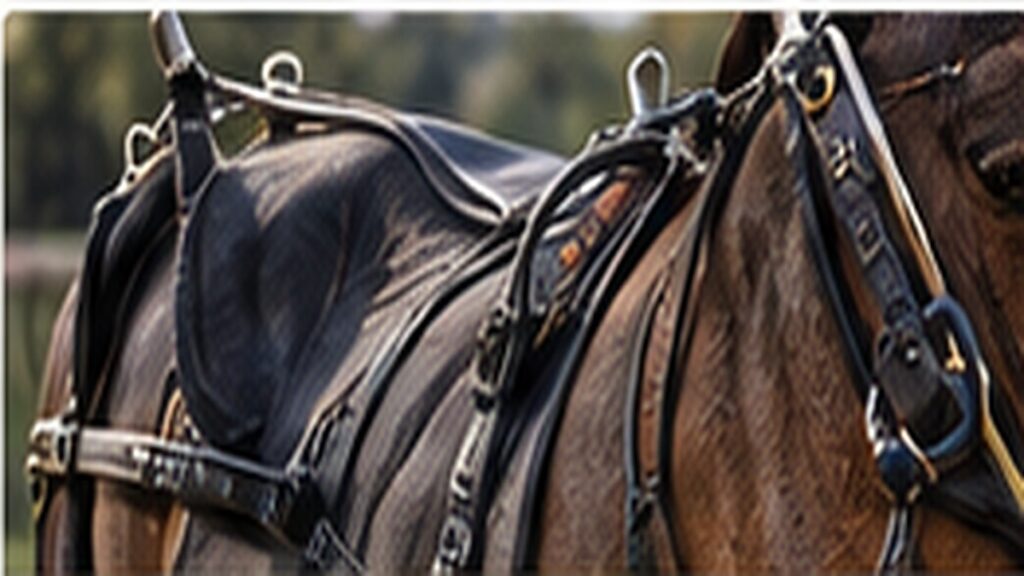
A driving harness is a coordinated system of leatherwork, metal fittings and carriage connections that allows a horse to pull, slow and steer a vehicle. It must distribute traction through suitable areas of the horse’s body, prevent the harness from shifting, transmit the driver’s rein aids and remain secure during acceleration, turning, stopping and uneven ground.
The correct term in British usage is usually putting to: the horse is put to the carriage. In North American usage, hitching is also common. The basic anatomy is similar across pleasure driving, private driving, commercial work, traditional turnout and competition, but the proportions, materials and auxiliary equipment vary considerably.
A harness should therefore be assessed as a system. A strong breastcollar does not compensate for weak traces; a correctly adjusted saddle does not make an unsuitable breeching safe; and an attractive set of leatherwork may still be inappropriate for the carriage, load, terrain or horse.
The principal functions of a driving harness
- Traction: traces transmit the horse’s pulling effort to the carriage through the breastcollar or collar.
- Support and positioning: the saddle, girth, backstrap, crupper and related straps keep the harness in its intended position.
- Braking and restraint: breeching, or a suitable alternative arrangement, allows the horse to help slow or hold back the vehicle where the design requires it.
- Steering and communication: the bridle, bit and reins transmit the driver’s aids.
- Connection to the vehicle: tugs, traces, pole straps, false martingale, breeching straps and other parts connect the horse to shafts, pole, swingletree or carriage fittings.
- Safety: buckles, billets, terrets, quick-release features and correctly selected materials must withstand expected loads while avoiding avoidable pressure, rubbing and restriction.
These functions should not be confused. Traces are primarily for pulling. Breeching is primarily for braking or holding back. The saddle supports the harness and carries certain fittings; it is not a riding saddle and is not intended to carry a rider. A crupper prevents the saddle and backband assembly from sliding forward, but it should not be used to pull the vehicle.
The horse-side anatomy
Collar or breastcollar
The front of the harness generally uses either a breastcollar or a full collar.
A breastcollar is a broad strap or padded assembly lying across the front of the chest, usually supported by a neck strap and connected below by a belly strap or related fittings. It is common on light driving harnesses and many modern pleasure and competition sets. Its advantage is adjustability and relatively low weight. Its limitation is that fit and alignment are particularly important: the breastcollar must not ride up into the windpipe, interfere with the point of the shoulder or sit so low that it restricts forelimb action.
A full collar surrounds the base of the neck and presents a larger, more continuous bearing surface. Properly fitted, it can be highly effective for heavier traction, but a collar that is too narrow, too short, too long or incorrectly shaped can create pressure and impair movement or breathing. Collar fitting is a specialist subject and should not be reduced to a single finger-width rule.
Whichever design is used, the pulling line should remain as direct and symmetrical as the carriage and harness allow. Uneven trace tension can produce rubbing, asymmetric loading and inefficient traction. The horse’s conformation, the carriage’s height and the angle of draught all influence the result.
Neck strap, breastcollar straps and false martingale
The neck strap supports the upper part of a breastcollar. It should stabilise the breastcollar without acting as a narrow pressure band over sensitive structures. A breastcollar may also have a centre strap, belly strap or false martingale arrangement to prevent it lifting or moving sideways.
The false martingale in a driving harness is not the same functional item as a riding martingale. It commonly runs from the lower part of the breastcollar or collar down to the girth area and helps maintain the position of the front assembly. Its adjustment should prevent displacement without drawing the breastcollar down against the airway or shoulder.
Traces
The traces are the principal pulling members. They run from the breastcollar or collar to the carriage’s swingletree, trace hooks or equivalent attachment points. In a single horse, the two traces should be of equal effective length and should leave the horse and carriage aligned correctly.
Trace construction may involve single leather, laminated leather, webbing, synthetic materials or combinations of these. Load capacity depends on the material, width, thickness, stitching, reinforcement, buckle design, edge condition and the way the trace is attached. A trace that appears visually sound may still be unsafe if its stitching is degraded, its leather has lost fibre strength or its buckle holes have elongated.
Traces should be checked for stretching, cracking, pulled stitching, damaged keepers, distorted buckles and evidence of contact with wheels, shafts or other hardware. Their attachment should be appropriate to the carriage. A trace should not be improvised with unsuitable straps, rope or hardware simply because the dimensions appear similar.
Saddle, backband and girth
The driving saddle, sometimes called the harness saddle, lies behind the withers and supports the backband, tugs, rein terrets and often the breeching or other rear harness connections. It is not intended to carry the driver’s weight.
The saddle must sit clear of the withers and shoulder blades while remaining stable under traction. The bearing surfaces should be appropriate to the horse’s back and the design of the harness. A saddle that rocks, bridges, tips forward or presses on the spine can create discomfort and can also alter the alignment of traces and shafts.
The girth secures the saddle around the barrel. It should be firm enough to keep the assembly stable but not so tight that it causes unnecessary restriction or rubs. The girth area is exposed to sweat, dirt and repeated movement, so girth billets and stitching deserve particular inspection.
The backband runs from the saddle towards the rear of the harness and supports or connects the breeching assembly and other straps. On some harnesses, terminology differs between makers and traditions; the same-looking strap may have a different name in a catalogue, so function and connection are more reliable than terminology alone.
Tugs and shaft supports
Tugs are the reinforcements or loops through which the shafts pass on a two-wheeled vehicle. They help locate the shafts relative to the horse and harness. The design may be open, closed, sliding or shaped for a particular style of harness and carriage.
On a single horse, the tugs must hold the shafts at a suitable height without forcing them into the horse’s sides or allowing excessive vertical movement. The shaft loops, shaft stops and wrap straps should be compatible with the carriage’s shaft ends and balance. A well-balanced carriage should not depend on excessive girth tension or tight straps to prevent the shafts from levering into the horse.
On a four-wheeled vehicle, the pole passes between the leaders or is connected to the single horse through a different arrangement. Pole straps, neck yokes and leader equipment must permit sufficient freedom of movement. FEI rules expressly require pole and pole straps to be long enough to allow free movement and prescribe additional dimensions for four-in-hand leader equipment in international competition.
Crupper
The crupper passes beneath the tail and connects to the rear of the saddle or backband. Its purpose is to prevent the saddle and associated harness from sliding forward. It should lie smoothly in the tail dock without twisting, pinching or pulling the tail down.
A crupper is not a substitute for correct saddle position or girth adjustment. It should not be tight enough to create continuous tension, nor should it be used to restrain the tail. The tail should remain free to move. In FEI competition, attaching the tail to the harness or carriage is prohibited except where a recognised tail guard is permitted.
Breeching
Breeching is the broad strap assembly around the quarters. It allows the horse to assist in slowing or holding back the carriage, particularly on descents, during deceleration and when manoeuvring a two-wheeled vehicle.
Its position should be high enough to avoid slipping beneath the quarters but low enough to engage the broad fleshy area above the point of the buttock without interfering with the movement of the hind limbs. The breeching should be level and symmetrical. Breeching straps connect it to the backband, while hold-back straps connect it to the shafts or carriage. The exact layout varies with vehicle type.
On a four-wheeled carriage, the braking arrangement may differ from that used with a two-wheeled vehicle. Some combinations rely more on carriage brakes, while others still require the horse and harness to help control the vehicle. A carriage’s brakes do not automatically eliminate the need for correctly designed and fitted harness components.
FEI driving rules make breeching compulsory when a single horse or pony is harnessed to a carriage during the specified competition and preparation periods. This is a competition requirement, but the underlying principle is broader: the harness must provide a safe means of controlling the vehicle’s momentum appropriate to the carriage and terrain.
The headgear and control system
Bridle and blinkers
The driving bridle supports the bit, reins and, where used, blinkers. It must remain stable without placing pressure on the eyes, ears or airway. Driving bridles often have a more substantial cheekpiece arrangement than riding bridles because the reins act through the vehicle and the horse cannot be directly influenced by a rider’s seat or legs.
Blinkers, also called blinders, limit rearward and lateral vision. They may help some horses concentrate on the direction of travel, but they also reduce the visual information available to the horse. They must be correctly positioned, clear of the eyes and sufficiently open for the horse’s individual eye shape. FEI rules state that blinkers and ancillary equipment must not impede forward vision or sit so close to the eyes that they cause irritation.
Bit and reins
The bit provides the mechanical interface for rein communication, but the effect depends on mouthpiece design, cheekpieces, rein position, driver technique and the horse’s response. A stronger-looking bit is not necessarily a more controllable or safer bit.
Driving reins are commonly long enough to run from the driver to the horse and may incorporate hand holes, billets or other features. They should be correctly threaded through the rein terrets so that they do not catch, twist or fall beneath the neck. The rein line should be consistent with the bridle and bit, and both reins should be equal in effective length unless a deliberate, skilled adjustment is being made.
Rein handling is part of harness safety. Reins should never be allowed to trail where they can catch on the carriage, wheels, shafts or other horses. Auxiliary reins and check reins are discipline-specific and controversial in welfare terms; FEI driving rules prohibit auxiliary reins, including check reins, when in harness at FEI events.
Terrets
Terrets are rings or guides that keep the reins in a controlled path. They are usually positioned on the saddle and may also be found on the bridle or pad arrangement. Terrets reduce the chance of reins dropping beneath the horse’s feet or catching on harness parts, but they must be smooth, securely mounted and appropriate to the rein layout.
Carriage-side connections
The harness cannot be evaluated independently of the carriage. The relevant connections include:
- Swingletree or whiffletree: a pivoting bar that distributes movement between the two traces and reduces uneven pulling. It is particularly important where a breastcollar is used.
- Trace hooks or trace bar: the carriage-side points to which traces are attached.
- Shafts: the two poles of a two-wheeled vehicle that run alongside the horse and are supported by the tugs.
- Pole: the central member of a four-wheeled vehicle placed between the leaders or connected to the single horse, depending on the turnout.
- Pole straps and neck yoke: components that connect the horse or team to the pole and permit controlled movement.
- Hold-back straps: straps connecting breeching to shafts or carriage fittings so the horse can help restrain the vehicle.
- Quick-release or safety fittings: devices intended to enable prompt separation in an emergency, where their design and use are appropriate.
The carriage must be correctly balanced, the shafts or pole must be the correct length and height, and all contact points must be free from sharp edges. Harness cannot correct an inherently unstable or unsuitable vehicle.
Materials and construction
Leather
Quality harness leather is selected for strength, flexibility, dimensional stability and resistance to repeated flexing. Bridle leather, harness leather and vegetable-tanned leather are not interchangeable descriptions of performance. Important indicators include consistent thickness, clean edges, sound grain, well-finished holes, correctly placed reinforcement and stitching that is protected from abrasion.
Leather should be conditioned according to the maker’s instructions. Excessive oiling can soften or stretch components that need dimensional stability, while neglect can lead to drying, cracking and loss of flexibility. Wet leather should be dried gradually away from direct heat before inspection and conditioning.
Synthetic materials
Synthetic webbing and coated materials can offer resistance to water, easier cleaning and lower maintenance. Their performance depends on webbing construction, coating, stitching, edge finishing, hardware compatibility and exposure to ultraviolet light, chemicals and abrasion.
Synthetic does not automatically mean weaker or stronger than leather. The correct comparison is between complete products and their intended working loads, not between material names alone. Manufacturer instructions, inspection intervals and replacement recommendations should be followed.
Metalwork and stitching
Buckles, rings, terrets, hooks and trace fittings should be made from suitable, well-finished material and should not have sharp edges, cracks or excessive deformation. Stainless steel, brass, plated steel and other alloys have different corrosion and wear characteristics. White corrosion, pitting and distorted load-bearing fittings warrant close examination.
Stitching should be even, tightly set and appropriate to the component. The ends of major load-bearing seams should be secured against unravelling. Rivets and Chicago screws can be useful in specific constructions, but their presence is not proof of superior quality. The design must prevent hardware from becoming a pressure point against the horse.
Fitting and adjustment principles
There is no single universal measurement that fits every horse or harness pattern. Fit should be checked with the horse standing square and then reassessed in motion and, where appropriate, while the carriage is attached.
- Inspect before fitting. Look for damaged leather, loose stitching, corrosion, cracked synthetic material, distorted buckles and missing keepers.
- Place the saddle correctly. Keep it clear of the withers and shoulder movement, aligned with the horse’s back and stable without excessive girth tension.
- Position the breastcollar or collar. It should remain clear of the airway and shoulder action, with even contact and no twisting.
- Set the crupper carefully. It should lie smoothly beneath the tail and prevent forward movement without pulling continuously.
- Fit the breeching symmetrically. It should engage the quarters without interfering with the hind legs, tail or dock.
- Check shafts, pole and traces. The connections should be level, secure and compatible with the vehicle’s balance and geometry.
- Thread and check reins. Confirm that both reins run freely through the terrets and cannot catch on the carriage or harness.
- Walk, halt and turn. Watch for shifting, rubbing, uneven trace tension, shaft contact and changes in breathing or way of going.
Fit must also be revisited when the horse changes condition, gains or loses weight, grows, changes workload or works in a different harness. Sweat marks can provide clues but are not a complete pressure map; symmetrical sweat does not prove comfort, and dry patches do not by themselves prove injury.
Quality indicators and warning signs
| Area | Positive indicators | Warning signs |
|---|---|---|
| Leather or webbing | Consistent thickness, flexible but stable, clean edges | Cracking, glazing, stretching, cuts, UV damage or deep abrasion |
| Stitching | Even tension, reinforced ends, protected load-bearing seams | Pulled stitches, loose ends, missing thread or seam distortion |
| Hardware | Smooth, correctly sized and free-moving where intended | Sharp edges, pitting, cracks, distortion or loose attachment |
| Adjustment | Symmetrical and secure with usable spare adjustment | Holes stretched, buckles sitting on pressure points or straps at their limit |
| Harness-to-carriage connection | Correct alignment and secure attachment | Trace rubbing, shaft movement, poor balance or improvised fittings |
Common misconceptions
“A tighter harness is a safer harness”
Excessive tension can restrict movement, create pressure and conceal poor balance. A harness should be secure and stable, not uniformly tight. Different components require different adjustment because they perform different functions.
“Breeching is only decorative on a light vehicle”
Its importance depends on the vehicle, terrain, braking system and driving conditions. Even a light carriage can generate momentum. Whether breeching is required by a particular rulebook is separate from whether the overall turnout has an appropriate means of controlling that momentum.
“Any leather strap can replace a trace or hold-back strap”
Load-bearing parts are designed as part of a system. Width, thickness, grain direction, stitching, buckle placement and hardware all matter. A visually similar strap may be unsuitable for traction or braking.
“More padding always means more comfort”
Padding can spread pressure, but excessive or poorly shaped padding can alter fit, trap heat, create ridges and move the harness away from its intended position. The bearing surface, stability and pressure distribution matter more than bulk alone.
“Competition rules define universal best practice”
Competition rules establish what is permitted within a discipline and jurisdiction. They are not a complete substitute for professional fitting, carriage assessment, training or welfare judgement. Conversely, equipment that is acceptable for private driving may not comply with British Carriagedriving or FEI rules.
Discipline and turnout considerations
Traditional harness may prioritise appearance, period correctness and elaborate brass or patent leather details. Pleasure harness may prioritise adjustability, comfort and practical maintenance. Competition harness is usually selected for security, consistent presentation, lightness and compliance with the relevant rules. Commercial or working harness may be built for repeated loading and harsh conditions, with greater emphasis on durability and repairability.
Four-in-hand and tandem harnesses introduce additional equipment and load paths. Leaders and wheelers have different jobs, and the pole, lead bar, traces, reins and connecting straps must be considered as a team. FEI rules specify, among other matters, minimum dimensions for certain four-in-hand lead bars and require harnesses to be safe, clean and appropriate to the turnout.
In Great Britain, owners should distinguish between the rules of British Carriagedriving, FEI regulations for international competition, local event rules and road-use obligations. The UK Government’s code of practice for horse-drawn vehicles addresses broader safe operation, including vehicle and road considerations; harness anatomy is only one part of that system.
Maintenance and inspection routine
After each use, remove dirt and sweat, check the horse-contact surfaces and hang the harness so that it is not sharply folded. Before every drive, inspect traces, breeching straps, girth billets, crupper, tugs, pole straps, reins and all carriage connections. At regular intervals, inspect hidden surfaces and stitching, not only the polished visible side.
Keep a record of repairs and replacement dates for critical components. Professional harness makers and competent carriage-driving instructors can identify construction and fit problems that are easy to miss during a quick visual check. A harness should be withdrawn from service if a critical load-bearing component is cracked, cut, badly stretched, insecurely repaired or of uncertain strength.
Cleaning products should be compatible with the material. Solvents, harsh detergents and unsuitable oils can damage leather finishes, synthetic coatings or stitching. Store harness in a dry, ventilated place away from rodents, direct heat and prolonged sunlight.
How the parts work together
The most useful way to understand a driving harness is as a chain of functions. The horse creates traction at the collar or breastcollar; the traces transmit it to the carriage; the swingletree helps equalise the pull; the saddle, girth, backband and crupper keep the harness located; the tugs and shafts manage lateral and vertical carriage forces; the breeching and hold-backs help control momentum; and the bridle, bit, reins and terrets transmit the driver’s instructions.
Failure in one part can overload another. Poor carriage balance can increase pressure on the breeching or breastcollar. Incorrect shaft height can make the tugs unstable. A slipping saddle can alter rein-terret position and trace alignment. Weak stitching can turn a sound design into a dangerous system. This is why harness selection should always include the horse, vehicle, intended work, terrain, driver experience and maintenance capacity.
Related industry reference: For businesses moving from technical research into trade sourcing, explore driving-harness suppliers on EquiGuild.
Sources and further reading
- Fédération Equestre Internationale, FEI Driving Rules — competition requirements for harness, breeching, blinkers, reins, pole equipment and welfare-related tack provisions.
- British Carriagedriving, Rules and technical regulations — British competition rules and current rulebook access.
- UK Government, Code of practice for horse-drawn vehicles — wider UK guidance on safe horse-drawn vehicle operation.
- The British Horse Society, Make sure your tack is fitted correctly — general principles of tack fit, inspection and horse comfort.
- Dragon Driving, Parts of the Harness — illustrated terminology reference for common driving-harness components.
- FEI Driving and Para Driving officials’ resources — stewarding, tack-control and technical reference materials.
Research note
Automatically researched source pack — editorial review required:
• inside.fei.org — https://inside.fei.org/sites/default/files/FEI%20-%20Driving%20Rules%202025_Clean-FINAL.pdf
• inside.fei.org — https://inside.fei.org/fei/your-role/officials/stewards-hub/driving
• britishcarriagedriving.co.uk — https://britishcarriagedriving.co.uk/bc-rules/
• equinewellbeing.fei.org — https://equinewellbeing.fei.org/assets/documents/Supporting%20information%20related%20to%20Tack%20and%20Equipment%20Early%20Recommendations%20to%20FEI%20October%202022.pdf
• www.bhs.org.uk — https://www.bhs.org.uk/go-riding-and-learn/stable-mates/tack-fit/
• www.drivinginfo.pl — https://www.drivinginfo.pl/post/pliki-do-pobrania
• www.indoordriving.co.uk — https://www.indoordriving.co.uk/rules.php
• www.bhs.org.uk — https://www.bhs.org.uk/go-riding-and-learn/riding-out-hacking/what-to-wear/hi-vis/
• www.gov.uk — https://www.gov.uk/government/publications/code-of-practice-for-horse-drawn-vehicles/code-of-practice-for-horse-drawn-vehicles
• uaeerf.ae — https://uaeerf.ae/Assets/FEIGeneralRegulations.pdf
• pmc.ncbi.nlm.nih.gov — https://pmc.ncbi.nlm.nih.gov/articles/PMC12248743/
• www.usef.org — https://www.usef.org/compete/disciplines/combined-driving/content/fei-resources
• www.fer.org.ro — https://www.fer.org.ro/regulament-atelaje-fei/
• www.dragondriving.co.uk — https://www.dragondriving.co.uk/download/harnessparts.pdf
• www.usef.org — https://www.usef.org/media/press-releases/fei-announces-suspension-of-implementation-of
• play.google.com — https://play.google.com/store/apps/details?hl=as&id=org.fei.tack
• www.bhs.org.uk — https://www.bhs.org.uk/go-riding-and-learn/riding-out-hacking/transporting-your-horse/
• britishcarriagedriving.co.uk — https://britishcarriagedriving.co.uk/Website%20documents/Rules/Technical%20Rules%20with%20changes%20highlighted.pdf
• en.wikipedia.org — https://en.wikipedia.org/wiki/Combined_driving
• en.wikipedia.org — https://en.wikipedia.org/wiki/Horse_harness