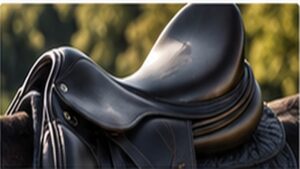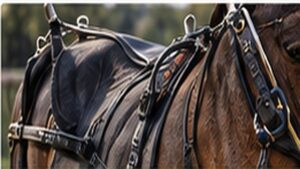
From leather to synthetic tack
For centuries, saddlery was shaped by the properties of animal hide. Leather was available, comparatively strong, flexible, repairable and capable of being cut, stitched, moulded and finished by hand. The craft traditions of the saddler therefore developed around a material rather than around a single design philosophy. Modern tack has not discarded that tradition so much as separated its functions: load-bearing components may be made from leather, nylon webbing, coated webbing, thermoplastics, synthetic textiles, foam, elastomers or composite structures, while the visible covering may be chosen for grip, appearance, weather resistance or cost.
In Great Britain, the word synthetic is used rather loosely. It may describe a complete saddle with a textile or polymeric outer, a leather-look polyurethane coating, a synthetic saddle tree, a nylon webbing core, a neoprene girth, a moulded polymer breastplate, or a coated webbing product sold under a proprietary name. These are not interchangeable materials. Their behaviour depends on the substrate, coating, thickness, reinforcement, stitching, hardware and the way the finished article is loaded.
The central practical principle is simple: material choice cannot compensate for poor design or poor fit. The British Horse Society notes that saddle fit and routine care matter whether a saddle is synthetic or leather, while the British Equestrian Trade Association advises regular inspection, correct use, appropriate cleaning and prompt repair or replacement of worn tack. BHS saddle-fit guidance and BETA tack-safety guidance are useful reference points.
Why leather became the traditional standard
Leather is a processed hide or skin whose collagen structure has been stabilised by tanning. Tanning prevents putrefaction and creates a material with a useful combination of tensile strength, flexural behaviour, tear resistance and surface friction. It is also anisotropic: its properties vary according to the direction and location of the fibres. A skilled saddler uses this variation when selecting bends, folds, straps and panels.
Several types of leather may appear in one item of tack. Full-grain leather retains the outer grain surface; corrected-grain leather has been mechanically altered or coated; split leather is taken from a lower layer of the hide; and suede or nubuck has a raised or abraded surface. “Leather” therefore describes a broad family, not a consistent grade. The quality of a bridle depends on more than the label: fibre density, thickness, temper, finish, edge treatment, stitching, reinforcement and the quality of the hardware all matter.
Vegetable tanning uses plant-derived tannins and is associated with a firmer handle and a pronounced ability to develop patina. Chrome tanning, which the Leather Working Group identifies as the dominant method globally, generally produces consistent and versatile leather. Chrome-free does not necessarily mean vegetable-tanned: aldehyde-tanned materials are commonly included under that broad description. The terminology is explained in the Leather Working Group’s leather FAQs.
In tack, leather’s advantages include a familiar hand, progressive flex, good surface grip when correctly finished, ease of hole punching and adjustment, and a long-established repair infrastructure. A well-made leather cheekpiece, rein or stirrup leather can often be restitched, shortened or replaced by a saddler. Leather may also change with use: it can soften, darken, crease and acquire a surface character that some riders value.
Those advantages are conditional. Leather absorbs water, sweat, grease and cleaning products. It can dry, stiffen, crack, stretch or become structurally weakened if neglected. Excessive oil or unsuitable dressings can soften it too much, affect stitching and alter friction. BETA specifically advises keeping leather supple, drying wet leather naturally at room temperature and inspecting stitching because even synthetic thread can wear thin through use.
The development of synthetic saddlery
Substitution began long before the modern “synthetic saddle” became familiar. Cotton and linen webbing, rubber, felt, canvas and early plastics were already used where low cost, flexibility, water resistance or consistency mattered. The decisive change was the arrival of engineered polymers and manufacturing methods capable of producing repeatable surfaces, moulded components and coated textiles.
Synthetic saddle trees illustrate this transition particularly clearly. A tree is the structural framework that determines much of a saddle’s shape and distributes rider load. Traditionally, trees used laminated wood, spring steel and other reinforced constructions. Thermoplastic trees introduced a different approach: a moulded polymer structure could be manufactured consistently and, in some designs, altered or paired with interchangeable components. German manufacturer Sommer records the development of a patented thermoplastic synthetic saddle tree in 1966, an example of the mid-twentieth-century movement towards polymer-based saddle construction. This is a manufacturer’s historical account rather than an independent industry-wide chronology, but it documents an important development in the field: Sommer company history.
Later synthetic saddles combined moulded or composite trees with textile, polymer-coated or suede-like external materials. Some designs prioritised low weight and easy cleaning; others aimed to reproduce the grip and visual finish of leather. Adjustable gullet systems, interchangeable components and air-filled or foam-based panels also developed alongside synthetic coverings. These features are design choices, not automatic consequences of being synthetic. A leather saddle may have an adjustable tree, while a synthetic saddle may have a fixed one.
In bridles, headcollars, breastplates, reins and driving harness, coated webbing has become particularly significant. A typical coated-webbing material consists of a woven textile core that supplies much of the tensile structure and a polymer coating that provides water resistance, colour, cleanability and surface protection. Polyurethane and polyvinyl chloride are common families, although formulations vary. Proprietary products such as BioThane should be evaluated by their specific data sheet rather than by assuming that every coated webbing has the same properties. BioThane’s published technical data, for example, reports test results for tensile break strength, abrasion, flexing, weathering and softening temperature for an identified product construction; those values should not be generalised to all synthetic tack. See the BioThane product data sheet.
What “synthetic” can mean in practice
| Material or construction | Typical tack applications | Useful characteristics | Limitations to investigate |
|---|---|---|---|
| Polymer-coated webbing | Bridles, reins, headcollars, breastplates, driving harness | Low water absorption, easy cleaning, colour consistency, broad range of finishes | Coating cuts, delamination, cold-weather stiffness, uncertain repair methods, hardware compatibility |
| Nylon or polyester webbing | Girths, reins, rug fittings, saddle reinforcement, training equipment | High strength-to-weight ratio, flexibility, low cost, rapid drying | Fraying, creep, abrasion, UV ageing, heat damage and stretch under sustained load |
| Polyurethane or PVC synthetic leather | Saddle outer panels, seat coverings, chaps, accessories | Consistent surface, easy wiping, animal-free material, predictable appearance | Surface cracking, hydrolysis in some polyurethane systems, heat and solvent sensitivity, limited repairability |
| Neoprene and other elastomers | Girth sleeves, padding, breastplates and protective contact areas | Softness, cushioning, flexibility and water resistance | Heat retention, sweat contamination, compression set, odour and degradation at edges or seams |
| Moulded thermoplastic or composite | Saddle trees, buckles, fittings and structural components | Repeatable geometry, low corrosion risk and manufacturing consistency | Material-specific fatigue, brittleness, heat sensitivity and difficulty of field repair |
A synthetic outer does not tell the buyer what lies underneath. A saddle marketed as synthetic may still contain leather, steel, wood, foam, wool, adhesives and textile reinforcement. Conversely, a leather saddle can contain substantial synthetic components, including webbing, synthetic thread, polymer foam and plastic fittings. The distinction is therefore best treated as a description of a principal material or finish, not a complete bill of materials.
Performance: strength is only one part of the question
Load paths and failure modes
Safety-critical tack should be assessed by how forces travel through the entire assembly. A rein, stirrup leather or girth does not rely on the strap alone. The load is transferred through holes, buckles, keepers, stitching, folded ends, billets, attachment points and sometimes reinforcement patches. A material with a very high published tensile strength may still fail at a poorly designed fold, a sharp-edged hole or a worn stitch line.
Leather often gives visible warning through cracking, thinning, stretching, fibre exposure and changes in flexibility. Synthetic materials can also show warning signs, but failure may present differently: surface cuts may expose the webbing core, a coating may peel or split, fibres may fuzz, holes may elongate, or a polymer may become hard and brittle. A clean appearance is not evidence of structural integrity.
Abrasion, flexing and environmental exposure
Repeated flexing is especially important in cheekpieces, reins and stirrup leathers. Abrasion occurs at buckles, keepers, billets, stirrup bars, girth straps and contact points with the horse or saddle. UV exposure, rain, sweat, stable disinfectants, mud, freezing temperatures and heat in a vehicle can all alter materials. The same product may perform differently in daily turnout, endurance, hunting, indoor schooling or occasional competition.
Technical data can help, but it must be read precisely. A laboratory abrasion result on a specified sample does not establish the life of a finished bridle. Nor does a tensile result for a straight strip prove the strength of a stitched assembly. Manufacturers and purchasers should ask which test method was used, what specimen was tested, whether the result is minimum, average or typical, and whether the tested construction matches production stock.
Grip and rider feel
Surface friction is a functional characteristic, not merely a matter of preference. Leather reins may become more supple and tactile with use, while coated webbing can provide predictable grip in wet conditions or may feel too smooth, sticky or stiff depending on its finish. Synthetic suede-like materials can offer a secure seat feel but may wear, flatten or pill. The correct choice depends on hand size, discipline, gloves, weather and whether the rider needs rapid rein adjustment or maximum resistance to slip.
Fit, welfare and biomechanics
Material selection should never displace fitting. A synthetic saddle is not inherently kinder or harsher than a leather saddle. The tree shape, panel design, flocking or air system, balance, bearing surface, girthing arrangement and rider position are more relevant than the label on the exterior.
Research has demonstrated that saddle pads and saddle construction can influence pressure distribution, but results are highly dependent on the specific horse, saddle, rider and gait. A study indexed by PubMed compared gel, leather, foam and reindeer-fur pads under a fitting dressage saddle and found differences in load distribution; it does not establish a universal ranking of pad materials. Similarly, an Equine Veterinary Journal study compared wooden-tree, treeless and flexible synthetic-tree racing saddles, showing why construction should be considered separately from the surface material. See Kotschwar et al. on saddle pads and Latif et al. on training-saddle pressure patterns.
Girths provide another example. They may use leather, elastic, nylon, neoprene, cotton, wool or combinations of these materials. Shape and tension affect both pressure and movement; a material comparison without controlling design and fit is therefore weak evidence. A recent study of girth design and tension examined a straight synthetic material girth alongside a leather anatomical girth, underlining that “leather versus synthetic” is often confounded with “straight versus shaped” or with different tension characteristics. The open-access study is available through PubMed Central.
Bridle fit is similarly independent of the material label. A soft synthetic crownpiece can still be poorly shaped or incorrectly adjusted; a leather bridle can still create pressure if its dimensions or padding are unsuitable. Check the anatomy, contact pressure, movement, buckles and edges rather than assuming that softness alone guarantees comfort.
Maintenance and hygiene
Leather
- Remove sweat, mud and grit regularly, especially around folds, buckles and stitching.
- Use products appropriate to the leather finish; more dressing is not necessarily better.
- Dry wet leather gradually at room temperature rather than against direct heat.
- Inspect the flesh side, edges, holes, billets and areas hidden beneath keepers.
- Use a saddler where structural repair, replacement of billets or assessment of a saddle tree is required.
Synthetic materials
- Follow the manufacturer’s cleaning instructions; many coated materials can be wiped or washed, but not all tolerate strong detergents, solvents or disinfectants.
- Rinse away sweat and grit, because waterproof surfaces can retain abrasive contamination at seams and buckles.
- Inspect coating edges, punched holes, folds and stitching rather than judging condition by surface shine.
- Allow neoprene, foam and padded components to dry thoroughly before storage.
- Do not assume that a washable item can be machine-washed without damage to reinforcement, adhesive, elastic or hardware.
Synthetic tack is often described as maintenance-free. That is inaccurate. It may require less conditioning and may tolerate water better, but it still needs inspection, cleaning, drying, correct storage and eventual replacement. BHS riding-school criteria call for tack to be fit, safe, clean and well maintained, with recorded safety inspections; the guidance specifically includes reins, stirrups and girths. BHS riding-school tack criteria.
Quality indicators for buyers and businesses
For a knowledgeable buyer, “leather” and “synthetic” are starting points, not quality grades. Examine:
- Construction: Is the load-bearing layer continuous, reinforced and appropriately oriented? Are folded ends secured by suitable stitching, riveting or moulding?
- Edges and holes: Are edges smooth and sealed? Are holes cleanly punched rather than torn or roughly cut?
- Stitching: Is the thread suitable for moisture and abrasion? Are stitch lines even, dense and placed away from stress concentrations?
- Hardware: Are buckles, rings and hooks corrosion-resistant, well finished and proportionate to the strap? Do moving parts operate without cutting or pinching?
- Consistency: Do left and right components match in thickness, finish and adjustment range?
- Traceability: Is there a manufacturer, importer, batch or product reference and clear care information?
- Repair support: Can the item be restitched, re-webbed or serviced, and is replacement hardware available?
- Use case: Is the product intended for riding, driving, turnout, training or competition, and does that match the expected loads and exposure?
For commercial users, a documented inspection schedule is more valuable than a general claim of durability. Record purchase dates, repairs, incidents and retirement decisions. Particular attention is warranted after a fall, collision, sudden loading event or unexplained tack failure. BETA advises inspection after an accident and replacement of broken, worn or badly damaged equipment.
Environmental and ethical considerations
Neither leather nor synthetic materials can be described honestly as automatically sustainable. Leather is animal-derived and depends on livestock systems, hide transport, tanning chemistry, energy, water, finishing and end-of-life management. The Leather Working Group’s life-cycle work covers impacts including global warming potential, eutrophication, resource depletion, water use, water consumption and freshwater ecotoxicity. It is useful evidence, but its assessment is primarily of leather production and does not by itself prove that a finished leather bridle has lower or higher impact than a particular synthetic alternative. The organisation also states that its tannery certification applies to facilities and sourcing practices, not to a universal product-level sustainability claim. See the LWG life-cycle assessment summary and LWG FAQs.
Synthetic tack avoids animal hide, but most conventional polymer-coated materials depend on fossil-derived feedstocks and can be difficult to recycle because coatings, textile cores, adhesives, foam and metal hardware are combined. Durability matters: a long-lived synthetic item may avoid repeated replacement, while a short-lived product can create more waste despite needing little cleaning water. Claims such as “vegan”, “eco”, “biodegradable” or “sustainable” should therefore be supported by a precise material declaration, evidence of durability, repair options and a credible end-of-life route.
For businesses, the most defensible procurement questions are practical: What is the composition? Which components are replaceable? What chemicals are restricted? Is the coating bonded mechanically or by adhesive? Can the manufacturer provide abrasion, flex, tensile or weathering data for the actual construction? Is the material available consistently across production runs? These questions are more informative than a simple leather-versus-plastic argument.
Common misconceptions
“Synthetic tack is always weaker.”
Not necessarily. Engineered webbing and polymer composites can have high strength and excellent resistance to water or abrasion. The relevant issue is the whole assembly, including stitching, holes, hardware and ageing. Poorly made synthetic tack can fail quickly; well-designed synthetic tack can be highly durable in its intended application.
“Leather is always safer because it gives warning.”
Leather can show visible deterioration, but neglected leather may fail suddenly at a weakened fold, billet or stitch line. Synthetic products also provide warning signs, although coating damage can conceal deterioration of the core. Inspection remains essential for both.
“Synthetic saddles do not need fitting.”
They do. The horse experiences the shape and pressure of the saddle, not the marketing category of its outer material. Adjustable components can help accommodate change, but they do not make every saddle suitable for every horse.
“Washable means indestructible.”
Water resistance and washability do not eliminate UV ageing, abrasion, fatigue, compression set, hardware corrosion or damage from unsuitable chemicals. Follow the maker’s instructions and inspect after cleaning.
“A recognised logo proves the entire product is sustainable.”
Certification normally applies to a defined facility, process or product characteristic. For example, the Leather Working Group explains that its logo relates to leather sourced from audited facilities and does not constitute a blanket product-level environmental comparison.
Choosing between leather and synthetic tack
A sensible selection process begins with the job. For daily yard use, wet climates, shared equipment and rapid cleaning, coated webbing or washable synthetic components may be highly practical. For a traditional bridle requiring repeated alteration and repair, quality leather may offer better long-term serviceability. For endurance, driving or outdoor work, low water absorption and easy cleaning may outweigh traditional appearance. For a saddle, fit, balance, structural design and access to competent fitting support should come before the outer material.
Consider climate and storage. Leather benefits from controlled drying and appropriate conditioning; some synthetic surfaces tolerate rain but may become hot, stiff or slippery in particular conditions. Consider the horse’s skin and coat, but avoid assuming that one material is universally hypoallergenic or comfortable. Edges, seams, pressure distribution, sweat retention and cleanliness are often more influential than the base material.
Finally, consider the complete service life: purchase quality, expected frequency of use, inspection burden, repairability, replacement parts, resale, and disposal. A higher initial price may be rational if the product is structurally repairable and supported by the manufacturer. A lower-cost synthetic item may be appropriate for a growing child, a changing horse or a high-wear training context, provided that it is correctly fitted and retired when worn.
Conclusion
The history of tack is not a simple progression from old leather to modern plastic. It is a continuing separation of functions. Leather remains valuable because of its handle, craftability, repair tradition and performance in well-designed applications. Synthetic materials have earned their place through consistent manufacture, low water absorption, cleanability, low weight, colour options and the ability to create forms that are difficult or expensive to produce in hide.
The expert approach is to assess material, construction and use together. Ask what carries the load, how the item will age, how it will be cleaned, whether it can be repaired, and whether it fits the horse and discipline. In both leather and synthetic tack, good design, accurate fit, sound hardware and disciplined inspection are more reliable indicators of safety and value than appearance or material ideology.
Related industry reference: For businesses moving from technical research into trade sourcing, explore leather-goods manufacturers on EquiGuild.
Related industry reference: For relevant trade sourcing and supply-chain context, explore leather suppliers on LeatherTradeHub.
Sources and further reading
- British Equestrian Trade Association: Tack safety and maintenance
- British Horse Society: Saddle fit
- British Horse Society: Riding Schools Criteria—Tack and Equipment
- Leather Working Group: Leather FAQs and terminology
- Leather Working Group: Life-cycle assessment for leather
- Sommer: Company history and thermoplastic saddle-tree development
- BioThane: Coated webbing properties sheet
- Kotschwar et al.: Effects of different saddle pads on forces and pressure distribution
- Latif et al.: Saddle pressure patterns of different training saddles
- Effect of girth design and tension on saddle-horse pressures and movement
Research note
Automatically researched source pack — editorial review required:
• beta-uk.org — https://beta-uk.org/tack/
• www.gov.uk — https://www.gov.uk/guidance/classifying-leather
• www.designequestrian.com — https://www.designequestrian.com/beta-2018-body-protector/
• www.equestriansurfaces.co.uk — https://www.equestriansurfaces.co.uk/about/history/
• www.bhs.org.uk — https://www.bhs.org.uk/horse-care-and-welfare/features/saddlery/
• www.sattelmacher.com — https://www.sattelmacher.com/en/company
• www.bhs.org.uk — https://www.bhs.org.uk/media/322nem42/riding-schools-criteria-v3.pdf
• pubmed.ncbi.nlm.nih.gov — https://pubmed.ncbi.nlm.nih.gov/20156245/
• beva.onlinelibrary.wiley.com — https://beva.onlinelibrary.wiley.com/doi/10.1111/j.2042-3306.2010.00237.x
• beta-uk.org — https://beta-uk.org/wp-content/uploads/2024/03/BETA-2018-Standard.pdf
• qualifications.pearson.com — https://qualifications.pearson.com/content/dam/pdf/BTEC-Nationals/equine-management/2017/Specification/btec-l3-nat-ext-dip-in-equine-management-spec.pdf
• romseysaddlery.co.uk — https://romseysaddlery.co.uk/wp-content/uploads/2023/09/BETA-Guide-to-Riding-Hats-v7-1.pdf
• www.bhs.org.uk — https://www.bhs.org.uk/go-riding-and-learn/riding-out-hacking/what-to-wear/body-protectors/
• www.oeko-tex.com — https://www.oeko-tex.com/en/our-standards/oeko-tex-leather-standard/supplements/
• beta-uk.org — https://beta-uk.org/
• pmc.ncbi.nlm.nih.gov — https://pmc.ncbi.nlm.nih.gov/articles/PMC12427339/
• novel.de — https://novel.de/wp-content/uploads/2021/07/1-s2.0-S0737080621000186-main.pdf
• assets.super.so — https://assets.super.so/e3806eb7-3aa9-4508-a1c8-ab233bb75ac4/files/922040a1-5d51-4b47-8ff4-a917de4b10e6/wes_rule_book_-_dec_2025.pdf
• www.reddit.com — https://www.reddit.com/r/Horses/comments/1sr3g0d/tack_material_for_racing/
• en.wikipedia.org — https://en.wikipedia.org/wiki/Saddle
Cite this article
Stable research ID: ERA-2026-000082
The Equestrian Research Atlas (2026) ‘From Leather to Synthetic Tack’. The Equestrian Research Atlas. Available at: https://equestrianresearchatlas.co.uk/research/from-leather-to-synthetic-tack/ (Accessed: 3 November 2026).
The Equestrian Research Atlas. (2026). From Leather to Synthetic Tack. The Equestrian Research Atlas. https://equestrianresearchatlas.co.uk/research/from-leather-to-synthetic-tack/
The Equestrian Research Atlas. “From Leather to Synthetic Tack.” The Equestrian Research Atlas, 2026, https://equestrianresearchatlas.co.uk/research/from-leather-to-synthetic-tack/. Accessed 3 November 2026.
Research references (70)
- beta-uk.org
- www.gov.uk
- www.designequestrian.com
- www.equestriansurfaces.co.uk
- www.bhs.org.uk
- www.sattelmacher.com
- www.bhs.org.uk
- pubmed.ncbi.nlm.nih.gov
- beva.onlinelibrary.wiley.com
- beta-uk.org
- qualifications.pearson.com
- romseysaddlery.co.uk
- www.bhs.org.uk
- www.oeko-tex.com
- beta-uk.org
- pmc.ncbi.nlm.nih.gov
- novel.de
- assets.super.so
- www.reddit.com
- en.wikipedia.org
- en.wikipedia.org
- en.wikipedia.org
- www.reddit.com
- en.wikipedia.org
- en.wikipedia.org
- en.wikipedia.org
- www.reddit.com
- www.reddit.com
- www.reddit.com
- www.reddit.com
- www.reddit.com
- www.reddit.com
- www.reddit.com
- www.leatherworkinggroup.com
- www.leatherworkinggroup.com
- www.biothane.us
- www.leatherworkinggroup.com
- www.bhs.org.uk
- www.leatherworkinggroup.com
- www.biothaneusa.com