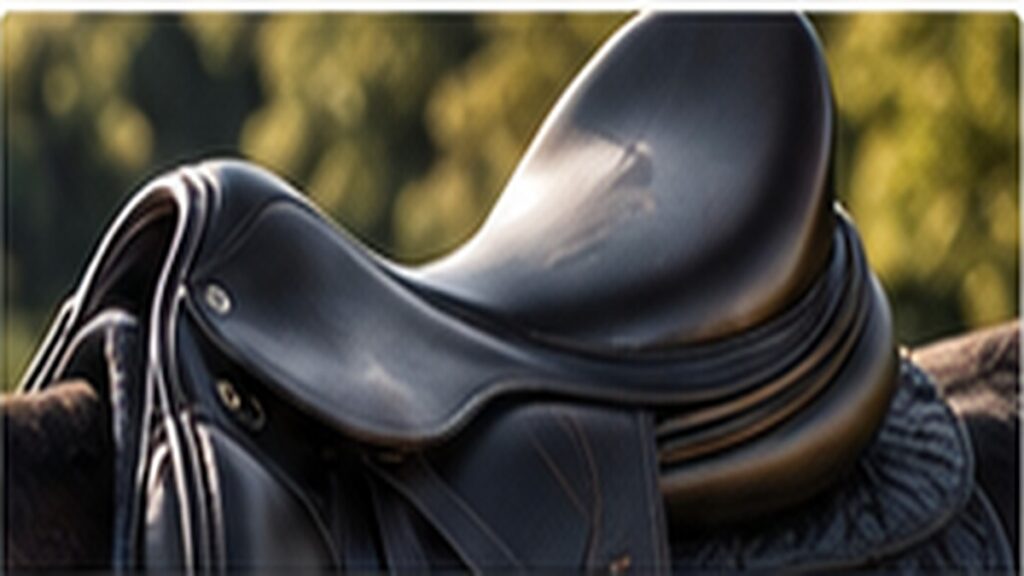
The saddle tree is the load-bearing framework around which a saddler builds the rest of the saddle. It influences the saddle’s overall profile, the position and stability of the rider, the distribution of load over the horse’s back, and the clearance available to the spine and scapulae. In a traditional English saddle, the tree is largely hidden beneath the seat, skirts, flaps and panels; nevertheless, it remains the principal determinant of the saddle’s underlying shape.
Tree design should therefore be considered as part of saddle fit and biomechanics rather than as a separate matter of saddle manufacture. A tree can be structurally sound yet unsuitable for a particular horse. Conversely, a technically sophisticated or highly adjustable tree cannot compensate for inappropriate geometry, unsuitable panels, poor balance, excessive rider load or incorrect positioning.
What the tree does
The basic functions of a tree are to:
- support the rider above the horse’s back;
- spread load over an appropriate area of the thoracic back;
- keep pressure away from the dorsal spinous processes and other vulnerable structures;
- provide a stable platform for the seat, stirrup attachments and girthing system;
- allow appropriate movement of the horse’s back without collapsing onto the spine or restricting the shoulder;
- give the saddle its intended balance, bearing length and discipline-specific shape.
In a conventional English saddle, the tree has a front arch or head, tree points extending downwards at the front, two longitudinal bearing members commonly called bars, and a rear arch or cantle area. The central channel between the bars is the gullet or spinal channel. Terminology varies between manufacturers and between English, western and other saddle traditions, so a measurement described as “gullet width” is not necessarily comparable between brands.
The tree is not the same thing as the visible seat. Seat depth, knee blocks, flap position and panel design can substantially alter the rider’s experience while leaving the underlying tree unchanged. Likewise, flocking or foam can modify contact and balance, but it cannot reliably transform a tree with the wrong fundamental angle, length or curvature into a suitable one.
Important elements of tree shape
Tree width and head angle
Tree width is commonly used as shorthand for the width of the front of the tree, but it is not a complete description of the fit. The angle of the tree points must correspond reasonably with the angle of the horse’s ribcage and scapular region. Two trees described as “medium” may have materially different head angles, point lengths and transitions into the bars.
In Great Britain, some manufacturers and fitters use angle-based categories. Research using British saddle-width conventions has, for example, treated narrow, medium, wide and extra-wide categories as successive angular ranges. However, these categories are not a universal cross-brand standard, and the number printed on an interchangeable gullet plate should not be assumed to describe the entire tree.
A tree that is too narrow may concentrate pressure at the front of the panels or tree points and can force the rear of the saddle down. A tree that is too wide may drop the front of the saddle, reduce wither clearance, create instability and overload areas toward the front of the panels. These are general mechanical tendencies, not diagnostic rules: panel shape, flocking, girthing, rider balance and the horse’s movement all modify the result.
Tree points
The points are the forward extensions of the tree beneath the front of the saddle. They help establish the head angle and contribute to lateral stability. Their length, angle, flare and termination matter. Long, relatively straight points may suit a different thoracic profile from short, more open or more curved points.
Point position is especially important near the caudal edge of the scapula. The tree must sit behind the shoulder while still providing enough bearing surface to distribute load. A horse’s shoulder does not remain static during locomotion: the scapula rotates and moves beneath the superficial tissues. Static clearance checks are therefore only one part of assessment.
Bars, bearing surface and bar flare
The bars are the longitudinal parts of the tree that transmit load through the panels. Their length and curvature influence how much of the horse’s back is loaded and whether contact is even from front to rear.
Bar flare describes how the front or rear of the bar opens away from the horse. Flare can help a tree accommodate a change in back angle along its length, but excessive flare may create localised contact while insufficient flare may produce pressure at an edge. The term “rock” refers broadly to longitudinal curvature: a more curved tree suits a more hollow or curved back, while a flatter tree may suit a flatter profile. Neither description should be applied in isolation from the horse’s actual shape and the panel beneath the tree.
Gullet and spinal channel
The gullet is the space formed between the bars. Its purpose is to keep the saddle clear of the dorsal midline and to allow the panels to bear on the musculature either side of the spine. Width, depth, shape and continuity all matter.
A narrow channel can bring panel edges or other structures close to the spine. A very wide channel may reduce useful bearing surface and can alter how the saddle stabilises. The appropriate channel is not a fixed number for every horse: spinal width, muscle development, body condition, tree geometry and panel construction must be considered together.
“Gullet size” is one of the most commonly over-simplified saddle terms. A point-to-point measurement may describe only one section of the head and says little about the full bar angle, longitudinal curve, channel shape or panel contact. It is useful as a specification, but not as a substitute for assessing the whole saddle on the horse.
Rock, twist and rear shape
Rock is the front-to-back curvature of the tree. Twist describes the transverse shaping through the waist of the saddle and affects both rider position and the way the tree presents to the horse. A tree can have the correct approximate width but unsuitable rock, twist or rear profile.
The rear of the tree influences how the saddle terminates over the horse’s back. Excessive length can extend beyond the horse’s weight-bearing thoracic region; inadequate length can leave too little surface for load distribution or compromise rider support. The relevant issue is not simply the nominal seat size. A 17.5-inch saddle from one design may have a different tree length and panel footprint from a 17.5-inch saddle from another.
Principal tree construction types
Rigid or fixed wooden trees
Traditional rigid trees are primarily wooden constructions without the longitudinal spring-steel reinforcement associated with a spring tree. They can be robust and stable, but generally offer less controlled flexion. Their performance depends on the wood, construction, reinforcement, finish and the way the tree is integrated into the saddle.
Rigid does not mean automatically stronger, safer or better fitting. A rigid tree may be appropriate for a particular discipline, horse and rider combination, but its limited adaptability makes initial shape accuracy especially important.
Wood-and-spring trees
The traditional English spring tree combines a shaped laminated wooden framework with metal reinforcement, commonly spring steel, running longitudinally and a reinforced head or gullet area. The metal helps provide strength while permitting a controlled degree of flexion. The exact behaviour varies considerably between designs; “spring tree” does not describe one standard stiffness.
Some manufacturers use multiple layers of thin wood veneer formed over a mould and bonded under heat and pressure. The finished wooden components are then reinforced and checked for symmetry. British Standard BS 6635:2015 specifies constructional and dimensional requirements for saddle trees made from wood, including materials, angle dimensions, symmetry, manufacture and marking. It is a product-construction standard, not a guarantee that a particular tree will fit a particular horse.
Spring steel is not simply a decorative reinforcement. Its thickness, temper, shape, attachment and relationship with the wooden components influence stiffness, resilience and durability. Poorly executed joints, inappropriate fasteners, corrosion, distortion or damage can compromise the structural system.
Moulded synthetic trees
Synthetic trees may be moulded from polymers such as polyurethane, thermoplastic materials or fibre-reinforced composites. Construction ranges from relatively rigid one-piece mouldings to designs incorporating metal plates, spring elements or other reinforcement. “Synthetic” therefore describes a broad family, not a single performance category.
Moulding can provide repeatable dimensions and efficient production. It may also permit designs that are difficult to achieve economically in laminated wood. Some synthetic trees are engineered to flex; others are intentionally stable and relatively rigid. Their long-term behaviour depends on the polymer, reinforcement, manufacturing quality, temperature exposure, loading and whether the material is prone to creep or fatigue.
A low-cost fibreglass or plastic tree should not automatically be equated with a high-quality engineered composite tree. Important questions include whether the manufacturer identifies the material, whether the tree is tested for the intended loading, how the stirrup and girthing forces are transferred, and what inspection or repair provisions exist.
Adjustable and interchangeable-head systems
Some saddles use interchangeable gullet plates or adjustable headplates. These systems can alter the front width or angle within a designed range and may be useful where the horse’s shape changes through training, age or seasonal condition.
Adjustability has limits. Changing a headplate generally does not alter the full length of the bars, their longitudinal rock, rear width, panel footprint, twist or channel. It may also change the balance of the saddle. A plate that produces an acceptable front angle cannot correct a tree that is too curved, too flat, too long or otherwise unsuitable.
Other systems allow a saddler to alter a tree by controlled widening or narrowing, while some manufacturers use replaceable or modular components. Such work should follow the maker’s specification. Unauthorised reshaping, heating or forcing may damage the tree or void its structural integrity.
How construction affects performance
Tree stiffness is not an isolated virtue. A tree must be stiff enough to distribute load and maintain its designed shape, yet not behave in a way that creates abrupt pressure concentrations or restricts normal back movement. The useful question is not whether a tree is “flexible” in the abstract, but how, where and under what load it flexes.
Related industry reference: For businesses moving from technical research into trade sourcing, explore saddle and saddlery suppliers on EquiGuild.
Flexion may occur longitudinally, laterally or torsionally. A tree that flexes easily from side to side may not provide adequate stability for a heavy rider or a discipline involving large dynamic loads. A tree that is rigid in torsion may resist unwanted twisting but may also fail to accommodate asymmetry or movement. Manufacturers rarely publish directly comparable stiffness data, so trade descriptions such as “close contact”, “dynamic” or “flexible” should be treated as design claims rather than standardised measurements.
Panel construction is equally important. Wool flocking can be adjusted by a qualified saddler and may accommodate small changes in contact and balance. Foam and moulded panels can offer consistency and a defined profile, but are not normally adjusted in the same way. Neither panel type makes an unsuitable tree suitable. The tree, panel, girthing system and rider load form one mechanical system.
What research shows about width and fit
Controlled studies support the practical importance of tree width, while also demonstrating why width alone is insufficient. In a study of 19 sound horses, saddles differing in tree width produced different pressure distributions. Saddles classified as too narrow showed higher pressure in the caudal region, while wide saddles showed increased pressure in the middle transverse region. The authors concluded that poorly fitting saddles distributed load over a smaller area and created potentially harmful pressure peaks.
A later study examining sports horses in trot and canter found that both a saddle fitted too wide and one fitted too narrow altered aspects of thoracolumbar movement and pressure distribution compared with a saddle selected according to fitting guidelines. The study also found changes in some limb and back-related measures. Its conclusion was not that a single width number solves saddle fit, but that correct fit is important to the interaction between horse and rider.
These findings should be interpreted carefully. They describe group-level responses under particular experimental conditions. They do not establish a universal pressure threshold for every horse, nor do they prove that every visible sweat pattern or movement change is caused by the tree. The studies also assessed immediate or short-term effects; long-term consequences require further evidence.
Professional assessment is not infallible. Research into repeatability among qualified Society of Master Saddlers fitters found that agreement was not complete for all observations, including tree width and clearance. This is a reason to combine structured assessment, dynamic observation, rider feedback and, where appropriate, objective pressure or movement data—not a reason to disregard professional fitting.
Selection factors for horses and riders
Tree selection should begin with the horse’s current shape and intended use. Relevant factors include:
- withers height and shape;
- shoulder angle and scapular mobility;
- ribcage width and curvature;
- the change in back shape from front to rear;
- spinal and paraspinal anatomy;
- muscle development, body condition and seasonal change;
- available bearing length;
- asymmetry or uneven development;
- discipline, speed, jumping demands and terrain;
- rider mass, balance, seat requirements and stirrup use.
The same horse may need a different design for different work, not necessarily because the tree material changes, but because rider position, panel length, flap geometry, girthing and expected dynamic loads change. A close-contact jumping saddle, dressage saddle and working or general-purpose saddle may present different compromises even when their nominal width is similar.
Quality indicators and inspection points
For manufacturers, retailers and purchasers of used saddles, useful quality indicators include:
- clear identification of the tree type and manufacturer’s model;
- symmetry of the front arch, points and rear of the tree;
- consistent bar shape without abrupt kinks or local distortions;
- sound, even stitching and secure attachment of the covering;
- absence of unexplained creaking, cracking, movement or distortion;
- secure stirrup-bar attachment and appropriate reinforcement;
- no evidence of tree breakage, crushed points or unauthorised alteration;
- panels that are symmetrical, appropriately filled and free from hard lumps;
- documentation of repairs, adjustments and manufacturer restrictions;
- an inspection route for damaged or heavily used saddles.
A saddle that has been dropped, involved in a fall or subjected to excessive loading may require internal inspection even if the leather appears undamaged. Tree failure is not always visible from the outside. Conversely, age alone does not prove that a tree is unsafe; condition, construction, use and maintenance are more informative than a simple age threshold.
Common misconceptions
“The number on the gullet plate tells me whether it fits.”
It tells you something about one adjustable component, but not necessarily the complete tree. Width, angle, rock, bar length, channel, panels and balance must be assessed together.
“A flexible tree is kinder to the horse.”
Flexibility can be useful, but uncontrolled or excessive movement may reduce stability or concentrate load. The relevant property is appropriate, controlled behaviour under the loads generated by that horse, rider and discipline.
“Synthetic trees are inferior.”
Synthetic trees vary widely. A well-engineered moulded tree may offer dimensional consistency and useful durability; a poorly made one may not. Material category alone cannot establish quality.
“Wooden trees do not change shape.”
Wood is dimensionally responsive to moisture, temperature, loading and construction history. Laminated construction and reinforcement improve predictability, but no material is immune to damage or deformation.
“Flocking can fix any fit problem.”
Flocking can alter contact and balance within limits. It cannot reliably correct fundamental errors in tree angle, length, rock or channel design.
“A perfect static fit stays perfect.”
Horse shape changes with age, workload, muscle development, weight, management and injury-related compensation. Saddle fit should be reviewed periodically and after significant changes in the horse, rider or work programme.
Practical approach to evaluating a tree
- Identify the construction. Establish whether the saddle has a rigid wooden, wood-and-spring, synthetic, adjustable or hybrid tree. Record the maker, model and any available specifications.
- Assess the horse’s shape. Consider the whole thoracic profile rather than the withers alone. Note front-to-rear curvature, shoulder angle, spinal width and asymmetry.
- Check position and clearance. Place the saddle correctly, assess the relationship with the scapula and examine the spinal channel. Do not rely on a single finger-width rule across all horses and designs.
- Assess balance and contact. Look for bridging, rocking, localised gaps, excessive front or rear loading and panel irregularities.
- Evaluate dynamically. Observe the saddle and horse in the intended work. A saddle may behave differently when girthed, mounted and loaded through the stirrups.
- Reassess the rider. The rider’s balance, seat size, stirrup length and discipline affect how the saddle loads the horse.
- Use objective methods appropriately. Pressure mapping, movement analysis and repeatable templates can add information, but each has technical limitations and should be interpreted by suitably trained professionals.
- Document change. Record the horse’s condition, saddle adjustments, rider feedback and any recurring signs of instability or discomfort.
The tree is a foundation, not a complete fit assessment. The strongest decisions combine construction knowledge with equine anatomy, saddle balance, panel mechanics and observation in motion. This is particularly important for horses with changing body shape, marked asymmetry, limited bearing length or demanding athletic work.
Conclusion
Saddle tree shape and construction determine much of what a saddle can and cannot do. Width and head angle matter, but so do point design, bar curvature, rock, twist, channel geometry, length, stiffness and the interaction with the panels. Wood-and-spring, rigid wooden, synthetic and adjustable systems each involve engineering compromises; none is inherently appropriate for every horse.
For the GB market, BS 6635:2015 provides a relevant construction reference for wooden saddle trees, while current biomechanical evidence supports careful attention to width and dynamic fit. The practical standard should be a structurally sound saddle whose complete geometry remains stable and distributes load appropriately for the individual horse and rider in the work they actually perform.
Sources and further reading
- Greve, L. and Dyson, S. (2007), “The influence of the width of the saddle tree on the forces and the pressure distribution under the saddle”, The Veterinary Journal.
- “The Effect of Tree Width on Thoracolumbar and Limb Kinematics, Saddle Pressure Distribution, and Thoracolumbar Dimensions in Sports Horses in Trot and Canter”, peer-reviewed open-access study.
- BS 6635:2015, Manufacture of saddle trees made from wood—Specification.
- “Investigation Looking at the Repeatability of 20 Society of Master Saddlers Qualified Saddle Fitters’ Observations During Static Saddle Fit”, peer-reviewed study.
- British Horse Society, Saddle Fit.
- City & Guilds, Saddlery qualification handbook: saddle-tree types and production methods.
- Passier, PS Saddle Tree technical description.
- Passier, Synthetic Saddle Tree technical description.
- Draupnir, Saddle Trees: construction and material information.
Research note
Automatically researched source pack — editorial review required:
• www.sciencedirect.com — https://www.sciencedirect.com/science/article/abs/pii/S1090023306000414
• www.lariot.co.uk — https://www.lariot.co.uk/
• pmc.ncbi.nlm.nih.gov — https://pmc.ncbi.nlm.nih.gov/articles/PMC6827167/
• uk.draupnir.no — https://uk.draupnir.no/draupnir-saddle-trees/
• beta-uk.org — https://beta-uk.org/saddle-fittings/
• www.bhs.org.uk — https://www.bhs.org.uk/horse-care-and-welfare/features/saddle-fit/
• www.passier.com — https://www.passier.com/en/Synthetic-Saddle-Tree~p6620
• www.equiscan.de — https://www.equiscan.de/en/saddle-trees
• www.bhs.org.uk — https://www.bhs.org.uk/media/jfgftanb/unit-1-stage-4-senior-care-trainer-guide-v3.pdf
• www.sciencedirect.com — https://www.sciencedirect.com/science/article/abs/pii/S0737080617300734
• www.thesaddlecompany.co.uk — https://www.thesaddlecompany.co.uk/faqs
• saddlerydresch.com — https://saddlerydresch.com/faq/
• www.simatree.com — https://www.simatree.com/saddle-tree
• www.bisas.org.uk — https://www.bisas.org.uk/assets/files/BSAS_2014_-_Proceedings.pdf
• schleese.com — https://schleese.com/wp-content/uploads/2016/09/The-Nine-Points-of-Saddle-Fit-Part-THREE-Oct2016.pdf
• www.steelesaddletree.com — https://www.steelesaddletree.com/SST/images/Binder2.pdf
• www.bisas.org.uk — https://www.bisas.org.uk/assets/files/BSAS_Proceedings_2025_%28FINAL_DRAFT%29_06.06.25%29_.pdf
• schleese.com — https://schleese.com/wp-content/uploads/2016/05/eGuide20160429.pdf
• www.reddit.com — https://www.reddit.com/r/Equestrian/comments/1u8f2iq/what_size_gullet_does_this_look_like/
• www.reddit.com — https://www.reddit.com/r/Equestrian/comments/16u4z5v
Cite this article
Stable research ID: ERA-2026-000252
The Equestrian Research Atlas (2026) ‘Saddle Tree Shapes and Construction’. The Equestrian Research Atlas. Available at: https://equestrianresearchatlas.co.uk/research/saddle-tree-shapes-and-construction/ (Accessed: 3 November 2026).
The Equestrian Research Atlas. (2026). Saddle Tree Shapes and Construction. The Equestrian Research Atlas. https://equestrianresearchatlas.co.uk/research/saddle-tree-shapes-and-construction/
The Equestrian Research Atlas. “Saddle Tree Shapes and Construction.” The Equestrian Research Atlas, 2026, https://equestrianresearchatlas.co.uk/research/saddle-tree-shapes-and-construction/. Accessed 3 November 2026.
Research references (66)
- www.sciencedirect.com
- www.lariot.co.uk
- pmc.ncbi.nlm.nih.gov
- uk.draupnir.no
- beta-uk.org
- www.bhs.org.uk
- www.passier.com
- www.equiscan.de
- www.bhs.org.uk
- www.sciencedirect.com
- www.thesaddlecompany.co.uk
- saddlerydresch.com
- www.simatree.com
- www.bisas.org.uk
- schleese.com
- www.steelesaddletree.com
- www.bisas.org.uk
- schleese.com
- www.reddit.com
- www.reddit.com
- www.reddit.com
- www.reddit.com
- en.wikipedia.org
- www.reddit.com
- www.reddit.com
- www.reddit.com
- www.reddit.com
- en.wikipedia.org
- www.reddit.com
- www.reddit.com
- en.wikipedia.org
- www.reddit.com
- www.reddit.com
- en.wikipedia.org
- en.wikipedia.org
- en.wikipedia.org
- arxiv.org
- arxiv.org
- arxiv.org
- arxiv.org