
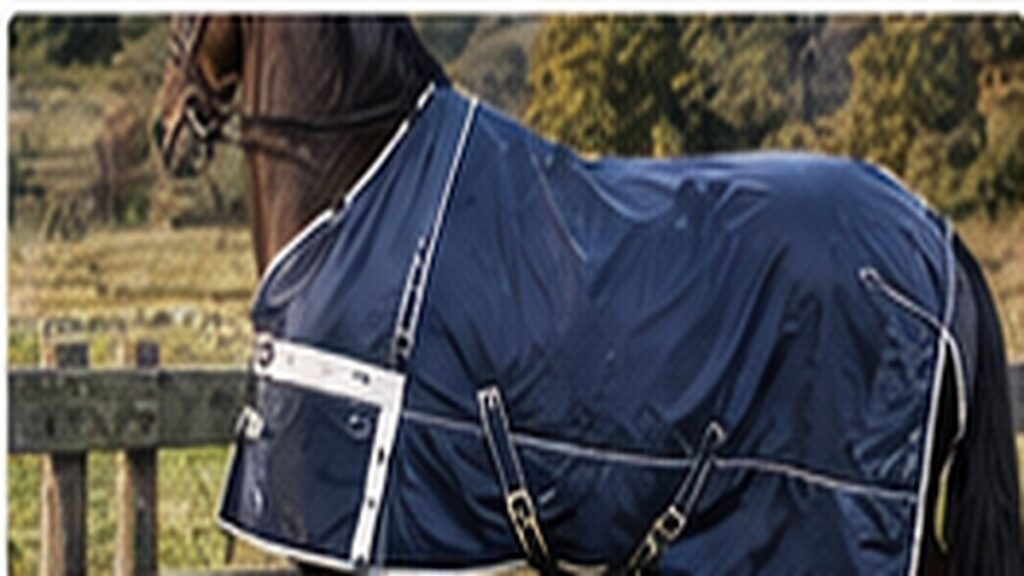
Why seam construction matters
A horse rug is a shaped technical textile assembled from panels, bindings, fastenings, insulation, linings and reinforcement components. Its useful life is determined by the interaction of all those parts rather than by the headline specification of one material. A high-denier outer can still fail at a chest closure, a surcingle attachment or a poorly supported panel join. Conversely, a comparatively light fabric may perform well when the load is distributed through an appropriate seam, reinforcement and fit.
Related industry reference: For businesses moving from technical research into trade sourcing, explore horse-rug and textile suppliers on EquiGuild.
In use, a rug is exposed to forces that are more complex than a simple pull in one direction. The horse walks, rolls, lies down, shakes, rubs against objects, reaches for forage and changes shape through the shoulder, back and hindquarters. Wind can inflate and flap the textile. Wet fabric becomes heavier, mud adds abrasion and contamination, and repeated laundering can alter coatings, thread lubrication and dimensional stability. These actions generate cyclic loading: relatively modest forces repeated many thousands of times.
For that reason, “seam strength” should not be treated as a single universal quality number. Textile standards distinguish between the strength of a sewn seam, the tendency of fabric yarns to slip away from a seam, tear propagation, tensile strength, abrasion and water penetration. ASTM D1683, for example, describes testing for sewn-seam strength, seam efficiency and seam slippage, while ISO 13936 addresses resistance to yarn slippage at a seam in woven fabrics. Neither standard, by itself, predicts the complete service life of a finished horse rug.
The practical question is therefore not simply whether a rug is stitched. It is whether the complete seam system is appropriate for the loads, weather exposure, horse, fit and maintenance regime expected in Great Britain.
Basic terminology
Seam, stitch and seam allowance
A seam is the joined region between two or more textile components. A stitch is the individual thread interlacing or penetration used to create the join. A seam may contain one or more rows of stitching, binding, tape, adhesive or welded construction.
The seam allowance is the material extending beyond the stitch line. It provides the fabric engaged by the seam and may subsequently be folded, bound or enclosed. A narrow allowance gives little area for load transfer and leaves limited tolerance for needle damage or repair. A wider allowance can improve load distribution, but adds bulk, stiffness and potential rubbing or water-collection points.
Seam efficiency compares the strength of a sewn assembly with the strength of the unsewn fabric under a specified test method. It is useful for engineering comparison, but a value from one seam assembly should not be transferred casually to a different fabric, stitch density, thread or production process.
Seam slippage
Seam slippage is the movement of fabric yarns away from the stitch line under load. It can appear as a progressively widening gap alongside the seam even when the sewing thread remains intact. It is especially relevant to woven fabrics whose yarns have relatively low resistance to displacement. Slippage is not the same as thread breakage and not the same as a tear through the fabric.
ISO 13936-3 describes a needle-clamp method for assessing the resistance of yarns at a seam in woven fabrics. The standard notes that seam preparation and sewing-thread variation can materially influence results. This is important in rug manufacture because a fabric specification alone cannot reveal how a particular production seam will behave.
Seam integrity and water resistance
A seam may remain mechanically intact while allowing water through needle holes, an unsealed seam allowance, a displaced tape or a damaged coating. Waterproofness is therefore a finished-product property, not simply an outer-fabric property. The British Equestrian Trade Association explains that stitching and fastenings cannot always be tape-seamed, particularly around components such as tail flaps and surcingles. A rug described as waterproof should not be assumed to be a completely sealed envelope.
Common seam constructions in horse rugs
Plain or open seam
In a basic plain seam, two fabric edges are placed face to face and stitched, leaving the seam allowances on the inside. It is economical and versatile, but the raw edges may fray and the stitch line may carry a high proportion of the load. In a lined rug, the lining may conceal the seam, but concealment does not itself add strength.
Plain seams can be entirely appropriate where the fabric is stable, the load is moderate and the seam is supported by adjacent construction. They are less forgiving when used at a high-movement or high-tension location without reinforcement.
Lapped and felled seams
In a lapped seam, one layer overlaps another and is secured through the overlap. This can increase the area over which load is transferred and can enclose an edge. A felled or enclosed seam folds the allowance so that raw edges are protected and additional stitching may secure the fold.
These constructions can provide useful durability and a cleaner internal finish, but they are not automatically superior. Extra folds increase stiffness and may create a raised ridge. On a rug, the design must balance mechanical strength with freedom of movement, low bulk, comfort and the ability to shed water.
Bound edges and edge binding
Binding wraps an exposed edge with another textile strip. It is commonly used around neck openings, leg arches, hems, tail openings and other boundaries where the fabric would otherwise fray or present a sharp edge. Binding can improve edge stability and protect the assembly from abrasion, but its effectiveness depends on adequate width, secure stitching and compatible flexibility.
A binding seam is often exposed to repeated bending. If the binding is too stiff, too narrow or caught inconsistently, the stitch line can become a hinge and the edge can curl or separate. At a leg arch, this may be accompanied by local rubbing or distortion when the rug shifts.
Gussets and shaped inserts
Gussets introduce an additional panel to create volume or movement allowance. They are valuable around the shoulder, chest, neck or hindquarter where a flat pattern would restrict motion. However, each gusset adds seam junctions, changes in grain direction and additional ends of stitching.
The ends of gussets are particularly important. A seam that terminates abruptly can create a stress concentration: load that was distributed along the seam becomes concentrated at a small point. Good engineering may use a curved termination, a gradual change in geometry, a bar-tack, an additional patch or another transition that avoids a sharp endpoint.
Quilted and multi-layer assemblies
Insulated rugs often contain an outer shell, filling and lining. Quilting or internal tacking keeps the fill in position, but every internal stitch can pierce a coating or membrane and can influence drape. If the outer shell and lining have different shrinkage or stretch behaviour, repeated washing and drying can introduce puckering, tension or distortion.
Quilting is not equivalent to structural reinforcement. Its purpose may be to control fill migration rather than to carry the principal loads generated at the chest, surcingles or attachment points.
Where stresses concentrate
Stress points are locations where force changes direction, enters or leaves the fabric, or is restricted by a fastening or rigid component. The following locations deserve particular attention.
- Chest closures: Buckles, clips, hook-and-loop panels and overlapping fronts transfer substantial load when the horse moves or when the rug catches wind. The closure may pull on a relatively small area of fabric, making reinforcement and load spreading important.
- Wither and neck transitions: A high-neck or shaped-neck panel changes the direction of the seam and may experience repeated bending, compression and rubbing. Abrupt corners or tight curves can become local failure points.
- Shoulder and gusset seams: These areas must accommodate protraction and retraction of the forelimb. A rug that is too small, too tight at the chest or poorly shaped may load the seam more heavily than a well-fitted rug of the same nominal size.
- Surcingle attachments: The webbing, rings or elastic components may concentrate force where they are sewn to the shell. Multiple rows of stitching do not guarantee durability if the fabric beneath is not reinforced or if the stitch ends are poorly secured.
- Leg arches and hems: Curved edges are repeatedly flexed and may contact the horse, mud, fencing or stable surfaces. Binding failure, fraying and local tearing are common forms of degradation here.
- Tail flap and rear corners: Wind, tail movement and contact with objects can cause flutter and peel-like loading. The rear edge may also be dragged or caught during rolling.
- Fastener ends and stitch terminations: The beginning and end of a seam can act as notches. If back-tacking is insufficient, thread can unravel; if the termination is abrupt, fabric stress can rise sharply.
- Repair interfaces: A patch stitched over a damaged area changes the stiffness of the local fabric. If it ends with square corners or is too rigid, the original tear may stop but a new tear can begin at the patch edge.
These areas should be evaluated as load paths rather than isolated details. For example, a surcingle may be strongly attached to the shell but still fail because the load is transferred into a weak panel seam a few centimetres away.
Principal failure modes
Thread breakage
Thread may break because its strength is inadequate for the seam, because the needle has damaged it, because stitch tension is incorrect, or because abrasion and ultraviolet exposure have degraded it. Thread breakage may begin at one point and then progress through adjacent stitches. Short, loose or inconsistent stitches can accelerate this process.
A heavier thread is not automatically better. It must be compatible with the needle, fabric thickness, stitch type and machine tension. An excessively large needle can create oversized holes; excessive thread tension can pucker the fabric or cut into it.
Fabric rupture beside the seam
Here the thread and seam may remain intact while the fabric tears close to the stitch line. This can occur when the seam is stronger than the surrounding material, when needle holes weaken the fabric, when the seam allowance is narrow, or when a rigid reinforcement creates a sharp stiffness transition.
Fabric rupture is one reason why “double stitching” is an incomplete quality claim. Adding rows of stitches can increase the load carried by the seam, but may also increase perforation and transfer more force into the adjacent fabric.
Seam slippage and pull-out
In seam slippage, woven yarns move away from the seam and an opening develops parallel to the stitch line. In pull-out, thread may draw through the fabric rather than breaking. Both modes are influenced by weave density, yarn friction, stitch type, stitch density, seam allowance and needle size.
Slippage can be visually subtle at first. A seam may look intact but show a widening pale line, distortion or small openings when gently flexed. Once yarns have displaced, the seam may have substantially less reserve strength even if no thread has snapped.
Tear propagation
A cut, snag or puncture can grow when the rug is loaded. Ripstop construction uses heavier or stronger yarns at intervals to help limit the propagation of a tear. Ripstop is therefore relevant to damage containment, but it does not make the fabric or seams waterproof and does not eliminate failure at a seam or attachment point.
Tear resistance and tensile strength are different properties. A fabric may withstand a high force applied across a broad strip yet perform less well when a small cut is forced to propagate. Testing must therefore match the anticipated damage mechanism.
Delamination, coating failure and seam-tape failure
In laminated or coated textiles, the bond between layers may weaken through flexing, abrasion, heat, contamination or inappropriate cleaning. A tape-sealed seam can lift at an edge, crease, wrinkle or high-flex point. Once the seal is compromised, water entry may occur even though the stitching remains mechanically sound.
Seam tape also adds stiffness and may affect drape. A design that is highly sealed but poorly shaped can shift, rub or restrict movement. Weather protection must therefore be considered alongside fit and mechanical durability.
Fastener and webbing failure
Webbing can fray, buckle, stretch or pull through its attachment. Hook-and-loop can lose effectiveness through contamination and fibre loading. Buckles and clips can deform or detach. These are not strictly seam failures, but the surrounding stitching and reinforcement determine how loads reach the fastener.
Design variables that influence durability
Stitch type and density
Stitch selection affects strength, flexibility, seam elongation and resistance to unraveling. A dense stitch line may improve security up to a point, but excessive density can perforate the textile and create a line of weakness. A sparse stitch line may allow seam opening, distortion or thread abrasion.
Stitch balance matters too. Uneven tension can produce loops, puckering or a seam that is stiff on one side and loose on the other. Technical sewing guidance identifies stitch density, stitch type and thread balance as significant influences on seam-breaking strength.
Thread material
Common industrial sewing threads include polyester and polyamide varieties, selected according to strength, abrasion resistance, flexibility, moisture exposure and processing requirements. The strongest thread in isolation may not produce the best rug seam if it is too stiff, poorly matched to the fabric or likely to cut through the shell.
Thread should also be considered after washing and weathering. Laboratory strength in new condition is not the same as retained performance after exposure to moisture, ultraviolet radiation, dirt, flexing and laundering.
Reinforcement geometry
Reinforcement patches, webbing, binding and bar-tacks work by redistributing force. Their shape matters. Rounded or tapered ends generally avoid the abrupt stiffness change associated with a square patch. A reinforcement that extends beyond the loaded region may be more effective than one placed only directly beneath a buckle.
However, reinforcement can create a new failure boundary. If a patch is much stiffer than the surrounding shell, stress may concentrate at its perimeter. The transition should be sufficiently gradual for the intended use.
Fabric direction and panel design
Woven fabrics have warp and weft directions with potentially different strength, elongation and slippage behaviour. Pattern orientation can therefore affect how a seam responds. Curved panel joins, bias-cut sections and changes from one fabric to another require particular care because they can introduce differential movement.
Panel design also controls the number of seams. Fewer seams can reduce potential leakage and failure sites, but a large uninterrupted panel may offer less shaping or movement allowance. More seams can improve fit and load distribution if they are correctly placed and supported.
Assessing construction in a finished rug
Owners and retailers cannot reproduce a full laboratory test with a visual inspection, but a structured check can identify useful quality indicators.
- Inspect the seam path: Look for consistent stitch length, straight or deliberately controlled curves, secure ends and no skipped stitches.
- Check seam allowance and edge finish: Raw edges should not be exposed where fraying or rubbing is foreseeable. Binding should lie flat and remain captured along its length.
- Examine attachments: Webbing, rings and fasteners should be supported by appropriate patches or load-spreading construction rather than a small isolated stitch box.
- Flex high-movement areas: Gently move the shoulder, neck, leg arch and tail areas. Look for puckering, cracking, adhesive lift or openings parallel to the seam.
- Look inside as well as outside: Lining and seam allowances can reveal exposed thread loops, sharp edges, rough reinforcement or trapped debris.
- Assess symmetry and fit: A seam can be well made but overloaded by poor fit. The rug should not pull sharply across the chest, drag at the hindquarters or sit with concentrated pressure at the wither.
- Document early defects: Photograph loose stitching, tape lift, fraying or seam opening before continued use. Early repair is usually more straightforward than reconstruction after a tear has propagated.
Do not test a rug by hanging from a fastening, pulling violently on a seam or placing it under an improvised load. Such actions may damage the product and provide no standardised performance result.
What manufacturers and buyers should specify
For commercial procurement, “durable construction” is too vague to be a useful technical requirement. A more informative specification identifies:
- outer, lining and reinforcement materials;
- fabric construction and relevant tensile, tear, abrasion or hydrostatic-pressure methods;
- seam type, stitch type, thread specification and stitch density;
- reinforcement details at chest, surcingles, leg arches and other attachment points;
- whether seams are sewn, taped, bonded, welded or a combination;
- the portion of the product covered by seam sealing;
- test direction, conditioning, wash procedure and acceptance criteria;
- sample size, production tolerance and inspection method; and
- repairability, spare parts and care instructions.
ASTM D1683 is explicit that seam results depend on the specified seam assembly and that the method does not predict actual wear performance. This limitation should be reflected in purchasing decisions. A laboratory seam-strength result is evidence about a defined test configuration, not a guarantee that every seam in a finished rug will survive every field condition.
Common misconceptions
“More denier means stronger seams”
Denier describes the mass per unit length of fibres or yarn and is not a complete measure of finished-fabric or seam performance. Weave, yarn construction, coating, tear behaviour, needle damage, seam design and reinforcement all matter.
“Ripstop means tear-proof and waterproof”
Ripstop can help limit tear propagation, but it does not prevent punctures, seam failure or water entry. Waterproof performance depends on the fabric system, coatings or membrane, seam treatment and product condition.
“A taped seam is always stronger”
Tape may improve water resistance, but it can add stiffness and introduce a bonded interface that may fail under flexing or contamination. Mechanical strength and water sealing are related but separate design objectives.
“Double stitching proves quality”
Multiple rows can improve load distribution when correctly engineered, but stitch density, thread balance, seam allowance, fabric integrity and reinforcement geometry remain decisive. Poorly executed extra stitching can create additional perforation or stiffness.
“A seam that has not split is sound”
Seam slippage, coating damage, thread abrasion and local distortion can reduce performance before a visible rupture occurs. Inspection should look for developing changes, not only complete separation.
Relation to rug fit, weather protection and maintenance
Seam durability cannot be separated from fit. A rug that shifts repeatedly may impose cyclic peel and shear loads on the chest, shoulder and rear corners. A rug that is too tight may load the front closure and shoulder seams; one that is too loose may catch wind, snag or rub. Correct sizing and adjustment reduce unnecessary seam loading.
Weather protection is similarly interconnected. A product may use a water-resistant outer, a membrane, seam tape or a combination. Yet openings, fastenings, needle holes, unsealed edges and damaged coatings remain potential routes for water. Wet filling or lining can also change the weight and drape of the rug, increasing mechanical demand.
Cleaning should follow the maker’s instructions because detergents, heat, solvents and aggressive brushing may affect coatings, tapes, elastics and thread. Before storage, the rug should be dry and free of excessive dirt. Repairs should preserve the original load path where possible rather than simply covering a tear with a rigid patch.
Practical conclusions
The most reliable assessment of a horse-rug seam is a systems assessment. Examine the fabric, seam geometry, stitch execution, thread, reinforcement, fastener attachment, waterproofing method, fit and likely use together.
For owners, the strongest quality indicators are consistent construction, sensible load spreading, protected edges, secure attachment points, appropriate movement allowance and clear care information. For manufacturers and trade buyers, credible evidence should identify the test method and product configuration rather than presenting an isolated denier, waterproof rating or seam-strength claim.
Most importantly, distinguish between different failure modes. Thread breakage, fabric rupture, seam slippage, tear propagation, delamination and fastener pull-out require different design responses. A rug is durable when its construction manages the likely combination of forces over time—not merely when one component appears heavy or heavily stitched.
Sources and further reading
- ASTM International: ASTM D1683/D1683M, Standard Test Method for Failure in Sewn Seams of Woven Fabrics
- International Organization for Standardization: ISO 13936-3, Textiles—Determination of the Slippage Resistance of Yarns at a Seam in Woven Fabrics
- British Equestrian Trade Association: Understanding Your Outdoor Rug
- AMANN: Seam Stability and Seam Quality
- Equestrian Research Atlas: Horse Rug Denier Explained
- Equestrian Research Atlas: Technical Textiles Used in Horse Equipment
- Equestrian Research Atlas: Turnout Rug Waterproofing and Breathability
Research note
Automatically researched source pack — editorial review required:
• store.astm.org — https://store.astm.org/d1683_d1683m-11.html
• www.iso.org — https://www.iso.org/standard/37219.html
• www.sciencedirect.com — https://www.sciencedirect.com/topics/engineering/slippage
• equestrianresearchatlas.co.uk — https://equestrianresearchatlas.co.uk/research/horse-rug-denier-explained/
• apshan.com — https://apshan.com/blog/seam-slippage
• equestrianresearchatlas.co.uk — https://equestrianresearchatlas.co.uk/research/technical-textiles-used-in-horse-equipment/
• www.clubmartin.com — https://www.clubmartin.com/textile-glossary/seams-garment-construction/seam-load-analysis/
• equestrianresearchatlas.co.uk — https://equestrianresearchatlas.co.uk/research/turnout-rug-waterproofing-and-breathability/
• www.amann.com — https://www.amann.com/knowledgehub/amann-wiki/seam-quality-explained-criteria-characteristics-and-performance/seam-stability/
• equestrianresearchatlas.co.uk — https://equestrianresearchatlas.co.uk/hub/horse-rugs-textiles/
• en.wikipedia.org — https://en.wikipedia.org/wiki/Seam_%28sewing%29
• ecostandard.org — https://ecostandard.org/resources/report-deep-dive-standards-to-measure-textile-durability/
• textiletuts.com — https://textiletuts.com/seam-strength-testing/
• www.testresources.net — https://www.testresources.net/applications/textile-seam-strength-test-equipment
• share.ansi.org — https://share.ansi.org/shared%20documents/standards%20activities/international%20standardization/standards%20alliance/trade%20africa%20documents/west%20africa/textiles%20march%202018/ghana/presentations%20english/9_bv%20%20performance%20testing%202018%5B3%5D.pdf
• cdn2.hubspot.net — https://cdn2.hubspot.net/hubfs/6609023/TestWise%202015-V5.0.20-Standards%20List.pdf
• beta-uk.org — https://beta-uk.org/wp-content/uploads/2024/11/35174-BETA-Outdoor-Rug-Leaflet_17782-BETA-rug-leaflet-3-reduced-size.pdf
• en.wikipedia.org — https://en.wikipedia.org/wiki/List_of_sewing_stitches
• austinpublishinggroup.com — https://austinpublishinggroup.com/textile-engineering/fulltext/arte-v7-id1067.pdf
• www.reddit.com — https://www.reddit.com/r/u_specform/comments/1udvh7v/standard_seam_types_iso_stitch_codes_for_tech/
Cite this article
Stable research ID: ERA-2026-000423
The Equestrian Research Atlas (2026) ‘Horse Rug Seam Construction, Stress Points and Failure Modes’. The Equestrian Research Atlas. Available at: https://equestrianresearchatlas.co.uk/research/horse-rug-seam-construction-stress-points-and-failure-modes/ (Accessed: 3 November 2026).
The Equestrian Research Atlas. (2026). Horse Rug Seam Construction, Stress Points and Failure Modes. The Equestrian Research Atlas. https://equestrianresearchatlas.co.uk/research/horse-rug-seam-construction-stress-points-and-failure-modes/
The Equestrian Research Atlas. “Horse Rug Seam Construction, Stress Points and Failure Modes.” The Equestrian Research Atlas, 2026, https://equestrianresearchatlas.co.uk/research/horse-rug-seam-construction-stress-points-and-failure-modes/. Accessed 3 November 2026.
Research references (30)
- store.astm.org
- www.iso.org
- www.sciencedirect.com
- equestrianresearchatlas.co.uk
- apshan.com
- equestrianresearchatlas.co.uk
- www.clubmartin.com
- equestrianresearchatlas.co.uk
- www.amann.com
- equestrianresearchatlas.co.uk
- en.wikipedia.org
- ecostandard.org
- textiletuts.com
- www.testresources.net
- share.ansi.org
- cdn2.hubspot.net
- beta-uk.org
- en.wikipedia.org
- austinpublishinggroup.com
- www.reddit.com
- file.yzimgs.com
- en.wikipedia.org
- de.wikipedia.org
- en.wikipedia.org
- en.wikipedia.org
- www.reddit.com
- arxiv.org
- www.reddit.com
- www.reddit.com
- arxiv.org
Related research
 Horse Rug Wholesalers SuppliersContinue research →How Horse Rug Liners WorkContinue research →Horse Rug Sizing and FitContinue research →Detachable Neck vs Combo Turnout RugsContinue research →Horse Rug Fill Weights ExplainedContinue research →Turnout Rug Waterproofing and BreathabilityContinue research →