Why grooming equipment matters
Horse grooming is often described as a routine stable task, but the equipment used affects far more than appearance. A suitable kit can remove loose hair and mud, support inspection of the skin and limbs, help maintain clean hooves, prepare the coat for tack and provide a controlled opportunity to observe changes in comfort, behaviour and body condition. Poorly selected or poorly maintained tools can cause discomfort, spread infectious material between horses, damage hair or skin, and create avoidable handling risks.
In Great Britain, grooming should be considered within the wider duty to protect a horse from pain, suffering, injury and disease. The English code of practice identifies suitable environment, diet, normal behaviour, companionship and protection from pain and disease as core welfare responsibilities. Grooming equipment is not a substitute for veterinary, farriery or other professional care, but it is part of the day-to-day management system through which owners notice and respond to changes.
The best grooming kit is therefore not the largest or most fashionable one. It is a set of tools matched to the individual horse, coat, environment, workload, management system and handler. A clipped Thoroughbred kept indoors will have different requirements from a feathered native pony living out, a cob with a dense winter coat, or a horse with sensitive skin and a low tolerance for vigorous brushing.
What a grooming kit needs to achieve
A practical grooming system usually has five functions:
- Surface cleaning: removing dried mud, dust, sweat and loose hair.
- Hair and coat management: laying the coat, distributing natural oils and keeping the mane, tail and feathers manageable.
- Inspection: allowing the handler to examine skin, limbs, hooves, eyes, nostrils and areas beneath tack or rugs.
- Preparation: leaving the horse clean, dry and comfortable before riding, work, clipping, turnout or competition.
- Hygiene and risk control: preventing tools becoming reservoirs for dirt, skin debris or infectious material.
Grooming should not be judged solely by visual polish. A horse can have a highly finished coat while still being uncomfortable, damp beneath a rug, sore under the girth area or developing a skin problem. Conversely, a horse living a healthy outdoor life may not need aggressive daily grooming to look show-ring clean. The purpose of the session should determine the intensity and tools used.
Core grooming equipment
Rubber curry combs
A rubber curry comb has flexible raised teeth or nodules that loosen mud, dead hair and surface debris. Rubber is generally more forgiving than rigid plastic or metal and is useful on the neck, shoulder, barrel and quarters of a horse that tolerates it. Flexible rubber can also conform to body contours and is easy to wash.
Use a curry comb with controlled pressure and avoid bony prominences, the face, spine, points of the hip, lower limbs and any area that is hot, swollen, painful or damaged. The familiar circular action is a technique rather than a rule: some horses prefer short strokes, and a horse with a fine coat may need only light use. A curry comb should loosen material for a brush to remove; it should not be used to scrub until the skin is irritated.
Rubber curry combs vary considerably. Softer rubber is usually more comfortable for fine coats and sensitive horses, while firmer, deeper teeth may be more effective on thick winter hair or dried mud. Examine the moulding for sharp flashing, cracks and rigid edges. A good tool remains flexible in cold conditions, does not shed fragments and can be cleaned thoroughly.
Plastic curry combs
Plastic versions normally have more defined teeth and may be useful for dense coats, dried mud or cleaning brushes. They are less forgiving than rubber, particularly where the plastic is hard or the teeth are narrow. Select a design with rounded tooth ends, a comfortable grip and no rough mould lines. Plastic is easy to disinfect, but some products become brittle with age, ultraviolet exposure or low temperatures.
Metal curry combs
Metal curry combs are primarily tools for cleaning grooming brushes, not for routine use directly on the horse. Their teeth can damage skin and hair, especially on fine-coated, clipped or sensitive horses. A metal curry comb may be used cautiously in some traditional grooming systems for removing heavy, dry mud from a robust winter coat, but this is an industry practice rather than a universal requirement. It should never be used on the face, limbs, thin-skinned areas or irritated skin.
Dandy brushes
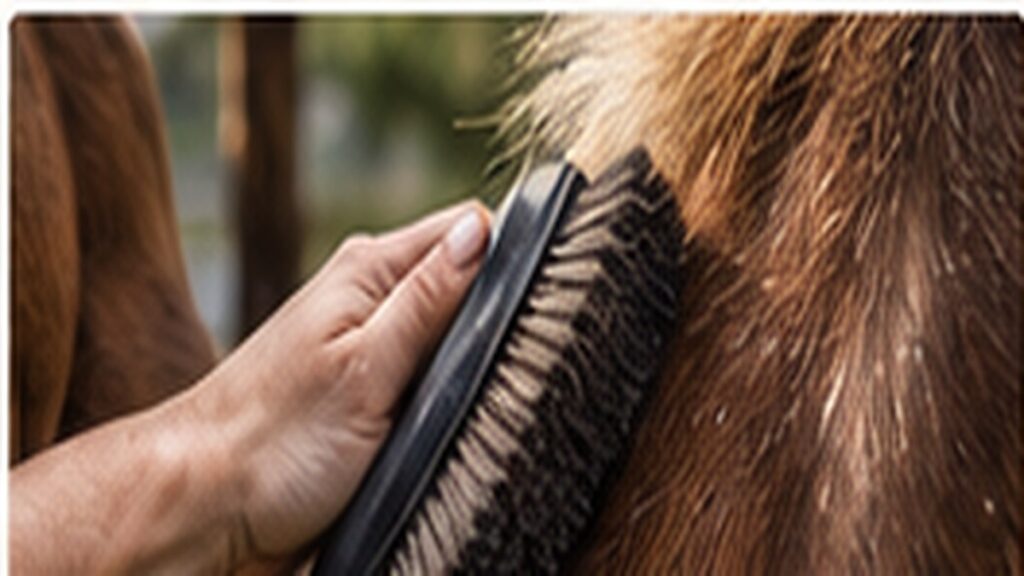
A dandy brush has relatively stiff bristles, commonly synthetic or natural fibre, and is intended to flick away loosened mud and debris. Stiffness, length, density and flexibility all affect performance. A long, moderately flexible bristle can reach through a thick coat; a short, dense brush may be effective on a fine coat but feel harsh on a sensitive horse.
Dandy brushes work best after the curry comb has loosened material. They are commonly used on the neck, shoulder, barrel, quarters and sometimes the upper limbs, provided the horse is comfortable and the bristles are not being driven into the skin. They are unsuitable for delicate facial areas and should be used cautiously over clipped coats.
Body brushes
Body brushes have shorter, softer bristles and are used to remove fine dust, smooth the coat and distribute surface oils. Natural bristles such as horsehair can give a pleasing finish but may retain moisture and organic material if not dried properly. Synthetic fibres are often easier to wash and may offer more consistent stiffness and durability.
For trade and professional use, the important characteristics are bristle security, density, resistance to deformation, grip comfort and cleanability. A brush that loses bristles into the coat, has an abrasive backing or develops a permanently compressed surface is no longer performing as intended.
Flick brushes
Flick brushes have longer, relatively flexible bristles that lift and throw away dust, bedding and loose hair. They are useful as a finishing tool or for horses that dislike heavier brushing. Their value is greatest on a dry coat; they are not designed to remove firmly adhered mud or scabs.
Grooming mitts and rubber gloves
Rubber mitts can be useful for washing, lifting loose hair and reaching around contours. They may give the handler better tactile feedback than a conventional brush, but the raised pattern can be abrasive if used forcefully or repeatedly. Their suitability depends on the horse’s coat and reaction. A grooming mitt should not be treated as a universal replacement for a soft brush.
Face, eyes and sensitive areas
Keep separate, clearly identified sponges or soft cloths for the face, eyes, nostrils and dock. The British Horse Society’s practical grooming equipment guidance distinguishes sponges for eyes, nose and dock, reflecting the importance of avoiding cross-contamination between body regions.
Use a clean, damp cloth or soft sponge around the eyes and facial folds. Do not use a curry comb, stiff brush or mane comb on the face. A separate face brush may be useful, but it should be visibly softer than the body brush and should not be shared between horses without appropriate cleaning.
Do not use grooming to remove material from an eye or to investigate persistent discharge, swelling, marked sensitivity or changes in facial behaviour. Those findings require appropriate professional assessment rather than more vigorous cleaning.
Hoof-care equipment
Hoof picks
A hoof pick is a basic inspection and cleaning tool. Useful designs have a strong, corrosion-resistant pick, a handle that remains secure when wet and, optionally, a small brush for clearing loose material from the frog and collateral grooves. The pick should be shaped to remove compacted dirt without requiring excessive force.
Hooves should be picked out as part of normal handling and before and after work where appropriate. The objective is not to excavate aggressively into the frog or sole. A sharp point used carelessly can cause injury, and a blunt or poorly shaped tool may encourage excessive pressure. Inspect the hoof pick regularly for a loose metal shaft, cracked handle, corrosion or a brush that has become contaminated.
Hoof brushes
A dedicated hoof brush can remove loose dirt after picking and is useful before applying a product where product use is appropriate. It should not be relied upon to compensate for poor hoof inspection. Keep hoof brushes separate from body brushes, and do not use a brush contaminated with manure or soil on the horse’s face or body.
Hoof dressing brushes and containers
If hoof products are used, select a brush with bristles compatible with the product and a handle that can be cleaned or discarded. Store products according to the manufacturer’s instructions and label brushes clearly. Hoof dressings are not a substitute for correct trimming, farriery, moisture management or investigation of hoof discomfort.
Mane, tail and feather equipment
Mane combs
A mane comb is generally used to separate, tidy or shorten mane hair, while a wide-toothed comb may be safer for detangling. Metal combs are durable and easy to clean, but can pull hair if dragged through knots. A comb should be used from the ends of a tangle upwards, with the handler supporting the hair rather than pulling continuously from the roots.
Whether a mane should be pulled, trimmed or left natural depends on breed, discipline, owner preference and the horse’s comfort. Repeatedly thinning a mane is not automatically welfare-neutral: some horses resent the process, and excessive removal reduces natural protection from insects and weather.
Mane and tail brushes
Wide paddle brushes and flexible detangling designs reduce the need to pull through knots. The best choice depends on hair texture. A stiff brush may be effective on a thick tail but can break fragile hair; a flexible, widely spaced design may be gentler but slower. Detangling sprays and conditioners can reduce friction, but their use should be proportionate and the hair should not be left excessively slippery where control or safety is affected.
Stand to the side rather than directly behind the horse, and work within a safe handling plan. Do not assume that a horse accustomed to body grooming will accept prolonged tail handling.
Feathering tools
Feathered legs require careful inspection because dense hair can conceal mud, scabs, parasites, swelling or skin damage. A soft brush, fingers and a clean cloth may be more appropriate than vigorous combing. Clipping feathers is a management decision, not an automatic improvement. Where hair is removed to permit examination or care, the process should be planned and performed with appropriate skill.
Clipping equipment
Clippers range from small trimmers for detail work to heavier machines designed for removing substantial coat. Selection should consider the proposed clip, coat density, noise, vibration, heat, battery or cable arrangement, blade availability, serviceability and operator competence.
Trimmers and clippers
Trimmers are useful for bridle paths, fetlocks, muzzles and small areas, but their lighter construction does not make them suitable for every full-body job. Full-size clippers normally have greater cutting capacity and cooling requirements. Cordless models improve freedom of movement but introduce battery charging, runtime and end-of-life considerations. Corded machines require careful cable management and an appropriate electrical safety system.
World Horse Welfare advises using suitable personal protective equipment, safe non-slip flooring, a tidy workspace and circuit-breaker protection for corded clippers. Blades should be kept sharp, oiled as directed and checked regularly for heat. Clean, dry coats reduce drag and help the machine work more efficiently. If blades become hot, stop and allow them to cool; overheating can cause discomfort or skin injury.
Clipping is not simply a technical haircut. The amount of coat removed affects thermoregulation and may alter rugging and stable-management requirements. The decision should take account of workload, coat growth, living conditions, body condition, age, health and the availability of shelter and appropriate rugs. World Horse Welfare specifically cautions that rugging decisions should be individual rather than based solely on what other horses are wearing.
Blade quality and maintenance
Blade quality depends on steel, precision of grinding, tooth geometry, hardness, surface finish and the ability to resharpen accurately. A blade that is technically sharp but damaged, incorrectly tensioned or poorly lubricated may cut unevenly and generate heat. Keep spare blades available for professional work, label blade sets if different cuts are required and send them for resharpening before they become visibly damaged.
After use, remove hair and debris, clean the clipper body according to the manufacturer’s instructions and store blades dry. Do not immerse electrical components unless the manufacturer expressly permits it. Service intervals should follow the technical documentation rather than an assumed annual schedule.
Introducing clippers to a horse
Noise and vibration can be more important than the cutting action itself. A horse that is worried should be introduced gradually, beginning with the equipment switched off and then progressing to sound and contact only while the horse remains calm. World Horse Welfare recommends breaking the process into manageable steps and avoiding the expectation that a frightened horse will become safe through restraint alone.
If urgent clipping is required for a medical reason and the horse cannot be handled safely, seek veterinary guidance. Sedation is a veterinary matter and should not be treated as a routine substitute for training or competent handling.
Bathing, drying and cleaning equipment
Bathing equipment commonly includes buckets, hose fittings, sponges, sweat scrapers, shampoo containers, towels and drying rugs. A sweat scraper removes excess water but should be used with awareness of pressure, skin sensitivity and temperature. A rigid scraper can be uncomfortable over bony areas or irritated skin.
Sponges should be assigned to specific uses and washed after use. Allow brushes, mitts and sponges to dry fully before storage. Damp, dirty equipment develops odour and can support microbial survival. Communal grooming kits deserve particular attention: where a horse has a suspected contagious skin condition, do not share equipment without a suitable cleaning and disinfection procedure based on professional advice and product instructions.
Shampoo is not an essential part of every grooming session. Frequent or unnecessarily strong washing may remove surface oils and worsen dryness or irritation in some horses. Use a product appropriate for the purpose, dilute it as directed, rinse thoroughly and dry the horse adequately. Persistent itching, hair loss, crusting, swelling or soreness should not be managed by repeatedly changing shampoos without investigating the cause.
Grooming-kit construction and material selection
| Component | Common materials | Advantages | Limitations and checks |
|---|---|---|---|
| Brush bristles | Horsehair, synthetic fibres, plant fibres | Different stiffness, finish and tactile response | Natural fibres can retain moisture; synthetic fibres may vary in flexibility and heat resistance |
| Brush backs | Wood, rubber, plastic | Wood offers a traditional grip; rubber and plastic are usually easier to wash | Wood needs drying and inspection; plastic can crack; rubber can degrade with age |
| Curry combs | Rubber, thermoplastic, metal | Rubber is flexible; plastic is easy to clean; metal is durable for brush cleaning | Hard edges or metal teeth can be abrasive on the horse |
| Hoof picks | Coated steel, stainless steel, plastic handles | Strong pick and corrosion resistance | Check handle security, corrosion and sharp accidental projections |
| Combs | Aluminium, stainless steel, plastic | Metal is durable; plastic can be lighter and less cold to handle | Closely spaced teeth can pull hair; rough moulding can scratch skin |
| Clippers | Metal housing, steel blades, polymer components | Repairable machines can have a long service life | Noise, vibration, heat, battery life and replacement-part availability matter |
For professional and commercial settings, inspect not only the initial purchase price but also replacement brushes, blade sharpening, battery replacement, warranty support, repair networks and cleaning time. A cheap tool that fails frequently or cannot be hygienically maintained may have a higher whole-life cost than a more durable alternative.
Quality indicators when buying equipment
- Secure construction: bristles, teeth, handles and metal components should not wobble, shed or separate under normal use.
- Rounded contact surfaces: no sharp moulding flash, burrs or splintered wood should contact the horse.
- Appropriate flexibility: tools should flex where intended without becoming weak or collapsing during use.
- Cleanability: avoid designs with deep, inaccessible cavities that retain hair, mud and moisture.
- Ergonomics: the grip should remain secure with wet or gloved hands and should not create excessive hand strain.
- Traceability: professional users should favour suppliers who provide material, care, warranty and replacement-part information.
- Fit for purpose: a tool designed for cattle, dogs or general household use may not be appropriate for a horse’s skin, coat or handling context.
Marketing terms such as “natural”, “premium”, “antibacterial” or “therapeutic” do not by themselves demonstrate better performance. Assess the tool’s construction, intended use, cleaning method and the horse’s response.
Hygiene and yard management
Every horse does not necessarily need a completely separate grooming kit, but communal equipment requires an agreed hygiene policy. The risk is greatest when tools are visibly dirty, remain damp, contact affected skin or are moved between horses without cleaning. Establish separate tools for faces, hooves and dirty legs, and quarantine or clean equipment after use on a horse with a suspected infectious condition.
Cleaning begins with removal of hair and organic matter. Wash tools with a suitable detergent, rinse and dry them completely. Disinfection is only reliable when the product is compatible with the material and used at the correct concentration and contact time. Follow the product label and yard biosecurity plan. Do not mix cleaning chemicals.
Store equipment off the floor, protected from rodents, moisture and direct weather. A ventilated grooming tote is usually preferable to a sealed, wet box. Empty hair and debris regularly. Replace sponges and brushes when they cannot be cleaned effectively.
Safety for horse and handler
Grooming is a handling activity, not a risk-free cosmetic procedure. The British Horseracing Authority’s health and safety material identifies temperament, equipment and safety in the box as relevant considerations for grooming, while clipping additionally involves electrical safety and protective equipment.
- Use a suitable, correctly fitted headcollar and lead arrangement where tying is appropriate.
- Use a quick-release system or breakaway point where the yard’s risk assessment requires it; do not create a fixed restraint that can trap the horse.
- Keep feet clear when picking up hooves and avoid placing yourself in a position where a sudden movement can pin you.
- Wear suitable footwear and, where the horse or task warrants it, gloves and head protection.
- Keep grooming tools, buckets, cables and stools out of escape routes.
- Do not groom beneath a horse that is loose, unsettled or inadequately restrained.
- Stop if the horse’s behaviour indicates escalating fear, pain or frustration.
Behaviour is information. Ear position, tail swishing, muscle tension, evasive movement, sudden aggression or repeated attempts to leave may reflect discomfort, fear, pain, learned anticipation or environmental stress. Do not label every objection as bad manners and respond by using a harsher tool. Change the method, reduce the intensity, improve the setup or obtain experienced help.
Common misconceptions
“More vigorous grooming is healthier.”
Not necessarily. Vigorous brushing may remove mud but can also abrade skin, damage hair, increase sensitivity and make grooming aversive. The correct pressure is the minimum needed for the stated purpose.
“A shiny coat proves the horse is healthy.”
Coat appearance is only one observation. Shine can be produced by grooming products or natural oils, while disease, nutritional imbalance, parasites, pain or poor management may not be obvious from appearance alone. Grooming should include inspection, not just polishing.
“Metal curry combs are standard for all horses.”
They are standard in some traditional kits but are not universally suitable for direct contact with the horse. Their primary modern use is often brush cleaning. Coat, skin and temperament should determine whether any firmer tool is appropriate.
“Every horse needs a full grooming kit with every brush.”
A focused kit is often better. A horse living out may need a hoof pick, appropriate mud-removal tool, soft brush, mane-and-tail equipment and inspection cloths, but not daily show-level polishing. Redundant tools increase clutter and hygiene problems.
“Clipping solves sweating and winter-coat problems.”
Clipping can be useful for horses in work, but it changes the horse’s insulation and increases management responsibilities. Rugging, shelter, forage, drying time and workload must be considered together.
A practical purchasing checklist
- Describe the horse’s coat, skin sensitivity, feathering, living conditions and workload.
- Define the jobs the kit must perform: daily inspection, mud removal, pre-ridden grooming, competition turnout, bathing or clipping.
- Buy separate face, hoof and body tools rather than relying on one multipurpose brush.
- Choose flexible, rounded and washable tools for sensitive areas.
- Check replacement-part availability for clippers and specialist equipment.
- Plan where tools will dry and how they will be cleaned between horses.
- Label communal or individual equipment clearly.
- Test the tool on a small, non-sensitive area and observe the horse’s response.
- Inspect equipment regularly and remove damaged tools from service.
- Review the kit as the horse’s coat, workload, age, health or management changes.
Connecting grooming with wider stable management
Grooming equipment works within a wider care system. Clean, dry bedding, sensible turnout, appropriate shelter, balanced feeding, regular hoof care, correct tack fit and effective parasite and biosecurity plans all influence what grooming can achieve. A brush cannot compensate for persistent wetness beneath rugs, poorly managed mud, inadequate drying after exercise or tack that rubs.
Regular grooming is also a useful observation period. It can reveal changes in weight, muscle, coat quality, limb filling, heat, sensitivity, wounds, rug rubs and behaviour. Record meaningful changes and seek professional advice when findings are persistent, severe, painful or unexplained. Grooming should support early recognition, not become an attempt to diagnose or treat a health problem with equipment alone.
The most defensible equipment choice is therefore welfare-led and task-specific: use enough pressure and equipment to achieve a clear management objective, maintain tools so they remain safe and hygienic, and adapt the routine to the individual horse rather than imposing a fixed grooming ritual.
Related industry reference: For businesses moving from technical research into trade sourcing, explore equestrian suppliers and manufacturers on EquiGuild.
Sources and further reading
- DEFRA: Code of practice for the welfare of horses, ponies, donkeys and their hybrids — statutory welfare guidance for England.
- British Horse Society: Owning a horse — practical equipment and ownership guidance.
- British Horse Society: Stage 1 Centre Guidance — examples of recognised grooming-kit components and safe preparation.
- World Horse Welfare: Clipping horses — welfare, safety, blade maintenance and acclimatisation guidance.
- World Horse Welfare: Rugging horses — individualised decisions about coat, clipping, shelter and temperature management.
- World Horse Welfare: Mud fever in horses — limits of grooming and the importance of professional advice for skin disease.
- British Equine Veterinary Association: Sedation for non-veterinary procedures — professional responsibilities where sedation is considered for clipping or other procedures.
- British Horseracing Authority: Health and Safety Manual — risk considerations for grooming, clipping, restraint, equipment and electrical safety.
Research note
Automatically researched source pack — editorial review required:
• www.worldhorsewelfare.org — https://www.worldhorsewelfare.org/advice/clipping-horses
• www.worldhorsewelfare.org — https://www.worldhorsewelfare.org/advice/mud-fever-in-horses
• www.beva.org.uk — https://www.beva.org.uk/news-insights/charter-for-the-horse-a-unified-approach-to-safeguarding-our-equines-and-equids/
• www.worldhorsewelfare.org — https://www.worldhorsewelfare.org/advice/rugging-horses-when-does-your-horse-need-a-rug
• eu.worldhorsewelfare.org — https://eu.worldhorsewelfare.org/index.php/advice/stabled-horses-how-to-occupy-them
• www.worldhorsewelfare.org — https://www.worldhorsewelfare.org/what-we-do/research/our-research/horses-in-our-hands
• www.beva.org.uk — https://www.beva.org.uk/resources/equine-dentistry-toolkit/current-regulations-on-equine-dental-procedures/
• www.worldhorsewelfare.org — https://www.worldhorsewelfare.org/news/weve-launched-a-free-tool-to-help-assess-horses-welfare-on-yards
• www.beva.org.uk — https://www.beva.org.uk/courses/clinical-catch-up-insect-induced-itchiness/
• www.beva.org.uk — https://www.beva.org.uk/resources/sedation-for-non-veterinary-procedures-professional-responsibilities-guidance/
• www.beva.org.uk — https://www.beva.org.uk/news-insights/the-brand-new-beva-ppe-toolkit-is-here/
• www.worldhorsewelfare.org — https://www.worldhorsewelfare.org/what-we-do/in-the-uk
• eu.worldhorsewelfare.org — https://eu.worldhorsewelfare.org/documents/eu-reports/2024-09-25-EfA-Equine%20White%20Paper-EN_0.pdf
• extension.psu.edu — https://extension.psu.edu/downloadable/download/sample/sample_id/23540/
• eu.worldhorsewelfare.org — https://eu.worldhorsewelfare.org/documents/horse-factsheets/horse-guide-factsheets---turnout---shelter-and-pasture.pdf
• extension.psu.edu — https://extension.psu.edu/downloadable/download/sample/sample_id/16802/
• extension.psu.edu — https://extension.psu.edu/downloadable/download/sample/sample_id/116113/
• www.gov.uk — https://www.gov.uk/government/publications/code-of-practice-for-the-welfare-of-horses-ponies-donkeys-and-their-hybrids
• www.bhs.org.uk — https://www.bhs.org.uk/horse-care-and-welfare/ownership-loaning/owning-a-horse/
• www.bhs.org.uk — https://www.bhs.org.uk/bhs-professional-qualifications-and-careers/equine-careers/groom/
Cite this article
Stable research ID: ERA-2026-000044
The Equestrian Research Atlas (2026) ‘Horse Grooming Equipment Guide’. The Equestrian Research Atlas. Available at: https://equestrianresearchatlas.co.uk/research/horse-grooming-equipment-guide/ (Accessed: 3 November 2026).
The Equestrian Research Atlas. (2026). Horse Grooming Equipment Guide. The Equestrian Research Atlas. https://equestrianresearchatlas.co.uk/research/horse-grooming-equipment-guide/
The Equestrian Research Atlas. “Horse Grooming Equipment Guide.” The Equestrian Research Atlas, 2026, https://equestrianresearchatlas.co.uk/research/horse-grooming-equipment-guide/. Accessed 3 November 2026.
Research references (54)
- www.worldhorsewelfare.org
- www.worldhorsewelfare.org
- www.beva.org.uk
- www.worldhorsewelfare.org
- eu.worldhorsewelfare.org
- www.worldhorsewelfare.org
- www.beva.org.uk
- www.worldhorsewelfare.org
- www.beva.org.uk
- www.beva.org.uk
- www.beva.org.uk
- www.worldhorsewelfare.org
- eu.worldhorsewelfare.org
- extension.psu.edu
- eu.worldhorsewelfare.org
- extension.psu.edu
- extension.psu.edu
- www.gov.uk
- www.bhs.org.uk
- www.bhs.org.uk
- www.bhs.org.uk
- www.bhs.org.uk
- www.britishhorseshop.com
- wwwprod.bhs.org.uk
- www.gov.uk
- www.bhs.org.uk
- www.bhs.org.uk
- media.britishhorseracing.com
- www.gov.uk
- wwwprod.bhs.org.uk
- www.gov.uk
- bhsq13prod.bhs.org.uk
- www.daera-ni.gov.uk
- www.legislation.gov.uk
- wwwinternaldev.bhs.org.uk
- www.reddit.com
- en.wikipedia.org
- en.wikipedia.org
- en.wikipedia.org
- en.wikipedia.org