
Purpose and scope
Farriery tools are designed around a sequence of controlled operations: inspecting and preparing the foot, removing an old shoe where necessary, trimming and shaping the hoof, making or modifying a shoe, fitting it, and securing and finishing the shoe with nails. The tools are not interchangeable. A hoof nipper cuts hoof wall; a rasp removes smaller amounts and finishes surfaces; pull-offs remove shoes; clinchers set nail clinches. Using the wrong tool may be inefficient, damage the hoof or shoe, or increase the physical load on the farrier.
This distinction matters particularly in Great Britain, where farriery is a regulated profession. The Farriers (Registration) Act 1975 restricts the use of the title “farrier” and the performance of farriery work to appropriately registered persons, subject to the legislation’s provisions. Tool ownership alone does not confer competence. Owners may use basic hoof-care equipment for routine observation or cleaning, but trimming and shoeing require practical training and professional judgement.
The terminology used in the trade varies. “Buffer” commonly means a clinch cutter, while “pincers” may refer either to shoe pull-offs or, depending on local usage, to other farrier pliers. Manufacturers may offer several patterns of the same tool for different hoof sizes, hand sizes, techniques and applications. The descriptions below therefore explain function rather than prescribing one universal design.
How the farrier’s toolkit is organised
A working kit can be divided into five overlapping groups:
- Inspection and cleaning tools: hoof pick, brush, hoof gauge, dividers and measuring equipment.
- Removal tools: clinch cutter, crease nail puller, nail nippers and shoe pull-offs.
- Hoof-preparation tools: hoof knives, loop knives, hoof nippers and rasps.
- Shoeing and finishing tools: driving hammer, nail punch, clinchers, clinch block, nail cutters and shoeing stand.
- Forging and hot-fitting tools: anvil, forge, tongs, rounding and turning hammers, pritchel, punches, creaser, fuller, hot-fitting tongs and wire brush.
Some tools appear in more than one group. A hammer, for example, may be used to drive nails, alter a shoe on the anvil or strike a clinch cutter. The important consideration is the tool’s intended geometry and the control required for the particular operation.
Inspection, cleaning and measurement tools
Hoof pick and brush
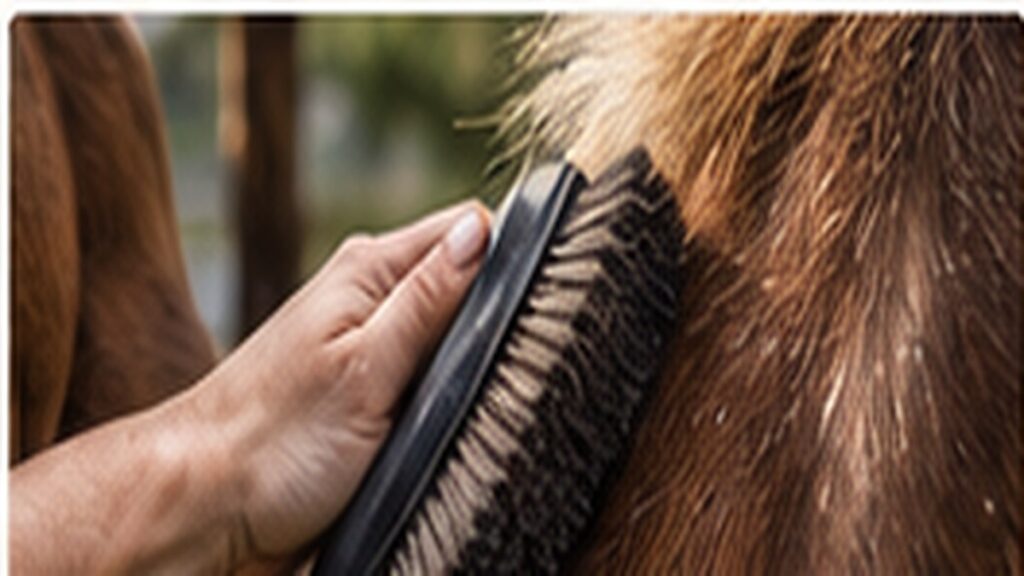
A hoof pick removes packed bedding, stones, mud and loose material from the central and collateral grooves of the foot. Many modern picks include a short brush for clearing finer debris after the larger material has been loosened. The tool is primarily for access and inspection, not for digging aggressively into sensitive structures.
A useful hoof pick should have a rigid, securely attached point, a comfortable handle and no sharp burrs where the hand rests. For professional work, durability and cleanability matter more than decorative features. A brush with firm but not excessively abrasive bristles helps reveal the junctions between wall, sole and frog.
Hoof gauge, dividers and measuring tools
A hoof gauge or hoof protractor helps record or compare hoof angles. Dividers, rulers and calipers may be used when assessing symmetry, shoe dimensions, clip placement or the relationship between the shoe and the prepared foot. These instruments support observation; they do not replace visual assessment, palpation, knowledge of hoof anatomy or evaluation of the horse in motion.
A common misconception is that a gauge can identify a single “correct” hoof angle for every horse. In practice, the reading is one measurement within a broader assessment. The two feet of the same horse may not be identical, and the appropriate trim or shoe design depends on conformation, limb alignment, workload, hoof quality, pathology where present, and the farrier’s clinical collaboration with the veterinary team.
Tools for removing shoes and nails
Clinch cutter or buffer
The clinch cutter is a short, chisel-ended tool used to lift, straighten or cut the turned-over ends of horseshoe nails—the clinches—before a shoe is removed. It is normally struck with a hammer. Removing or opening the clinches first reduces the likelihood of tearing the hoof wall as the shoe is pulled.
The cutting or striking end should be properly hardened but not excessively brittle. The striking head must be kept free from dangerous mushrooming: repeated hammer blows can cause metal to flare at the end, creating fragments or an unstable striking surface. A farrier should inspect the tool regularly and dress or replace it in accordance with competent workshop practice.
Crease nail puller and nail nippers
A crease nail puller is shaped to extract an individual nail from the shoe crease. Removing nails one at a time can provide more control than levering the whole shoe away, particularly where preserving the hoof wall is important. Nail nippers, sometimes called nail cutters, are used to cut or remove protruding nail ends and may also assist with nail removal depending on the pattern.
These tools should not be confused with hoof nippers. Hoof nippers have cutting jaws intended for hoof wall; nail pullers and nail nippers are designed around the smaller, harder nail and the geometry of the shoe crease. Using hoof nippers on nails can damage their cutting edges or create excessive leverage at the rivet.
Pull-offs or shoe pullers
Pull-offs are robust pincers with jaws designed to grip and lever a shoe from the foot after the clinches have been opened. The jaws, pivot, handle length and curvature vary. A longer handle can provide mechanical advantage but also increases the force transmitted if the tool slips or is used carelessly.
Professional technique generally aims to remove the shoe progressively rather than applying uncontrolled force. Pulling against an unopened clinch or levering unnecessarily against the hoof wall can cause avoidable wall damage. The tool should be matched to the shoe size and the available access around the foot.
Hoof-preparation tools
Hoof knife
A hoof knife is a small, curved cutting tool used for controlled paring of loose sole material, exfoliating sole, frog trimming and selected areas of hoof-wall preparation. Single-edged knives are made in left- and right-handed patterns so that the bevel and cutting action suit the direction of work. Double-edged and loop patterns are also available.
Knife design involves a compromise between access, control and durability. A narrow blade can reach restricted areas; a broader blade may provide greater stability for appropriate paring. The handle should permit a secure grip without forcing the wrist into an awkward position. The edge must be sharp enough to cut cleanly, but sharpness does not make the tool suitable for removing large amounts of sound horn. Excessive paring is a technique problem, not a tool-quality problem.
Loop knives are specialised curved blades used where a small, controlled channel or opening is required. They are not general-purpose substitutes for a standard hoof knife. Because they are capable of removing material quickly in a confined area, their use requires training and a clear understanding of hoof anatomy.
Hoof nippers
Hoof nippers are heavy end-cutting pliers used to remove excess hoof wall during trimming. They are available in different jaw widths, handle lengths, head shapes and pivot arrangements. Some patterns are designed for smaller feet or closer access; others provide greater leverage for thick or hard horn.
The cutting edges should meet evenly and be maintained so that they cut rather than crush or split the horn. Excessive looseness at the pivot produces inaccurate cuts and wastes effort. Conversely, a nipper that is too tight may be difficult to open repeatedly and may encourage the user to compensate with poor body mechanics.
Nippers remove bulk; they do not establish the entire finished hoof. A typical preparation sequence uses them conservatively, followed by a rasp for levelling, balancing and finishing. The amount removed should be determined by the foot being prepared, not by the apparent capacity of the tool.
Rasp
The rasp is a large, toothed file used to level and shape hoof wall, refine the bearing surface and remove sharp edges after nipper work. Conventional rasps have a coarse face for material removal and a finer face for finishing. The coarse side is efficient but can leave a rough surface; the finer side gives greater control for final work.
Rasp selection is influenced by cut, width, length, tooth pattern, handle design and the horn being worked. A sharp rasp should remove material predictably without excessive pressure. A blunt or clogged rasp encourages forceful strokes, reduces control and increases fatigue. A rasp handle is not merely a comfort accessory: it keeps the hand away from the toothed surface and provides a more secure grip, particularly when the farrier is working at speed or in wet conditions.
Rasps are consumable tools. Their service life depends on horn hardness, dirt contamination, storage, cleaning and workload. They should not be dropped onto hard surfaces or used on metal, as this damages the teeth. A wire brush can remove debris from the teeth; brushing should follow the direction of the cut rather than being forced aggressively across the rasp.
Nailing and finishing tools
Driving hammer
The driving hammer is used to drive horseshoe nails through the shoe and hoof wall, and in some designs to strike a clinch cutter or punch. Head weight, face size, handle length and balance affect control. A heavier hammer is not automatically better: excessive mass may reduce accuracy and increase fatigue, while an undersized hammer may require repeated blows.
The face should be smooth and appropriately dressed, without sharp lips or excessive mushrooming. The handle must be secure and free from splits. Hammer technique is inseparable from nail selection and shoe fit; the tool cannot compensate for an unsuitable nail, misplaced nail hole or poorly fitted shoe.
Clinchers
Clinchers turn the protruding nail ends down and set them neatly against the hoof wall. Patterns include straight, offset, race-track and “alligator” styles, each offering a different approach to access and leverage. The jaws should contact the nail and wall in a controlled manner rather than crushing a large area of horn.
A clincher is a finishing tool, not a substitute for accurate nailing. If a nail has been driven at an inappropriate exit point, excessive clinching force can worsen wall damage. The tool must be kept clean, aligned and free of damaged jaw surfaces.
Clinch block and nail cutter
A clinch block provides a firm surface against which a clinch may be set or finished. It helps support controlled work when the foot is positioned appropriately. A nail cutter or nipper removes excess nail length before the final clinch is formed. The sequence varies with the farrier’s method, but the underlying principle is consistent: cut cleanly, avoid leaving sharp projections and finish without crushing the wall.
Forging and hot-fitting equipment
Anvil and stand
The anvil provides the hard, shaped working surface on which a shoe can be drawn, bent, punched, creased and finished. Its face, horn, heel, hardy hole and pritchel hole support different operations. Anvils vary substantially in mass and design. A stable stand at a suitable height is essential for accurate work and safer body mechanics.
An anvil should be securely supported and positioned so that the farrier can work without excessive bending or reaching. A damaged face, loose stand or unsuitable height affects both the result and the physical demands of forging.
Turning, rounding and clipping hammers
A rounding or turning hammer alters the shape of a shoe on the anvil. A clipping hammer is used when drawing and shaping clips or performing related shoe-forging operations. The faces and peens are dressed for their intended work. The correct hammer is selected by the operation, shoe section and amount of metal being moved, rather than simply by weight.
Tongs
Farrier’s tongs hold a hot shoe or bar while it is forged or hot-fitted. Different jaw patterns are available for different shoe sections and shapes. The jaws should grip securely without distorting the work, and the handles should remain cool enough and long enough for controlled use.
Tongs are not intended to replace proper support when carrying or positioning heavy material. Hot metal should be assumed to be hot, even when its colour is misleading, and the work area must control access by people, animals and combustible materials.
Pritchel, punches, creaser and fuller
A pritchel is a pointed tool used to open, finish or enlarge punched nail holes in a horseshoe. A punch makes or refines holes; the precise tool and sequence depend on whether the hole is being punched, drifted or finished. A creaser forms the groove that houses the nail head, while a fuller creates or deepens a groove or channel during forging.
These are forging tools rather than hoof-preparation tools. Their dimensions must correspond to the shoe section and nail pattern. Poor alignment can produce distorted holes, weak shoe sections or nail heads that do not seat correctly. In manufactured shoes, the crease and nail holes are already formed; the farrier may still modify them, but doing so requires judgement about remaining metal thickness and shoe strength.
Forge and wire brush
A forge heats steel sufficiently for shaping and, in hot fitting, permits the shoe to be fitted to the hoof with controlled contact. A wire brush removes scale from hot metal and helps reveal the working surface. Forge layout, ventilation, fuel storage, hot-work controls and fire precautions are part of the equipment system, not optional additions.
Hot fitting is an established professional practice, but the presence of a forge does not make every shoeing situation suitable for heat. The decision depends on the farrier’s assessment, the horse, the shoe, the premises and the available safety controls. Owners should not attempt to replicate hot-fitting operations without appropriate training and supervision.
Selection and quality indicators
Price alone is a poor measure of a farrier tool. More useful indicators include:
Related industry reference: For businesses moving from technical research into trade sourcing, explore equestrian suppliers and manufacturers on EquiGuild.
- Correct geometry: jaws, blades, faces and pivots should be designed for the stated operation.
- Material and heat treatment: cutting edges need wear resistance; striking tools need toughness and resistance to dangerous deformation.
- Alignment: jaws should meet consistently and moving parts should operate without excessive side play.
- Surface finish: working faces should be smooth where they contact the hoof or nail; sharp burrs and cracks are unacceptable.
- Ergonomics: handle shape, length, balance and grip affect control and cumulative strain.
- Repairability: some professional tools can be sharpened, dressed or rehandled; others are better replaced when worn.
- Traceability and support: established manufacturers and specialist suppliers are more likely to provide dimensions, replacement parts and technical guidance.
“Forged steel” is not, by itself, a guarantee of quality. The finished geometry, heat treatment, inspection and maintenance determine performance. Likewise, a heavier tool is not necessarily stronger or safer. Tool choice should be based on the work, the operator’s technique and the horse’s foot.
Maintenance, storage and workshop safety
Tools should be cleaned after use, dried before storage and protected from corrosion. Cutting edges should be sharpened by a competent person using a method appropriate to the tool. Grinding can remove temper or alter the intended edge angle if excessive heat is generated. Pivots should be maintained as recommended by the manufacturer, and damaged handles, loose heads and cracked jaws should be removed from service.
Rasps and knives should be stored so that their working edges cannot injure hands or damage other equipment. Hammers, punches and pritchels require particular attention to striking ends: mushroomed ends can shed fragments under impact. Safety glasses are appropriate where there is a risk from flying scale, metal fragments or grinding debris. Gloves may protect against rough edges and heat in suitable tasks, but they do not remove the need for secure handling and should not compromise control around moving or cutting tools.
Farriery is physically demanding. Repeated lifting, holding, bending, kneeling and striking can contribute to musculoskeletal injury. UK workplace guidance treats manual handling broadly, including lifting, carrying, pushing, pulling and supporting loads. A sensible setup therefore considers the position of the horse, the height of the hoof stand, the location of the tool box and anvil, and whether equipment can be moved without unnecessary lifting or twisting. ([hse.gov.uk](https://www.hse.gov.uk/agriculture/topics/manual-handling.htm?utm_source=openai))
Common misconceptions
- “A rasp can do everything a nipper can do.” A rasp is useful for controlled reduction and finishing, but it is not a direct substitute for a hoof nipper in every foot or workload.
- “Pull-offs and hoof nippers are the same tool.” Their general appearance may be similar, but their jaws and intended loads differ.
- “The sharpest knife is the safest knife.” Sharpness improves cutting efficiency, but safe use also depends on direction, restraint, anatomy, hand position and training.
- “A hoof gauge gives the correct angle.” It gives a measurement. Interpretation requires a complete assessment of the horse and foot.
- “More leverage is always preferable.” Longer handles reduce effort in some operations but can magnify slips, excessive force and damage when the tool is misapplied.
- “Hot fitting burns the hoof.” Heat is controlled by the farrier’s technique and timing; however, hot work carries additional risks and must be performed competently and with suitable controls.
- “A complete tool kit makes someone a farrier.” Farriery is a skilled, regulated occupation. Tools support judgement and technique; they do not replace either.
Choosing equipment for different users
A professional farrier needs redundancy, specialist patterns and consumables appropriate to the caseload. The working kit may include multiple nippers, knives, rasps, clinchers and hammers because no single pattern performs optimally on every foot or in every condition.
An apprentice should prioritise correctly sized core tools, instruction from an approved or otherwise suitably qualified mentor, and safe maintenance practices rather than buying a large collection immediately. Training institutions commonly specify a core list including nippers, knives, rasps, pull-offs, clinchers, a driving hammer, clinch cutter and forging tools. The exact list varies with the course and whether the student is learning cold shoeing, hot shoeing or both. ([montana.edu](https://www.montana.edu/msufarrierschool/tools_books.html?utm_source=openai))
For a horse owner, the appropriate personal kit is usually limited to a hoof pick, brush and perhaps basic observation equipment. Hoof knives, nippers, rasps and shoe-removal tools can cause injury or alter the foot if used without training. Their presence in a tack room should not be taken as an invitation to undertake trimming or shoe removal independently.
Relationship to wider hoofcare practice
Tools are one part of a wider hoofcare system that includes hoof anatomy, horn growth, conformation, movement, shoe design, nail choice, environmental management and communication between owner, farrier and veterinary surgeon. The tool determines how material can be altered; it does not determine what should be altered.
Good farriery therefore combines appropriate equipment with repeatable observation. The farrier assesses the foot before selecting the tool, uses the least aggressive effective operation, checks the result during the process and evaluates the finished work in relation to the horse. This is why two experienced farriers may prefer different brands or patterns while achieving sound, comparable results: hand size, training, caseload and technique influence equipment choice.
Sources and further reading
- University of Kentucky, Horse Discovery: Equipment — concise descriptions of hoof-care and shoe-removal tools.
- Montana State University Farrier School: Tools and Books — example training-equipment list covering shoeing and forging tools.
- UK Health and Safety Executive: Agriculture—Manual Handling — workplace guidance relevant to farriery’s physical demands.
- UK Health and Safety Executive: Musculoskeletal-disorder resources — assessment resources for workplace strain and manual handling.
- Farriers Registration Council: Who’s Who in UK Farriery — background on British farriery organisations and professional regulation.
- Farrier Products: Product Guide — manufacturer technical information illustrating common patterns of farrier hand tools.
Research note
Automatically researched source pack — editorial review required:
• afs.ca.uky.edu — https://afs.ca.uky.edu/horse-discovery/equipment
• www.toolsmithltd.co.uk — https://www.toolsmithltd.co.uk/blogs/news/farrier-first-10-tools-uk-apprentice-starter-kit-2026
• ncc.kerala.gov.in — https://ncc.kerala.gov.in/images/pdf/handbook/rvc_sr/RV%20SD%20SW%20WEB%20FINAL%2017%20OCT%202025.pdf
• afs.mgcafe.uky.edu — https://afs.mgcafe.uky.edu/sites/afs.ca.uky.edu/files/HA%20Level%204%20Rev%2011.24_1.pdf
• www.montana.edu — https://www.montana.edu/msufarrierschool/tools_books.html
• www.farrier-reg.gov.uk — https://www.farrier-reg.gov.uk/fileadmin/uploads/frc/News/Who%27s%20Who%20in%20UK%20Farriery%20-%20FRC%20website%20-%20May%202020.pdf
• www.fizzasurgical.com — https://www.fizzasurgical.com/hoof-trimming-tools-farrier-instrument-guide/
• webcollect.org.uk — https://webcollect.org.uk/bfba
• ynrinstruments.co.uk — https://ynrinstruments.co.uk/collections/farrier
• piaffehorse.com — https://piaffehorse.com/guides/farrier-tools-for-hoof-care/
• www.oldscollege.ca — https://www.oldscollege.ca/_media/farrier-science-tool-list.pdf
• en.wikipedia.org — https://en.wikipedia.org/wiki/Farrier
• www.americanfarriers.com — https://www.americanfarriers.com/articles/11234
• www.berwickshirerda.org.uk — https://www.berwickshirerda.org.uk/index.asp?pageid=555139
• farrieriq.com — https://farrieriq.com/farrier-equipment-checklist
• www.hse.gov.uk — https://www.hse.gov.uk/agriculture/topics/manual-handling.htm
• www.hse.gov.uk — https://www.hse.gov.uk/msd/resources.htm
• www.farrierproducts.com — https://www.farrierproducts.com/PDFS/FPDProductGuide_web.pdf
• static1.squarespace.com — https://static1.squarespace.com/static/54d3b2bbe4b03a40912d2cc9/t/612fee72507ef841d49ca005/1630531191800/Brochure%2B2021.pdf
• www.reddit.com — https://www.reddit.com/r/Farriers/comments/1rqh3y0/got_me_some_new_tools_before_summer_hardens_up/
Cite this article
Stable research ID: ERA-2026-000236
The Equestrian Research Atlas (2026) ‘Farriery Tools and Their Functions’. The Equestrian Research Atlas. Available at: https://equestrianresearchatlas.co.uk/research/farriery-tools-and-their-functions/ (Accessed: 3 November 2026).
The Equestrian Research Atlas. (2026). Farriery Tools and Their Functions. The Equestrian Research Atlas. https://equestrianresearchatlas.co.uk/research/farriery-tools-and-their-functions/
The Equestrian Research Atlas. “Farriery Tools and Their Functions.” The Equestrian Research Atlas, 2026, https://equestrianresearchatlas.co.uk/research/farriery-tools-and-their-functions/. Accessed 3 November 2026.
Research references (38)
- afs.ca.uky.edu
- www.toolsmithltd.co.uk
- ncc.kerala.gov.in
- afs.mgcafe.uky.edu
- www.montana.edu
- www.farrier-reg.gov.uk
- www.fizzasurgical.com
- webcollect.org.uk
- ynrinstruments.co.uk
- piaffehorse.com
- www.oldscollege.ca
- en.wikipedia.org
- www.americanfarriers.com
- www.berwickshirerda.org.uk
- farrieriq.com
- www.hse.gov.uk
- www.hse.gov.uk
- www.farrierproducts.com
- static1.squarespace.com
- www.reddit.com
- www.reddit.com
- www.reddit.com
- www.reddit.com
- www.reddit.com
- www.reddit.com
- www.reddit.com
- www.reddit.com
- www.reddit.com
- www.reddit.com
- www.reddit.com
- www.reddit.com
- en.wikipedia.org
- en.wikipedia.org
- en.wikipedia.org
- en.wikipedia.org
- en.wikipedia.org
- www.hse.gov.uk
- www.montana.edu
Related research
 Maintaining, Sharpening and Replacing Farriery ToolsContinue research →Farriery Aprons, Stands and Workshop EquipmentContinue research →Hoof Protection for Work, Turnout and RehabilitationContinue research →Hoof Rasp Design and Abrasive PerformanceContinue research →
 Horseshoe Materials ComparedContinue research →Hoof Boots: Materials, Fit and ConstructionContinue research →