
End-of-life decisions for tack should begin with a functional question rather than a material label: can the item still be used safely for the purpose for which it was designed? If the answer is yes, continued use, repair, resale or donation normally has a stronger circular-economy case than material recycling. If it cannot be used as tack, the next question is whether useful components can be recovered. Only after those options have been considered should the residual material be directed to recycling, recovery or disposal.
This matters because equestrian equipment is usually a composite product. A leather headcollar may include hide, synthetic thread, edge coatings, dyes, adhesives, buckles and rings. A saddle may contain leather, flocking or foam, a tree, webbing, metal fittings and bonding agents. A synthetic girth or bridle may combine several polymers that cannot be separated economically. Consequently, a household textile bank or general plastics collection is not automatically an appropriate route for worn tack.
The hierarchy: keep the product in use for as long as possible
In England, the waste hierarchy places prevention first, followed by preparing for reuse, recycling, other recovery and disposal. Preparing for reuse means checking, cleaning or repairing an item so that it can be used again; recycling means reprocessing waste into products, materials or substances. The hierarchy is a useful decision framework across the UK, although detailed waste regulation and local collection arrangements differ between England, Wales, Scotland and Northern Ireland. The National Planning Policy for Waste summarises the hierarchy and its meaning.
For tack, this gives a practical order of preference:
- Prevent premature failure: buy appropriately, maintain correctly, store dry and ventilated, and replace individual worn parts where this is technically sound.
- Reuse: sell, loan, donate or pass on equipment that remains fit for its original purpose.
- Prepare for reuse: have suitable items professionally inspected, cleaned, repaired or reflocked before resale or donation.
- Repurpose: use non-safety-critical leather or hardware for craft, workshop or display purposes.
- Recycle: send clean, identifiable and suitably separated materials to a route that accepts them.
- Recover energy or dispose: use only an appropriate, controlled waste route for material that cannot safely or economically be reused or recycled.
These are priorities, not guarantees. A heavily contaminated item may be unsuitable for reuse. A repair that conceals structural failure may create a greater risk than disposal. Likewise, dismantling a complex product into multiple small streams can consume more resources than sending it intact to a licensed contractor.
First decision: is the tack still safe to use?
Environmental benefit must not override equine or human safety. Tack should not be passed on for riding or handling merely because it looks serviceable. Load-bearing leather and webbing can lose strength through abrasion, stretching, hydrolysis, ultraviolet exposure, sweat, mould, chemical attack and repeated flexing. Damage may be hidden beneath keepers, stitching, lining, padding or decorative coverings.
Before reuse, a competent person should consider:
- cracks, deep cuts, brittle or spongy areas, severe thinning and pulled holes;
- failed or loose stitching, especially at billets, girth points, reins, cheekpieces and stirrup-leather attachments;
- distorted, fractured or corroded buckles, rings, hooks, bars and rivets;
- delamination, bubbling, tackiness or powdering in coated synthetic materials;
- compressed, contaminated or degraded foam and elastic;
- tree damage, broken panels or altered geometry in saddles; and
- unknown provenance, missing history or uncertainty about previous overloading, chemical exposure or improper repair.
Where a component is safety-critical, the appropriate route may be inspection by a qualified saddler, harness maker, manufacturer or other technically competent person. A decorative reuse project is different: an irreparably damaged girth may be suitable for a wall display, but that does not make it suitable for another horse.
Leather tack: durable, repairable and chemically complex
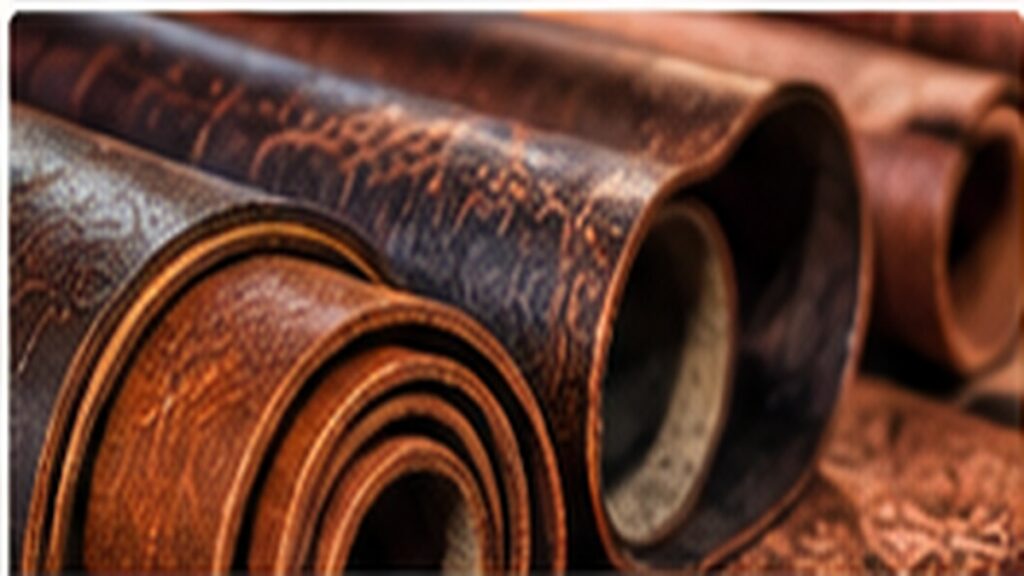
Leather is a collagen-based material whose properties depend on the animal hide, tanning system, retannage, finishing, thickness, fibre structure and use history. Tack is commonly chrome-tanned, vegetable-tanned or made from combinations of leather and coated materials. “Real leather” does not mean that the end-of-life route is automatically composting or garden waste. Tanning, dyes, finishes, oils, waxes, adhesives, mould treatments and metal contamination can all affect the appropriate route.
Reuse and repair
Good-quality leather often has the highest value when kept in service. Bridlework, reins, headcollars and breastplates may be repairable if the damage is localised and the surrounding leather retains adequate strength. Repairs should preserve the original load path and should not rely solely on decorative stitching, glue or a new hole placed next to a failed hole. A saddler or harness maker can advise on replacing billets, keepers, stitching, buckles and panels.
Repair is not always sustainable if it requires replacing most of the product, introduces incompatible materials or merely postpones failure. For businesses, recording the reason for rejection can help distinguish repairable stock from material that should be dismantled or quarantined.
Repurposing leather
Leather that is no longer safe as tack may be suitable for non-load-bearing goods such as small cases, labels, tool rolls, book covers, handles or workshop templates. This is generally an example of open-loop reuse or downcycling, not leather-to-leather recycling. The distinction matters: the original material remains useful, but it may not return to an equivalent tack application.
Before cutting, remove or isolate metal fittings and inspect for mould, oil contamination, sharp wire, broken rivets and residues of cleaning chemicals. Do not assume that an old saddle can be safely stripped by an untrained person: trees can contain wood, laminate, fibreglass or other structures, and springs or staples may be concealed beneath coverings.
Why leather recycling is not a kerbside option
Industrial leather-waste treatments include size reduction, fibre recovery, collagen hydrolysis, composite manufacture, chromium recovery, biological treatment and thermal processes. Research reviews describe potential recovery of collagen-derived materials, chromium, fats, biogas and other secondary feedstocks, but these are specialist industrial routes rather than ordinary domestic recycling. Chrome-tanned leather is particularly important to identify because chromium-bearing residues require controlled management; the presence and chemical form of chromium cannot be inferred reliably from colour or appearance.
A 2021 review in the Journal of Cleaner Production describes the potential recovery of chromium, collagen hydrolysate, nutrients, fats and energy from tannery waste, while also noting the need to manage environmental and regulatory risks. A separate review of chrome-tanned leather recycling explains that recovered leather fibres and hydrolysed collagen may be incorporated into polymer composites, but this remains a technically controlled process rather than a universal collection service. Chojnacka and colleagues, 2021; Polymers review of chrome-tanned leather recycling.
For a UK owner, the sensible action is to ask a potential recycler specifically whether it accepts post-consumer leather tack, whether it requires leather to be separated from metal and synthetic components, and what it does with chrome-tanned material. “Leather recycling” on a general textile collection page may refer to shoes, clothing or production offcuts and may not include bulky or composite equestrian equipment.
Webbing: identify the polymer before choosing a route
Webbing is a woven or knitted narrow textile. Common tack materials include nylon, polyester and polypropylene, with elastomeric fibres sometimes used in girths, protective equipment and adjustment sections. The fibres may be solution-dyed, coated, laminated, stitched, bonded or combined with foam and leather.
| Material or construction | Typical characteristics | End-of-life implications |
|---|---|---|
| Nylon or polyamide | High strength, abrasion resistance and elasticity; may absorb more moisture than polyester. | Potentially valuable to specialist polymer or textile recyclers, but colour, coatings, stitching and mixed assemblies reduce acceptance. |
| Polyester | Good dimensional stability and resistance to many environmental factors; widely used in woven webbing. | May be accepted by some textile or polymer routes; a webbing product is not necessarily accepted by bottle or packaging recycling. |
| Polypropylene | Low density and moisture resistance; often used in economical webbing and ropes. | Requires a route that accepts polypropylene textile products; contamination and mixed fibres remain obstacles. |
| Elasticated or laminated webbing | Contains elastane, rubber, foam, adhesive or polymer coatings in addition to the carrier textile. | Usually difficult to recycle as a single material; dismantling may be the only way to recover hardware or a clean textile fraction. |
Do not rely on a burn test or informal visual identification. It can be unsafe and may not distinguish blends or coatings. Product labels, manufacturer specifications and records are preferable. If the material cannot be identified, describe it to the waste contractor as mixed or unknown synthetic textile rather than making an unsupported claim.
Mechanical and chemical textile recycling
Mechanical textile recycling generally cuts, tears, shreds or opens material. It can produce wiping cloths, padding, insulation, non-woven products or recovered fibre. The process often shortens or damages fibres, so the output may be lower-grade and used in an open-loop application rather than spun into equivalent new webbing.
Chemical recycling can dissolve, depolymerise or otherwise separate selected polymers into intermediates or monomers. It may offer a route to higher-quality fibre or plastic output, but it needs controlled, relatively consistent feedstock. The European Commission’s Joint Research Centre reports that textile recycling remains dominated by mechanical processing, with chemical processes operating at a smaller scale, and that blends and composite products are particularly difficult. Its technical assessment also reports that fibre-to-fibre recycling represented a very small proportion of separately collected used textiles at the time of the study. JRC circular-economy perspectives for EU textiles; JRC assessment of used and waste textiles.
This is why a claim such as “the webbing will be recycled into new tack” should be treated cautiously unless the collector identifies the actual process and output. More commonly, a clean, sorted fraction may be downcycled or combined with other feedstock.
Synthetic tack: plastics, foams, coatings and composites
“Synthetic” is not a single material category. Tack may use PVC-coated fabric, polyurethane-coated textile, thermoplastic polyurethane, polyethylene, polypropylene, nylon, polyester, rubber, EVA foam or combinations of these. A synthetic bridle can therefore be more difficult to recycle than a simple woven strap, despite appearing easier to clean.
Common failure modes include surface cracking, hydrolysis, embrittlement, tackiness, delamination and loss of flexibility. Polyurethane coatings and foams can degrade with age and moisture; PVC products may contain plasticisers and stabilisers; elastics lose recovery; and adhesives can prevent clean separation. A product that has become sticky, powdery or strongly odorous should not be passed on for equestrian use merely because the webbing core appears intact.
Cleaning before reuse or recycling
Remove mud, hair and loose contamination using the least aggressive method compatible with the material. Avoid soaking composite products unless the manufacturer permits it. Do not apply oils or dressings to synthetic materials simply to improve appearance: a temporary cosmetic improvement can interfere with sorting, contaminate a recycling stream or conceal degradation.
For recycling, “clean” usually means free from excessive organic matter, hazardous residues and loose attachments, not necessarily cosmetically perfect. Ask the receiving scheme for its specification. A contractor may reject tack with mould, manure, oil, pesticide residue, veterinary-product contamination, wet material or attached metal.
Hardware, foam, flocking and other components
Metal buckles, rings, snaps and stirrup irons are generally more straightforward to recycle than leather or composite straps, provided they are separated and free from excessive contamination. Stainless steel, aluminium, brass and plated steel should not be assumed to share the same value or acceptance criteria. Small quantities can be impractical to sort, and some recycling centres will accept metal only through designated household or commercial channels.
Related industry reference: For businesses moving from technical research into trade sourcing, explore leather-goods manufacturers on EquiGuild.
Related industry reference: For relevant trade sourcing and supply-chain context, explore leather suppliers on LeatherTradeHub.
Foam, rubber, flocking and elastic are more problematic. Saddle flocking may be wool, synthetic fibre, foam or a mixture, sometimes contaminated with dirt and sweat. Polyurethane foam is not equivalent to expanded polystyrene packaging. Rubber components may be vulcanised and may not be accepted in ordinary plastics collections. These fractions are normally best handled through a specialist waste contractor unless the item is being repaired or repurposed.
Donation, resale and the legal meaning of waste
In England, the Environment Agency explains that an item may not be waste if it is intended for lawful reuse in the same purpose, requires no more than minor repair, and is managed in a way that does not indicate disposal. Once an item has been discarded and becomes waste, simply giving it away does not automatically remove its waste status; an end-of-waste assessment may be relevant. Environment Agency: Check if your material is waste.
In practical terms, businesses should distinguish clearly between:
- Sale or donation of usable tack: describe condition honestly, identify known repairs and do not imply that an item is safe where this has not been assessed.
- Donation for repair or parts: label it explicitly as such and remove any expectation that it can be used immediately on a horse.
- Waste transfer to a recycler or contractor: use an appropriate carrier and retain relevant transfer or collection records where required.
The Environment Agency’s waste-classification guidance states that producers must classify waste to determine whether it is hazardous and which controls apply. A mixed load of tack is not automatically hazardous, but contamination, chemical residues and particular materials may change the assessment. Technical Guidance WM3.
A practical route for households and yards
- Quarantine unsafe items. Mark them clearly so they cannot return accidentally to the tack room.
- Sort by intended outcome. Separate usable tack, repair candidates, parts, craft material and residual waste.
- Record material information. Keep labels, manufacturer information and photographs of construction where useful.
- Remove obvious loose contamination. Keep material dry and do not mix it with food, sharps, chemicals or wet waste.
- Separate accessible hardware. Do not dismantle complex or tensioned assemblies if doing so creates injury risk.
- Contact the recipient before transport. Confirm that it accepts equestrian tack, the material type, size, condition and contamination level.
- Use a licensed or appropriately authorised waste route for business waste. Keep documentation where the rules require it.
Local authority textile banks may accept clean shoes, clothing and some household textiles, but acceptance of leather tack, saddles, synthetic bridles and bulky equipment varies. A local recycling centre’s acceptance of textiles does not prove that it accepts composite tack. In England, household recycling requirements do not turn every plastic or textile article into a kerbside item; local authority instructions remain decisive. GOV.UK guidance on simpler recycling.
Guidance for manufacturers and equestrian businesses
End-of-life performance is largely designed in. Manufacturers can improve circularity by reducing unnecessary material combinations, using reversible fastenings where practicable, documenting fibre and polymer content, avoiding hard-to-remove coatings, and designing replaceable wear parts. Product passports or clear material labels can make sorting more reliable, although labels alone do not create a recycling market.
Businesses should avoid broad claims such as “fully recyclable”, “biodegradable” or “zero waste” unless the claim is specific, evidenced and qualified by collection geography, preparation requirements and actual recycling output. A product may be technically recyclable in a laboratory or specialist facility but not accepted through any realistic GB route.
Useful procurement questions include:
- Which components are load-bearing and replaceable?
- Are the webbing fibres and coatings identified?
- Can the product be dismantled without destroying otherwise recoverable materials?
- Does the supplier operate a take-back, repair or refurbishment scheme?
- What proportion of returned products is reused, recycled, recovered or disposed of?
- Are recycled-content claims supported by chain-of-custody or third-party verification?
Common misconceptions
- “Leather is natural, so it can go in compost.” Tanned and finished leather is not equivalent to untreated hide. Chromium, coatings, dyes and adhesives may make composting inappropriate.
- “Synthetic means recyclable plastic.” A synthetic product may contain several polymers, textile reinforcement, foam, elastics and metal.
- “If a textile bank accepts clothes, it accepts tack.” Collection operators set their own specifications and may reject contaminated, bulky or composite items.
- “Recycling is always better than reuse.” The waste hierarchy prioritises preparation for reuse over recycling where reuse is safe and realistic.
- “Downcycling is the same as closed-loop recycling.” Turning webbing into padding or leather into a craft item can retain value, but it does not return the material to an equivalent product system.
- “A recycler will separate everything.” Separation may be technically possible but uneconomic, unsafe or unavailable at the scale of individual tack items.
Bottom line
The best end-of-life route for tack is determined by condition, construction, contamination, material identity and the receiving system. Keep safe equipment in use; repair it where competent repair restores function; donate or sell it honestly; repurpose non-safety-critical parts; separate clean materials where a confirmed route exists; and send complex or contaminated remnants through an appropriate waste contractor.
For GB equestrian businesses, the strongest circularity improvement is often not a novel recycling claim but better product stewardship: longer service life, replaceable components, reliable material information, take-back arrangements and transparent reporting of what actually happens after collection.
Sources and further reading
- UK Government, National Planning Policy for Waste: waste hierarchy
- Environment Agency, Check if your material is waste
- Environment Agency, Technical Guidance WM3: Waste Classification
- Environment Agency and Defra, Packaging waste and recyclables: how to classify
- European Commission Joint Research Centre, Circular economy perspectives in the EU textile sector
- European Commission Joint Research Centre, Techno-scientific assessment of used and waste textiles
- Chojnacka et al., Progress in sustainable technologies of leather wastes valorization, Journal of Cleaner Production
- Recycling of chrome-tanned leather and its utilisation in polymer-based composites, Polymers
- RSPCA, Donate tack and horse equipment
Research note
Automatically researched source pack — editorial review required:
• www.gov.uk — https://www.gov.uk/guidance/packaging-waste-and-recyclables-how-to-classify
• www.gov.uk — https://www.gov.uk/government/publications/waste-classification-technical-guidance
• www.gov.uk — https://www.gov.uk/guidance/landspreading-benefits-and-risks-of-the-waste-types-you-can-use/04-waste-codes
• www.gov.uk — https://www.gov.uk/guidance/waste
• www.gov.uk — https://www.gov.uk/guidance/check-if-your-material-is-waste
• www.gov.uk — https://www.gov.uk/guidance/separate-collection-of-waste-paper-plastic-metal-and-glass
• www.gov.uk — https://www.gov.uk/guidance/simpler-recycling-household-recycling-in-england
• www.gov.uk — https://www.gov.uk/government/publications/national-planning-policy-for-waste/national-planning-policy-for-waste
• op.europa.eu — https://op.europa.eu/en/publication-detail/-/publication/760bcc13-932d-11ee-8aa6-01aa75ed71a1/language-en
• knowledge.bsigroup.com — https://knowledge.bsigroup.com/products/data-sheets-footwear-tests-materials-and-test-adhesives-1
• single-market-economy.ec.europa.eu — https://single-market-economy.ec.europa.eu/sectors/textiles-ecosystem/textiles-leather-fur_en
• www.gov.uk — https://www.gov.uk/government/consultations/waste-assessment-and-classification
• assets.publishing.service.gov.uk — https://assets.publishing.service.gov.uk/media/5a795abde5274a2acd18c223/pb13530-waste-hierarchy-guidance.pdf
• publications.jrc.ec.europa.eu — https://publications.jrc.ec.europa.eu/repository/bitstream/JRC134586/JRC134586_01.pdf
• environment.ec.europa.eu — https://environment.ec.europa.eu/document/download/74126c90-5cbf-46d0-ab6b-60878644b395_en?filename=COM_2022_141_1_EN_ACT_part1_v8.pdf&prefLang=el
• assets.publishing.service.gov.uk — https://assets.publishing.service.gov.uk/media/5a797dfde5274a3864fd7772/pb13529-waste-hierarchy-summary.pdf
• assets.publishing.service.gov.uk — https://assets.publishing.service.gov.uk/media/5c18f11740f0b60bbee0d827/resources-waste-strategy-dec-2018.pdf
• en.wikipedia.org — https://en.wikipedia.org/wiki/Clog_%28British%29
• en.wikipedia.org — https://en.wikipedia.org/wiki/Technical_Guidance_WM2
• de.wikipedia.org — https://de.wikipedia.org/wiki/Schuh
Cite this article
Stable research ID: ERA-2026-000247
The Equestrian Research Atlas (2026) ‘End-of-Life Options for Leather, Webbing and Synthetic Tack’. The Equestrian Research Atlas. Available at: https://equestrianresearchatlas.co.uk/research/end-of-life-options-for-leather-webbing-and-synthetic-tack/ (Accessed: 3 November 2026).
The Equestrian Research Atlas. (2026). End-of-Life Options for Leather, Webbing and Synthetic Tack. The Equestrian Research Atlas. https://equestrianresearchatlas.co.uk/research/end-of-life-options-for-leather-webbing-and-synthetic-tack/
The Equestrian Research Atlas. “End-of-Life Options for Leather, Webbing and Synthetic Tack.” The Equestrian Research Atlas, 2026, https://equestrianresearchatlas.co.uk/research/end-of-life-options-for-leather-webbing-and-synthetic-tack/. Accessed 3 November 2026.
Research references (61)
- www.gov.uk
- www.gov.uk
- www.gov.uk
- www.gov.uk
- www.gov.uk
- www.gov.uk
- www.gov.uk
- www.gov.uk
- op.europa.eu
- knowledge.bsigroup.com
- single-market-economy.ec.europa.eu
- www.gov.uk
- assets.publishing.service.gov.uk
- publications.jrc.ec.europa.eu
- environment.ec.europa.eu
- assets.publishing.service.gov.uk
- assets.publishing.service.gov.uk
- en.wikipedia.org
- en.wikipedia.org
- de.wikipedia.org
- en.wikipedia.org
- de.wikipedia.org
- en.wikipedia.org
- www.reddit.com
- publications.jrc.ec.europa.eu
- journals.sagepub.com
- susproc.jrc.ec.europa.eu
- cris.unibo.it
- www.sciencedirect.com
- publications.jrc.ec.europa.eu
- pmc.ncbi.nlm.nih.gov
- susproc.jrc.ec.europa.eu
- publications.jrc.ec.europa.eu
- publications.jrc.ec.europa.eu
- qmro.qmul.ac.uk
- publikace.k.utb.cz
- op.europa.eu
- www.rspca.org.uk
- www.tandfonline.com
- wrwa.gov.uk
Related research
 Designing Equestrian Equipment for Disassembly, Repair and Material RecoveryContinue research →
 Packaging Choices for Equestrian BrandsContinue research →Environmental Claims and Greenwashing in Equestrian RetailContinue research →
 Recycled Textiles in Equestrian ProductsContinue research →
 Repairability of Saddlery, Rugs and Horse EquipmentContinue research →Durability as a Sustainability Measure in Equestrian ProductsContinue research →