Technical textiles are among the least visible but most consequential components of modern horse equipment. A turnout rug, saddle pad, tendon boot, bandage, girth sleeve or riding jacket may look simple from the outside, yet its performance depends on a combination of fibre chemistry, yarn construction, fabric architecture, coatings, membranes, insulation, stitching and finishing treatments.
For horse owners, the important question is rarely whether one fibre is universally “best”. The more useful question is whether the complete textile system is appropriate for the intended load, weather, contact area, washing regime and horse. A tough outer fabric may resist field damage but feel stiff. A soft lining may reduce friction but retain moisture. A highly breathable membrane may perform well in laboratory conditions but lose effectiveness when contaminated, compressed or covered by another layer.
After exercise, bathing or travel, the aim is usually controlled cooling rather than rapid heat loss. Examples of moisture-managing designs can be compared in the fleece and cooler rug range at JSM Equestrian Supplies.
This article uses “technical textile” in the practical sense: a textile selected or engineered primarily for a functional property such as tear resistance, moisture management, insulation, abrasion resistance, stretch, cushioning, dimensional stability or weather protection, rather than appearance alone.
How technical textiles are built
Textile performance should be understood at several levels:
- Fibre: the basic material, such as polyester, polyamide, polypropylene, cotton, wool, elastane or a regenerated or recycled fibre.
- Yarn: fibres twisted, spun, extruded or combined into a continuous strand.
- Fabric construction: woven, knitted, braided, felted or nonwoven structures.
- Finish: a surface treatment, coating, laminate, dye, water-repellent treatment or chemical modification.
- Product construction: panels, seams, binding, quilting, padding, fasteners and fit.
A fabric specification is therefore not a complete product specification. Two fabrics described as “1200 denier polyester” may differ substantially in yarn structure, weave density, coating, backing, tear resistance, flexibility, seam behaviour and service life.
Fibre families used in horse equipment
Polyester is widely used in rugs, saddle pads, linings, clothing and protective equipment. It offers relatively low moisture absorption, good dimensional stability, useful abrasion resistance and broad compatibility with coatings and dyes. Its properties can be altered through fibre shape, yarn construction, blending and finishing. Polyester is not inherently waterproof: water resistance normally comes from fabric construction, a coating, a membrane or a combination of these.
Polyamide, commonly called nylon, is valued for high strength, toughness and abrasion resistance. It is often used where repeated flexing, rubbing or impact is expected. Polyamide can absorb more moisture than polyester, and its performance may change with moisture, ultraviolet exposure, finishes and heat. A nylon lining can feel smooth and durable, but the value of a particular lining depends on its surface, weight and resistance to snagging rather than the word “nylon” alone.
Polypropylene has low density and very low moisture absorption. It is used in some rug shells, webbings, ropes, bindings and functional textiles. Its low density can produce a relatively light fabric for a given volume, but ultraviolet stability, heat behaviour and surface characteristics must be considered. Manufacturer claims about strength should be treated as product-specific rather than assumed for every polypropylene textile.
Cotton is comfortable, absorbent and familiar in saddle cloths, shirts, stable fabrics and bandages. Absorbency can be useful where sweat needs to be taken up, but a wet cotton textile becomes heavier and may dry more slowly than a hydrophobic synthetic. Cotton can also shrink or lose dimensional stability if laundering is unsuitable.
Wool provides useful insulation, moisture buffering and resilience in some pads, rugs and clothing. Its performance depends on fibre length, crimp, density, blend and finishing. Wool should not automatically be regarded as cooler, safer or more hygienic; the complete construction and maintenance regime remain decisive.
Elastane and other stretch fibres provide recovery and four-way or two-way stretch when blended into a textile. They are important in close-fitting clothing, supportive sleeves and flexible panels. Stretch can improve freedom of movement, but repeated heat, chemicals, ultraviolet exposure and overextension may reduce recovery. A stretchy textile may also provide less structural protection than a rigid or densely woven alternative.
Denier, yarn count and fabric weight
Denier is a measure of linear density: traditionally, the mass in grams of 9,000 metres of yarn or filament. In equestrian marketing, “600D”, “1200D” and similar descriptions usually refer to the approximate denier of the yarn used in a woven outer fabric. Denier is not a direct measurement of fabric strength, waterproofness or product quality.
A higher-denier yarn may contribute to a heavier or more robust fabric, but the result also depends on yarn type, filament number, weave, density, coatings and finishing. A tightly constructed 600D fabric may outperform a poorly constructed 1200D fabric in a particular test. Conversely, a heavier outer may resist some forms of abrasion or tearing better while being less flexible and heavier to handle.
Denier should therefore be read alongside:
- fabric mass, often stated in grams per square metre;
- tear strength and tensile strength;
- abrasion resistance;
- seam and fastener construction;
- coating or membrane type;
- care instructions and tested wash performance.
Another potential source of confusion is that denier may describe a yarn rather than the finished fabric. It does not indicate the number of yarns per centimetre, the proportion of fibres in the yarn, the ripstop grid size or the presence of a laminate.
Woven, knitted and nonwoven constructions
Woven fabrics
Woven fabrics are made by interlacing warp and weft yarns. They can provide good dimensional stability, controlled drape and useful resistance to tearing or abrasion. Many rug shells are woven polyester, polyamide or polypropylene fabrics. The weave may be plain, twill, basket, oxford, triple-weave or ripstop, among others.
Ripstop is a construction in which heavier or stronger yarns are incorporated at intervals to help limit the propagation of a tear. The visible grid is not a guarantee that the fabric cannot tear. It may improve tear containment, but the outcome depends on yarn strength, grid spacing, weave density, coating, damage location and the forces applied to the finished product.
Knitted fabrics
Knitted textiles are formed from loops of yarn. They can offer stretch, comfort, drape and close conformity to the body. They are common in riding clothing, soft linings, breathable panels and some support products. Knits can be more vulnerable to snagging or laddering than tightly woven fabrics, although construction and yarn choice can significantly alter this behaviour.
Nonwovens and fibre fills
Nonwovens are made by arranging fibres into a web and bonding them mechanically, thermally or chemically rather than weaving or knitting them. Felted saddle-pad materials, interlinings, filter-like layers, insulation and some cushioning products may use nonwoven construction.
Rug insulation is often a synthetic fibre fill, sometimes thermally bonded and quilted. The practical properties include loft, resilience, compressibility, moisture behaviour and resistance to clumping. A nominal fill weight, such as 100 g or 200 g, describes the mass of insulation per unit area; it does not alone determine the warmth of the finished rug. Fit, wind leakage, lining, compression, wetting and the horse’s own coat and environment also matter.
Water resistance, waterproofing and breathability
These terms are often used together but describe different properties.
Water repellency is usually a surface effect. Droplets bead and run off rather than immediately wetting the face of the textile. Durable water-repellent finishes can reduce wetting and help a fabric dry or shed dirt, but they do not necessarily make a textile waterproof.
Water penetration resistance concerns the pressure required to force liquid water through a fabric. Hydrostatic-head testing applies increasing water pressure to a specimen. ISO 811:2018 specifies a hydrostatic pressure method for determining resistance to water penetration in fabrics, whether or not they have a water-repellent finish.
Commercial claims such as “5,000 mm” or “10,000 mm” normally refer to a hydrostatic-head result, but the test method, specimen condition and whether the figure applies to the fabric or finished product should be checked. A fabric result does not automatically predict performance at seams, closures, needle holes, worn areas or under pressure from rolling and lying down.
Waterproof is therefore not a magic property that exists uniformly throughout a rug. It is a system outcome involving the shell, membrane or coating, seams, panels, closures, fit, damage and maintenance.
Breathability usually refers to the movement of water vapour from the warmer, wetter side of a textile to the cooler, drier side. It is commonly expressed using a moisture vapour transmission rate, often in grams per square metre per 24 hours. Higher numbers generally indicate greater vapour transmission under the stated test conditions, but figures from different methods are not necessarily directly comparable.
Breathability also depends on the conditions that create the vapour-pressure difference. A horse standing in cool, windy rain may produce less moisture than a horse exercising under a rug or wearing a close-fitting layer. If the outer surface is saturated, the textile is compressed, the inner layer is wet, or the ambient air is already humid, practical moisture movement may be reduced.
Coatings and membranes
A coating is applied to the surface of a textile. Polyurethane and other polymer coatings can close pores and resist liquid water. A membrane may be laminated between textile layers or incorporated into a composite. Membranes may be microporous, with pores intended to be smaller than liquid water droplets but capable of transmitting vapour, or hydrophilic, where moisture is transported through the polymer by molecular mechanisms rather than open pores.
Each approach has trade-offs. A highly impermeable coating may provide strong liquid-water resistance but restrict vapour movement. A breathable membrane may be more sensitive to contamination, pressure, abrasion or delamination. A membrane can also perform well in a laboratory fabric test while the finished product fails at unsealed seams or damaged edges.
For technical procurement, useful questions include:
- Is the stated waterproof figure based on ISO 811 or another named method?
- Does the figure apply before or after washing?
- Was the complete garment or only the fabric tested?
- Are seams taped, bound or otherwise protected?
- Is breathability stated as MVTR, RET or another metric?
- Are the test conditions and specimen sides identified?
Textiles in rugs and sheets
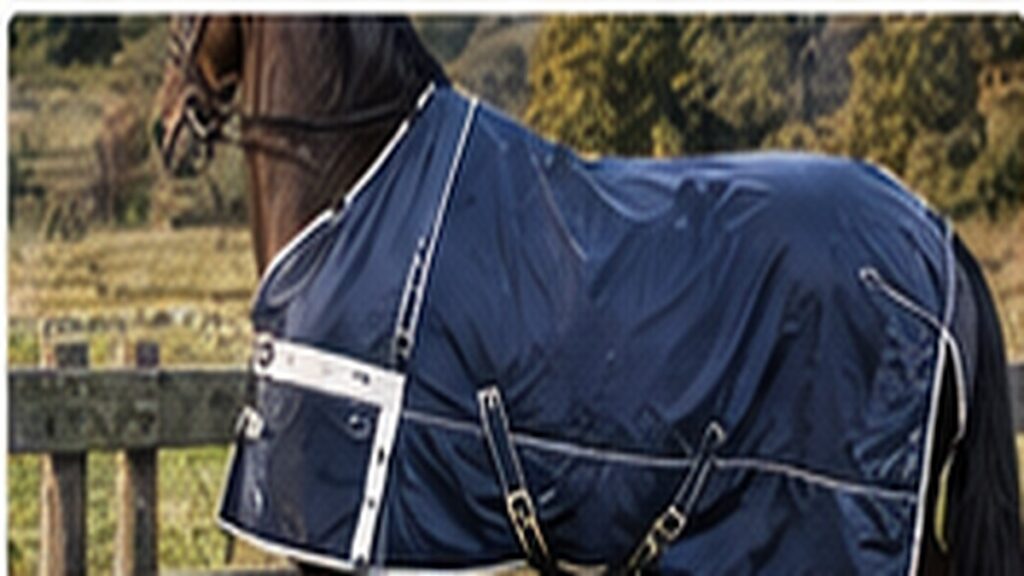
Turnout rugs usually combine a weather-resistant outer shell, a barrier layer or finish, insulation where required, a lining and structural components such as binding, webbing and closures. The outer must balance tear resistance, abrasion resistance, flexibility, weight and weather protection. The lining must interact safely with the coat and remain stable under movement and washing.
There is no single ideal rug fabric. A horse living alone in a small, sheltered paddock may impose different demands from one turned out in a group where rugs can be grabbed, rubbed against fencing or exposed to repeated mud contamination. A lighter fabric may improve drape and reduce weight; a heavier fabric may tolerate certain mechanical stresses better. Neither choice removes the importance of fit and inspection.
Common failure points include shoulder and chest areas, surcingle channels, attachment points, tail-flap seams, folded edges, fastener patches and locations where the horse rolls or rubs. These areas may require reinforcement, load-spreading construction or more robust stitching rather than simply a higher-denier shell.
“Breathable” does not mean that a rug actively cools a horse. It means that, under relevant conditions, the material permits some water-vapour transfer. Ventilation through fit and openings may be equally important. A rug can be waterproof and breathable in the fabric yet feel wet inside because of condensation, sweat, poor fit, blocked fabric or water entry through an unprotected seam.
Saddle pads, numnahs and cushioning textiles
Saddle pads use combinations of woven cloth, knitted fabrics, foam, felt, wool, synthetic fibre fill, spacer fabrics, quilting and grip materials. Their functions may include protecting the pad from sweat, managing moisture, improving stability, accommodating a particular saddle design or providing limited cushioning.
A pad does not correct a poorly fitting saddle, and greater thickness does not automatically mean greater protection. Adding material can alter saddle fit, contact area and pressure distribution. Published equine research has examined saddle pressure and the use of pads, but findings are highly dependent on the saddle, horse, rider, movement, pad construction and measurement method. A pad should therefore be evaluated as part of the complete saddle system.
Material selection should consider:
- surface friction and whether it encourages unwanted movement;
- compressive resilience and whether the material permanently packs down;
- moisture absorption and drying time;
- seam placement and pressure-sensitive bulk;
- dimensional stability after washing;
- compatibility with the saddle’s panels and clearance.
Wool and cotton can provide a comfortable, absorbent surface, while synthetic meshes and spacer fabrics may improve drying and airflow. However, “natural”, “antibacterial”, “memory foam” and “temperature regulating” are not sufficient descriptions of performance. The construction, test evidence and use conditions matter.
Boots, bandages and protective equipment
Leg boots combine textile shells, synthetic leather, mesh, neoprene-like foams, moulded polymers, padding, hook-and-loop fasteners and binding. Textiles may be selected for abrasion resistance, flexibility, moisture management, low weight or comfort against the limb. A boot that is mechanically protective may also retain heat or moisture, particularly when worn for long periods or in warm conditions.
Bandages are commonly knitted or woven. Their stretch, recovery, width, edge stability, friction and fastening method affect how consistently they can be applied. A soft textile is not automatically safer: excessive stretch, uneven tension, bunching or damaged edges can be more significant than the fibre label. Products intended for support or protection should be used in accordance with the manufacturer’s instructions, and equipment should be removed and inspected regularly.
Textiles used close to the skin should be checked for rough seams, exposed edges, abrasive trims, hard contamination, retained grit and changes in surface condition. Moisture, heat and friction can interact, so a material that feels acceptable when dry may behave differently after exercise or prolonged turnout.
Durability and test methods
Durability is multidimensional. Tensile strength measures resistance to a force pulling in a specified direction. Tear strength measures resistance to the growth of a cut or tear. Abrasion tests examine wear under a defined rubbing action. Seam strength evaluates the joined product rather than the fabric alone.
Relevant textile methods include ISO 13934-1 for maximum force and elongation of many woven fabrics, ISO 13937-2 for tear force using a single-tear method, and the ISO 12947 series for Martindale abrasion testing. These methods are useful for comparison only when the test details, specimen preparation, direction, conditioning and endpoint are understood.
Coated textiles may need different abrasion methods from uncoated fabrics. ISO 5470-2:2021 addresses abrasion resistance of rubber- or plastics-coated fabrics using a Martindale abrader, while noting that uncoated textile surfaces are covered by the ISO 12947 series.
Laboratory results should not be treated as a direct prediction of lifespan in a field. A horse’s movement, rubbing behaviour, fencing, handling, washing, ultraviolet exposure, mud, sweat and repairs all change service conditions. Product testing on horses and field trials can add valuable evidence, but claims should identify what was tested and under what conditions.
Care, contamination and ageing
Care is part of textile performance. Dirt, grease, sweat, hair, mud and detergent residues can alter handle, absorbency, surface wetting and vapour transmission. A rug whose face fabric is clogged with soil may not behave like the new fabric tested in a laboratory.
Follow the product’s own care instructions rather than assuming that all technical textiles can be washed alike. ISO 6330:2021 specifies domestic washing and drying procedures for textile testing and recognises that machine type, detergent, ballast and drying method can affect results. A consumer wash label is not the same as a performance guarantee, but repeated laundering should be considered when assessing dimensional stability, coating retention, seam integrity and insulation loft.
Potential ageing mechanisms include ultraviolet degradation, hydrolysis of some polyurethane systems, delamination, loss of water-repellent finish, fibre fatigue, elastic recovery loss, abrasion through the coating and corrosion or failure of adjacent hardware. Folding wet equipment, storing it before it is dry, using unsuitable detergents or applying unapproved waterproofing products can shorten service life.
Quality indicators for buyers and businesses
A credible technical specification should identify the material and the relevant performance property without relying solely on adjectives. Stronger evidence may include:
- fibre composition and fabric construction;
- fabric mass and yarn specification where relevant;
- water penetration method and result;
- breathability method and result;
- tear, tensile or abrasion data;
- seam, closure and reinforcement information;
- washing instructions and post-wash performance;
- clear repair, warranty and replacement policies;
- traceability for materials and manufacturing batches.
For retailers and manufacturers, fibre-content labelling is a legal consideration in Great Britain. UK government guidance states that textile labels must show fibre content, including fur and other animal parts, and that products containing different fibre compositions may require the composition of each component to be shown. The relevant regulatory framework should be checked for the product category and current market position.
For consumers, useful questions are more specific than “Is it good quality?” Ask what the outer material is, what the lining and insulation are, how waterproofness was measured, whether the seams are protected, what washing is allowed and whether the claim applies to the fabric or finished article.
Common misconceptions
“Higher denier always means better.”
Higher denier may support strength or abrasion resistance, but it does not automatically mean better tear resistance, waterproofing, comfort or fit. Construction and end use determine whether the additional mass is beneficial.
“Waterproof and breathable means completely dry in every condition.”
No textile system prevents all wetness under every combination of rain, pressure, sweat, condensation, contamination and wear. Claims should be interpreted as test results under defined conditions.
“Ripstop cannot rip.”
Ripstop construction can help limit tear propagation. It does not make a fabric immune to puncture, abrasion, seam failure or tearing under concentrated loads.
“Natural fibres are always kinder to the horse.”
Natural fibres may offer useful comfort or moisture behaviour, but skin contact depends on surface, seams, contamination, fit, temperature and duration of use. Synthetic textiles can also be soft, stable and functional.
“A thicker saddle pad protects the back better.”
Thickness alone does not establish cushioning or pressure reduction. A pad can alter saddle fit and may compress unevenly. The complete horse–saddle–rider system must be considered.
Practical selection framework
- Define the use: stable, turnout, exercise, competition, transport or recovery.
- Identify the main loads: rain, wind, sweat, abrasion, snagging, compression, stretching or repeated washing.
- Choose the construction: woven, knitted, nonwoven, foam, membrane, coating or a layered combination.
- Compare relevant data: not just denier, but tear, tensile, abrasion, water and moisture-vapour performance.
- Assess the finished product: fit, seams, reinforcement, closures, lining, binding and adjustability.
- Check maintenance: washing, drying, reproofing, storage and repair requirements.
- Inspect in use: look for rubbing, dampness, coating failure, stretched fasteners, damaged seams and packed-down insulation.
The best technical textile is the one whose complete construction matches the horse, environment and management system. A specification that is impressive in isolation may be irrelevant if the product fits poorly, cannot be cleaned properly or fails at a seam or fastener.
Connections within the Equestrian Materials authority hub
Technical textiles overlap with several adjacent material subjects. Fibre choice connects with synthetic and natural materials; coatings and membranes connect with waterproofing and surface finishes; saddle-pad textiles connect with pressure distribution and saddle fit; boot and bandage construction connects with protective equipment and skin-contact materials; and care instructions connect with durability, repairability and sustainability.
For manufacturers and trade professionals, these relationships are important because material performance is rarely isolated. A change in coating may alter handle and breathability. A stronger yarn may require different needles or seam construction. A denser pad may change saddle fit. A recycled fibre may have a different strength, dyeing or finishing profile from the virgin fibre it replaces. Sound product development therefore evaluates the entire system rather than selecting a material by marketing label alone.
Sources and further reading
- UK Government: Textile labelling — guidance for manufacturers and retailers on fibre-content labelling.
- The Textile Products (Labelling and Fibre Composition) Regulations 2012 — UK regulatory framework and explanatory material.
- ISO 811:2018 — hydrostatic pressure testing for resistance to water penetration.
- ISO 13934-1:2013 — tensile properties of textile fabrics.
- ISO 13937-2:2000 — tear properties of textile fabrics.
- ISO 12947-3:1998 — Martindale abrasion and mass loss.
- ISO 5470-2:2021 — abrasion resistance of rubber- or plastics-coated fabrics.
- ISO 6330:2021 — domestic washing and drying procedures for textile testing.
- Dittmann et al., saddle pressure and saddle-pad research — peer-reviewed equine study concerning saddle pressure measurement and pad use.
- Horseware: Product technology and innovation — manufacturer technical information on rug fabrics, layers, waterproofness and breathability.
- WeatherBeeta Laboratory — manufacturer information on field testing, ripstop and turnout construction.
Research note
Automatically researched source pack — editorial review required:
• www.gov.uk — https://www.gov.uk/guidance/textile-labelling
• www.iso.org — https://www.iso.org/standard/75934.html?browse=tc
• www.weatherbeeta.co.uk — https://www.weatherbeeta.co.uk/essential-rug-landing-page
• www.legislation.gov.uk — https://www.legislation.gov.uk/uksi/2012/1102/pdfs/uksiod_20121102_en.pdf
• www.premierequine.co.uk — https://www.premierequine.co.uk/pages/lookbook-rug-technology
• www.horseware.com — https://www.horseware.com/en-gb/technology-innovation
• stierna.co.uk — https://stierna.co.uk/pages/fabric-technology
• www.designequestrian.com — https://www.designequestrian.com/product/600d-mediumweight-turnout-rug-hood/
• www.premierequine.co.uk — https://www.premierequine.co.uk/blogs/news/horse-rug-waterproof-ratings-explained
• www.leantex.com — https://www.leantex.com/900d-ripstop-horse-rug-fabric/
• convixion.es — https://convixion.es/en/convixion-textile/
• www.criterion-uk.com — https://www.criterion-uk.com/products/1200d-plain-winter-turnout-rug
• www.weatherbeeta.com — https://www.weatherbeeta.com/weatherbeeta-laboratory
• cdn.webshopapp.com — https://cdn.webshopapp.com/shops/310357/files/490944907/catalogue-2026-en-final.pdf
• cdn.standards.iteh.ai — https://cdn.standards.iteh.ai/samples/75934/78283455013141e2b7b91b2bce775132/ISO-6330-2021.pdf
• www.tvfinc.com — https://www.tvfinc.com/wp-content/uploads/2025/01/casestudy_tvf_equestrian.pdf
• www.agrihealth.ie — https://www.agrihealth.ie/wp-content/uploads/2019/01/2019MackeyUK.pdf
• orgprints.org — https://orgprints.org/44611/1/dittmann-etal-2022-Pferdeheilkunde-Vol38-Issue2-p100-108.pdf
• en.wikipedia.org — https://en.wikipedia.org/wiki/Ventile
• www.iso.org — https://www.iso.org/standard/65149.html