
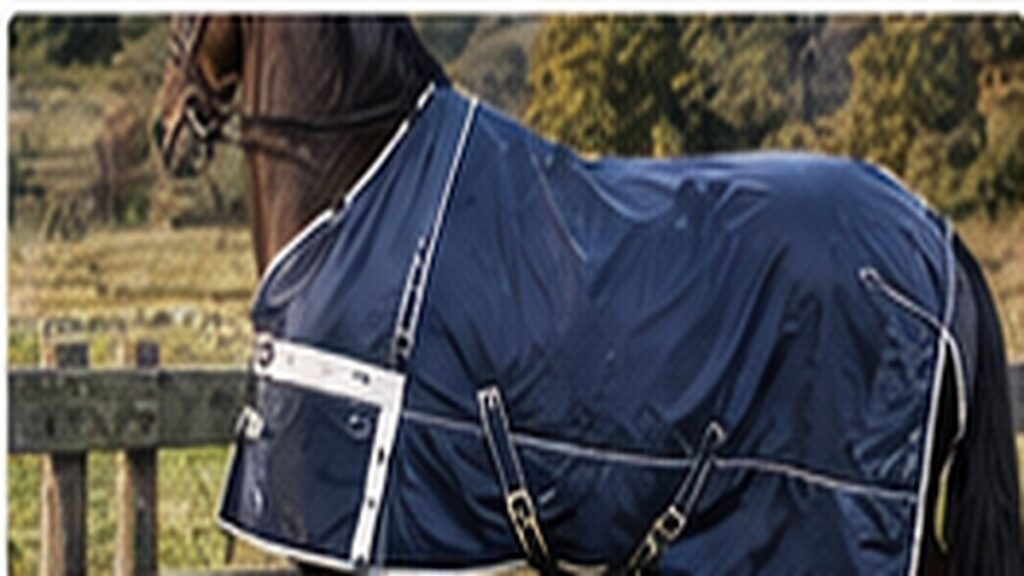
Recycled textiles are now used across a widening range of equestrian products, including turnout and stable rugs, fleece coolers, saddle pads, riding breeches, base layers, jackets, fly products, bandages, stable mats and textile-based arena components. The term sounds straightforward, but it describes several materially different practices. A product may contain polyester spun from recycled PET bottles, mechanically recycled cotton recovered from cutting waste, regenerated nylon made from discarded fishing nets, or fibres recovered from used textiles. These materials do not have identical properties, environmental benefits or end-of-life options.
The central distinction is between recycled content and circular product design. Recycled content concerns the origin of some or all of the material. Circular design is broader: it considers service life, repair, reuse, fibre and component separation, chemical safety, likely recovery routes and what happens after the product is discarded. A hard-wearing horse rug containing recycled polyester may be a better choice than an equivalent product made from virgin polyester, but that conclusion depends on its useful life, construction, laundering, treatments, transport and eventual disposal.
What “recycled textile” means
In technical use, recycled material is material reprocessed from recovered material and incorporated into a product or component. It can be pre-consumer or post-consumer. Pre-consumer material is generated before a product reaches the consumer, such as yarn waste, offcuts or defective fabric. Post-consumer material has been recovered after use, such as a discarded garment, rug or plastic bottle.
This distinction matters. Factory offcuts are generally cleaner and more uniform than worn, contaminated or mixed-fibre products. Post-consumer feedstock may deliver a stronger waste-prevention benefit, but it requires collection, sorting, cleaning and removal of zips, hooks, coatings, elastane, labels and other components. A claim that a product is “made from recycled materials” should therefore be read alongside the stated percentage, the feedstock type and the certification or evidence supporting the claim.
UK environmental guidance places reuse above recycling in the waste hierarchy. Reuse generally retains more of the original product’s value and avoids the energy and processing required to turn it into a new fibre. Recycling remains important for items that are no longer safe, functional or hygienic to reuse, but it is not a reason to discard serviceable equipment prematurely. The UK government’s waste-prevention programme notes both the importance of reuse and the limited scale of textile-to-textile recycling. Waste Prevention Programme for England
The main recycled fibres found in equestrian products
Recycled polyester
Recycled polyester, often abbreviated to rPET, is the most visible recycled fibre in equestrian goods. It is chemically the same polymer family as conventional polyester: polyethylene terephthalate, or PET. It is commonly made by collecting and sorting PET bottles, shredding them into flakes, melting and extruding them into filaments or staple fibres. The resulting yarn can be woven into ripstop, Oxford, fleece, mesh or lining fabrics, or used as fibrefill.
Because rPET has broadly similar polymer chemistry to virgin polyester, it can provide the familiar combination of low moisture absorption, dimensional stability, abrasion resistance, relatively low weight and rapid drying. These qualities explain its use in turnout shells, linings, coolers and technical riding garments. A recycled yarn is not inherently weaker than a virgin yarn; performance depends on polymer quality, processing, yarn construction, fabric weight, weave, coatings, seam design and quality control.
There are nevertheless limits. Mechanical processing and repeated heat histories can reduce polymer quality, so feedstock purity and process control matter. Some manufacturers blend recycled and virgin polymer to achieve specified strength, colour, consistency or processing performance. In addition, the recycled content may apply only to the fabric, not to the whole product. Thread, webbing, binding, elastic, hook-and-loop tape, buckles, coatings, membranes and insulation may be made from different materials.
Recycled nylon or polyamide
Recycled nylon can be produced from pre-consumer industrial waste, discarded fishing nets and other polyamide waste. Nylon is valued in some equestrian applications for strength, abrasion resistance and a favourable strength-to-weight ratio. It may be found in technical apparel, webbing, protective equipment and high-wear fabrics, although polyester remains more common in many horse-rug ranges.
Some nylon recycling routes are mechanical; others depolymerise the material and rebuild polymer of a controlled quality. The latter can potentially produce a more consistent feedstock, but the environmental case depends on the actual process, energy source, feedstock, transport and comparison baseline. “Regenerated nylon” is not a guarantee of low impact, and it should not be confused with natural or biodegradable fibre.
Recycled cotton and other cellulosic fibres
Mechanically recycled cotton is usually made by shredding and opening cotton textile waste back into fibres. This can reduce the need for virgin cotton, but the fibres become shorter during processing. Recycled cotton is therefore often blended with virgin cotton or another fibre, or used in nonwoven products, insulation, felt, padding and lower-load applications. A high recycled-cotton percentage may be technically unsuitable for a hard-wearing waterproof outer shell unless supported by an appropriate construction.
Cellulosic textile waste may also be processed through chemical or solvent-based regeneration into a new fibre. These systems can offer different quality and blending possibilities from mechanical recycling, but they are process-specific and should not be treated as interchangeable. A manufacturer should identify whether a claim refers to mechanically recycled fibre, regenerated fibre or a blend.
Recycled wool and mixed-fibre feedstocks
Recycled wool can be obtained from pre-consumer waste or used wool textiles. It may be used in felt, insulation or blended yarns. Mixed-fibre textiles are more difficult to recycle because the fibres cannot always be separated economically or without loss of quality. Elastane is a particular challenge in riding garments because it is used for stretch and close fit but complicates fibre recovery.
How recycled fibres are made
| Route | Typical feedstock | Strengths | Limitations |
|---|---|---|---|
| Mechanical recycling | Clean production waste, used textiles, PET flakes | Established for many materials; relatively direct; can be suitable for fibres, felt and nonwovens | Fibre or polymer quality may decline; colour and contamination are constraints |
| Mechanical PET recycling | Sorted PET bottles or industrial PET waste | Can produce polyester staple fibre or filament for yarns and fillings | Does not necessarily use discarded textiles; bottle-to-fibre is not automatically fibre-to-fibre |
| Chemical or molecular recycling | Selected polyester or nylon waste | Can potentially restore polymer to a more controlled quality and accept some difficult feedstocks | More complex; energy, solvents, yield, scale and commercial availability must be assessed |
| Regeneration of cellulosics | Cellulosic textile waste or pulp | Can create new regenerated fibres from suitable cellulose feedstock | Feedstock preparation and separation are demanding; not applicable to all blends |
“Recycling” is therefore not one universal process. A manufacturer specifying recycled material should be able to describe the feedstock, process, recycled percentage, chain of custody and the product components covered by the claim.
Performance in horse rugs and other horsewear
For equestrian products, performance is usually more important than the fibre’s environmental label. A turnout rug must resist rain, wind, abrasion, tearing, dirt, repeated flexing and movement across the shoulders and withers. It must also fit the horse, remain secure and allow appropriate freedom of movement. A saddle pad needs dimensional stability, moisture management, pressure distribution and a surface that does not cause avoidable rubbing. A riding garment needs stretch recovery, comfort, colourfastness and resistance to repeated washing.
Recycled polyester can meet these requirements when properly engineered. The relevant variables include:
- Fibre and yarn quality: filament or staple fibre length, tenacity, crimp, twist and uniformity influence strength, pilling and handle.
- Fabric construction: denier is only a yarn linear-density measure; it does not by itself define tear strength or durability. Weave, density, ripstop structure and fabric weight are equally important.
- Finishes and coatings: water repellency, polyurethane coatings, membranes, laminates and seam tape may determine waterproof performance more than the recycled status of the base yarn.
- Seams and stress points: front closures, surcingles, leg straps, gussets, wither areas and attachment points often fail before the main fabric.
- Lining and filling: a rug may have a recycled outer shell but virgin lining, insulation, binding or thread. The reverse may also occur.
- Care resistance: repeated washing, detergents, drying, UV exposure, mud and stable chemicals can affect coatings, colour, elastics and fibre surfaces.
Product specifications should therefore state measurable performance where relevant: hydrostatic head or water-column testing, breathability method, tear and tensile strength, seam performance, abrasion resistance, colourfastness, dimensional change and filling weight. A recycled claim is not a substitute for those data.
Commercial examples show that recycled polyester is already being used in horse rugs. One UK retail specification describes a turnout rug made with 100% recycled polyester, a 1,680-denier outer fabric, taped seams and a stated 5,000 mm water-column rating. Such details are more useful to a buyer than the word “sustainable” alone, although independent test evidence and the scope of each specification should still be checked. Example recycled-polyester turnout specification
Environmental benefits: real but conditional
Using recycled feedstock can reduce demand for virgin raw materials and may reduce the amount of material sent to landfill or incineration. For PET-based polyester, recycling can avoid some extraction and processing of new fossil feedstock. For textile-to-textile recycling, the potential benefit is more directly connected to keeping used textiles in productive circulation.
However, no single recycled-content percentage proves a lower overall environmental impact. The comparison depends on what the recycled material replaces, how it is processed, the electricity mix, transport, dyeing and finishing, product lifetime and end-of-life route. A durable virgin-fibre rug that lasts twice as long as a poorly made recycled-fibre rug may be the lower-impact choice over the period of use. Conversely, a durable recycled rug that replaces a virgin equivalent and remains in service for many seasons may have a strong environmental case.
Reuse and repair are especially important in equestrian goods. A repaired rug, resoled boot or reused stable textile may avoid the manufacture of a replacement product altogether. Businesses can support this by offering replacement straps, buckles, clips, repair panels and professional cleaning, and by designing products so that high-wear components can be replaced without destroying the rest of the item.
Microfibres and microplastics
Synthetic recycled fibres remain synthetic fibres. Polyester and nylon do not become biodegradable simply because they were recycled. During laundering and use, fibres can be shed from many textile products, including fleece, clothing and horsewear. Shedding depends on fibre type, yarn and fabric construction, surface treatment, abrasion, washing conditions and product age.
It would be inaccurate to claim that recycled polyester eliminates microfibre release. The evidence base and measurement methods remain developing, and different studies do not always produce directly comparable results. The European Commission’s textiles strategy identifies unintentional microplastic release from synthetic textiles as an issue requiring policy and technical action. EU Strategy for Sustainable and Circular Textiles
Practical risk reduction should focus on product longevity, avoiding unnecessary washing, following the care label, using suitable low-agitation cycles and preventing heavily soiled items from being washed more often than necessary. Any capture device or filtration system should be assessed for compatibility with the machine and its actual ability to retain fibres; marketing claims should not be accepted without evidence.
Durability, repair and end-of-life
Durability is a sustainability attribute in its own right. For a horse rug, useful life is affected by fit, turnout conditions, herd behaviour, fencing, washing, storage and whether repairs are made promptly. The best material choice cannot compensate for poor pattern engineering or weak hardware.
Designers should consider:
- replaceable buckles, straps, clips and elastic components;
- reinforced or replaceable panels at shoulders, chest and hindquarters;
- single-fibre constructions where technically practical;
- removable linings, fillings or accessories;
- limited use of unnecessary bonded laminates and permanent mixed-material assemblies;
- clearly labelled fibre composition and care instructions;
- repair, resale, take-back or recycling routes that are realistic in the GB market.
A product described as recyclable may only be recyclable through a specialist route, not through household kerbside collections. Coatings, laminated membranes, foam, elastane, hook-and-loop fasteners and metal hardware can make separation difficult. If a brand offers a take-back scheme, it should explain whether items are repaired, resold, downcycled, mechanically recycled or sent for energy recovery.
Certification, traceability and credible claims
Certification can help distinguish a documented recycled-content claim from an unsupported marketing statement, but certificates have a defined scope. The Recycled Claim Standard verifies recycled material and chain of custody. The Global Recycled Standard adds broader social, environmental and chemical requirements and uses a minimum recycled-content threshold of 50% for certified products. Neither standard proves that a product is durable, fully recyclable or superior across every environmental impact.
Chain of custody is important because textile supply chains commonly involve fibre producers, spinners, knitters or weavers, dyehouses, laminators, cut-and-sew factories and distributors. A certificate should relate to the relevant supplier, product, transaction and production period. A logo alone is not enough: buyers should ask for the certificate number, scope, certified facility and the percentage of recycled content.
ISO 14021 provides principles for self-declared environmental claims and defines recycled content as the proportion by mass of recycled material in a product, component or packaging. It also recognises that mass-balance accounting can mean the claimed content is attributed across a system rather than guaranteed in each individual item. ISO 14021 overview
In Great Britain, the Competition and Markets Authority’s Green Claims Code is particularly relevant to equestrian brands and retailers. Claims should be accurate, clear, supported by up-to-date evidence and presented in a way that does not create a misleading overall impression. “Eco-friendly”, “planet-friendly” or “sustainable” are broad claims that require evidence covering the relevant life cycle, not merely proof that one component is recycled. CMA Green Claims Code
| Claim | What a careful buyer should ask |
|---|---|
| Made with recycled polyester | What percentage by mass? Which components? Pre-consumer or post-consumer feedstock? |
| 100% recycled fabric | Does this describe the fabric only, or the complete product? Are the yarn, dye, coating and backing included? |
| Recyclable | Through which route, in which country, and after removal of hardware or coatings? |
| Eco-friendly or sustainable | What defined environmental impacts are covered, and what evidence supports the whole-product impression? |
| GRS certified | Is the specific product and supply chain within the certificate scope? What percentage and transaction records apply? |
Selection guidance for horse owners
For an individual buyer, the most defensible approach is to prioritise fit, safety, durability and repairability, then compare material and evidence. A recycled product is worth considering when it matches the performance of competing products and the recycled claim is specific and substantiated.
Related industry reference: For businesses moving from technical research into trade sourcing, explore equestrian suppliers and manufacturers on EquiGuild.
- Choose the correct product for the horse, climate and use rather than buying a lighter or less robust item solely because it carries a recycled label.
- Check the stated fibre composition and whether the claim concerns the whole product or one fabric panel.
- Look for construction details: denier or fabric weight, seam treatment, closure quality, reinforcement and replaceable parts.
- Read the care instructions and consider whether the product can be cleaned without excessive washing or specialist treatment.
- Ask whether the manufacturer provides repairs, spare parts, resale or take-back arrangements.
- Keep serviceable equipment in use, repair promptly and pass on or resell items that remain safe and functional.
Selection guidance for manufacturers and trade buyers
Manufacturers should specify sustainability and performance as parallel requirements. A technical pack might include recycled-content percentage by component, feedstock classification, certification scope, yarn and fabric specifications, restricted-substance requirements, test methods, wash durability, colourfastness, seam performance and planned end-of-life arrangements.
Supplier questionnaires should distinguish verified content from supplier declarations. They should also identify whether recycled content is allocated through physical segregation, controlled blending or mass balance. For private-label products, the retailer remains responsible for claims made to customers even when the information originated with a factory or yarn supplier.
Product development should test the finished article rather than relying only on fibre-level data. For example, a recycled polyester shell may perform well in fabric tests but fail because the seam tape lifts, the front closure bends or the lining pills and mats. Field trials can be useful, but they should complement, not replace, defined laboratory methods and documented acceptance criteria.
Common misconceptions
“Recycled means biodegradable.”
No. Recycled polyester and recycled nylon remain durable synthetic polymers. Their waste and resource profile may differ from virgin materials, but biodegradability is a separate characteristic.
“A recycled bottle becomes a recycled textile indefinitely.”
Not necessarily. Some PET recycling routes are effectively downcycling from a bottle to fibre, and repeated processing can affect quality. Textile-to-textile recycling is technically possible for some materials but is not universal or available at unlimited scale.
“100% recycled fabric means the whole rug is recycled.”
Usually not. The wording may refer to a particular fabric. A complete rug can also contain virgin thread, binding, elastic, webbing, coating, membrane, foam, hardware and labels.
“Recycled is always weaker.”
No. Performance depends on the feedstock, process, yarn, fabric construction and manufacturing controls. It should be demonstrated by relevant tests rather than assumed from the fibre’s origin.
“Recycled content makes a product sustainable.”
It can improve one aspect of material sourcing, but it does not settle questions of durability, chemical management, labour conditions, transport, washing, microfibre release or end-of-life. Sustainability is a whole-life assessment, not a fibre label.
Conclusion
Recycled textiles have a legitimate and growing role in equestrian products. Recycled polyester is already technically capable of serving demanding applications such as horse rugs, while recycled cotton, wool, nylon and recovered textile fibres have more specialised uses. The strongest choices combine verified recycled content with long service life, robust construction, repairability, responsible care and a credible end-of-life route.
For the GB market, the practical standard should be evidence-led rather than label-led. Buyers should ask what has been recycled, how much, from which feedstock, under what certification, and with what effect on performance. Manufacturers should make claims that are precise enough to be checked. Recycled content is valuable, but it is one design decision within the wider sustainability and circularity system.
Sources and further reading
- UK Government, Waste Prevention Programme for England
- Environment Agency, Importing and exporting waste and non-waste textiles
- Competition and Markets Authority, Green Claims Code
- Textile Exchange, Recycled Claim Standard and Global Recycled Standard
- ISO 14021, Environmental statements and programmes for products
- European Commission, EU Strategy for Sustainable and Circular Textiles
- Kramer Equestrian, recycled-polyester turnout rug technical listing
- Bucas, Greenline Turnout technical catalogue information
Research note
Automatically researched source pack — editorial review required:
• environment.ec.europa.eu — https://environment.ec.europa.eu/strategy/textiles-strategy_en
• www.samshield.com — https://www.samshield.com/en/content/29-samshield-technicalities
• www.kramer.co.uk — https://www.kramer.co.uk/Horse/Horse-Rugs/rPET-Turnout-Rug-Life-Cycle-0g
• www.kramer.co.uk — https://www.kramer.co.uk/Horse/Horse-Rugs/Coolers/Fleece-Wicking-Rug-Life-Cycle
• www.gov.uk — https://www.gov.uk/government/publications/waste-prevention-programme-for-england-maximising-resources-minimising-waste/the-waste-prevention-programme-for-england-maximising-resources-minimising-waste
• convixion.es — https://convixion.es/en/convixion-textile/
• www.recyclhorse.fr — https://www.recyclhorse.fr/feutrerecyclhorse
• equeswear.com — https://equeswear.com/horse-rugs/
• bucas.com — https://bucas.com/wp-content/uploads/2022/02/Catalogue-2022-EN.pdf
• equeswear.com — https://equeswear.com/products/
• www.horseluxe.eu — https://www.horseluxe.eu/en/about-the-product/
• www.re-poly.co.uk — https://www.re-poly.co.uk/
• www.gov.uk — https://www.gov.uk/guidance/importing-and-exporting-waste-and-non-waste-textiles
• assets.publishing.service.gov.uk — https://assets.publishing.service.gov.uk/media/5a7edf53ed915d74e33f2f2d/GBS_textiles_Impact_Assessment.pdf
• relondon.gov.uk — https://relondon.gov.uk/wp-content/uploads/2023/06/Londons-fashion-footprint_report.pdf
• environment.ec.europa.eu — https://environment.ec.europa.eu/document/download/35f73195-e891-4e7c-b681-9fe0daf585c1_en?filename=COM_2022_141_1_EN_annexe_autre_acte_part1_v3.pdf
• www.uksport.gov.uk — https://www.uksport.gov.uk/-/media/files/resources/uk-sport-apparel-sustainability-report-accessible.pdf
• eur-lex.europa.eu — https://eur-lex.europa.eu/legal-content/EN/TXT/PDF/?uri=CONSIL%3AST_14248_2023_ADD_3
• en.wikipedia.org — https://en.wikipedia.org/wiki/Track_surface
• en.wikipedia.org — https://en.wikipedia.org/wiki/Hyosung_TNC
Cite this article
Stable research ID: ERA-2026-000244
The Equestrian Research Atlas (2026) ‘Recycled Textiles in Equestrian Products’. The Equestrian Research Atlas. Available at: https://equestrianresearchatlas.co.uk/research/recycled-textiles-in-equestrian-products/ (Accessed: 3 November 2026).
The Equestrian Research Atlas. (2026). Recycled Textiles in Equestrian Products. The Equestrian Research Atlas. https://equestrianresearchatlas.co.uk/research/recycled-textiles-in-equestrian-products/
The Equestrian Research Atlas. “Recycled Textiles in Equestrian Products.” The Equestrian Research Atlas, 2026, https://equestrianresearchatlas.co.uk/research/recycled-textiles-in-equestrian-products/. Accessed 3 November 2026.
Research references (42)
- environment.ec.europa.eu
- www.samshield.com
- www.kramer.co.uk
- www.kramer.co.uk
- www.gov.uk
- convixion.es
- www.recyclhorse.fr
- equeswear.com
- bucas.com
- equeswear.com
- www.horseluxe.eu
- www.re-poly.co.uk
- www.gov.uk
- assets.publishing.service.gov.uk
- relondon.gov.uk
- environment.ec.europa.eu
- www.uksport.gov.uk
- eur-lex.europa.eu
- en.wikipedia.org
- en.wikipedia.org
- en.wikipedia.org
- en.wikipedia.org
- en.wikipedia.org
- en.wikipedia.org
- www.gov.uk
- www.iso.org
- greenclaims.campaign.gov.uk
- www.gov.uk
- www.gov.uk
- www.gov.uk
- www.gov.uk
- www.gov.uk
- textileexchange.org
- textileexchange.org
- assets.publishing.service.gov.uk
- www.iso.org
- textileexchange.org
- www.gov.uk
- textileexchange.org
- assets.publishing.service.gov.uk
Related research
 Designing Equestrian Equipment for Disassembly, Repair and Material RecoveryContinue research →End-of-Life Options for Leather, Webbing and Synthetic TackContinue research →
 Packaging Choices for Equestrian BrandsContinue research →Environmental Claims and Greenwashing in Equestrian RetailContinue research →
 Repairability of Saddlery, Rugs and Horse EquipmentContinue research →Durability as a Sustainability Measure in Equestrian ProductsContinue research →